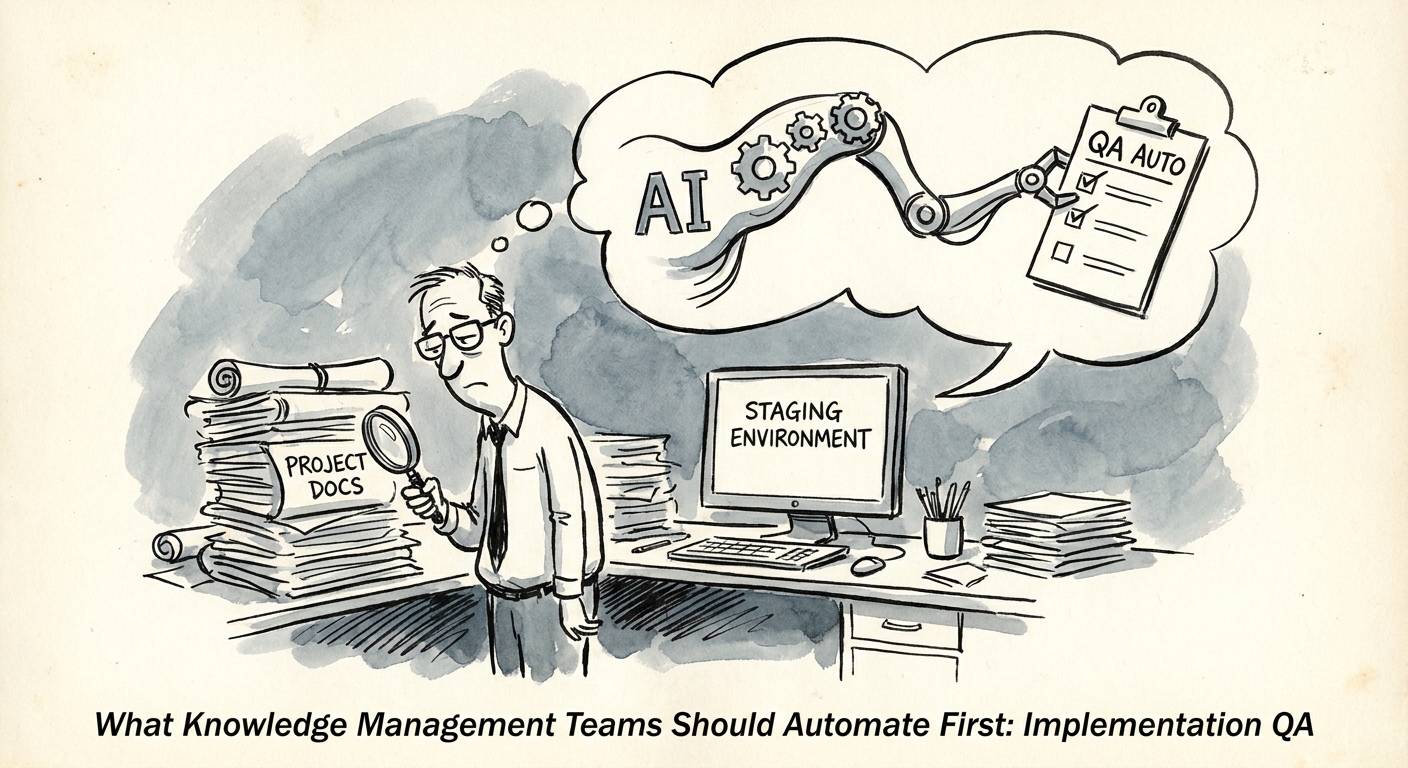
The retrospective nobody reads
Picture a 60-person systems integrator. A delivery lead wraps a migration, writes a thoughtful retrospective — the data-residency requirement that surfaced in week six, the integration that needed a sandbox the client swore existed, the sign-off that stalled because no one had defined "done." That document goes into a project folder. Six weeks later the lead is staffed on something else. Eight months later a different team kicks off a near-identical engagement and walks straight into the same week-six surprise, because nobody on that team has read a folder they don't know exists.
This is the real failure mode in professional services delivery, and it has almost nothing to do with talent. The lesson exists. It was written down. It simply never reached the next team in time to change a decision. For knowledge management, that's the most automatable problem you own — narrow, repetitive, and tied to artifacts that already live in your systems. The Deloitte State of AI in the Enterprise 2026 is blunt about where AI actually pays off: embedded in a recurring production workflow, not a one-off pilot. Implementation QA is exactly that recurring workflow.
And it scales with you in the wrong direction. The U.S. Census Bureau analysis of AI use in businesses shows adoption widening, but a mid-market firm doesn't need a broad AI strategy to start — it needs one use case it can actually govern. Surfacing prior delivery lessons against a live project plan is small enough to control and painful enough that fixing it changes your margin.
Build three libraries before you build a model
Most firms try to automate QA by pointing a chatbot at SharePoint and hoping. It returns plausible nonsense because closed-project folders are a junk drawer, not a knowledge base. Before any retrieval works, structure three things.
The scope library: what each past engagement actually committed to deliver — not the SOW boilerplate, the real acceptance criteria, change orders, and the line items that got renegotiated mid-flight. The lessons-learned library: retrospectives tagged by what they actually were — a data issue, a stakeholder issue, an integration issue, an estimation miss — so the system can match on problem shape, not keyword. The acceptance-check library: the concrete "done" definitions that closed each phase, including the ones that turned out to be wrong.
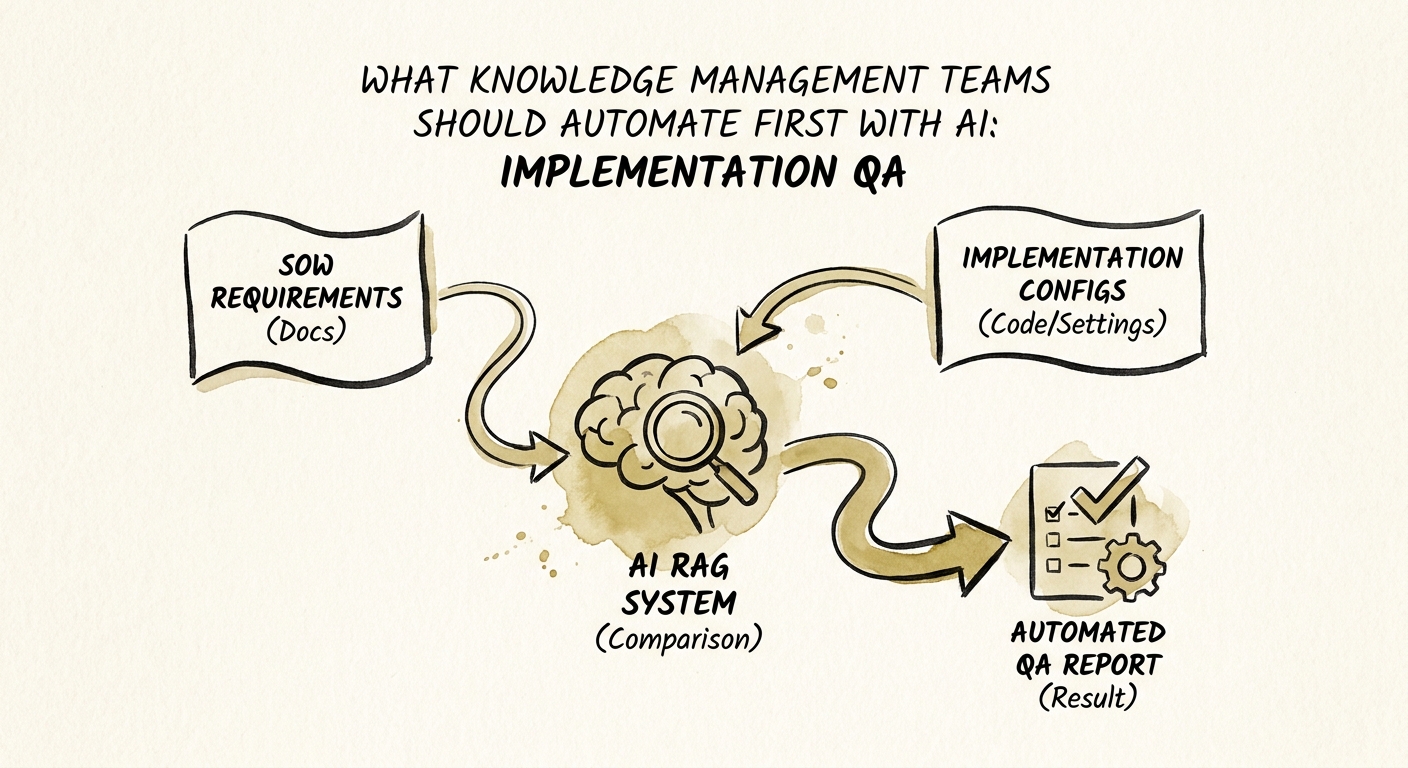
Then the workflow is mechanical and reviewable: when a new project plan lands, retrieve the prior engagements that look like it, compare their lessons against the current plan, and hand a delivery lead a short review packet — "three past projects with this integration pattern hit the same sandbox gap; here's where." A human decides what's relevant. That oversight model is the point of the NIST AI Risk Management Framework: AI-assisted findings stay measurable and a person stays accountable for the call. Critically, every flag links back to the source retrospective — an exception a delivery lead can't trace to a real prior project is an exception they'll correctly ignore. The retrieval mechanics underneath this are the same ones in our guide on AI knowledge search for professional services.
Decide what the system is allowed to see
Here's the part that separates a useful tool from a liability. Your implementation artifacts are full of things that should never surface in a cross-project search: a client's internal system credentials referenced in a runbook, the discounted rate you gave one account, a confidential requirement another client would pay to know about. A knowledge system that retrieves freely across every engagement will eventually put one client's secret in front of another client's delivery team.
So the access boundary is a design decision you make first, not a setting you tune later. Use the CISA AI data-security best practices to define what gets ingested, what stays out, how long lessons are retained, and which fields are stripped before an artifact is ever indexed. The pattern that works: retrieve the lesson ("phased migrations in regulated industries hit a residency requirement around week six") without retrieving the client-specific detail that made it sensitive.
What you end up with isn't an AI auditor sitting in judgment of your delivery teams. It's a better project-kickoff rhythm — every new engagement starts with the relevant scar tissue from the last three like it, visible before anyone commits to a timeline. On Monday, pick your ten most recent retrospectives, tag each by problem shape, and pull the scope and acceptance criteria from those same projects. That's the first version of all three libraries, built by hand, and it's enough to prove whether the next near-identical engagement avoids the surprise that cost you margin last time. When it does, you'll know exactly what to automate. If you want a sequenced plan for it, that's what our AI roadmap is for.
