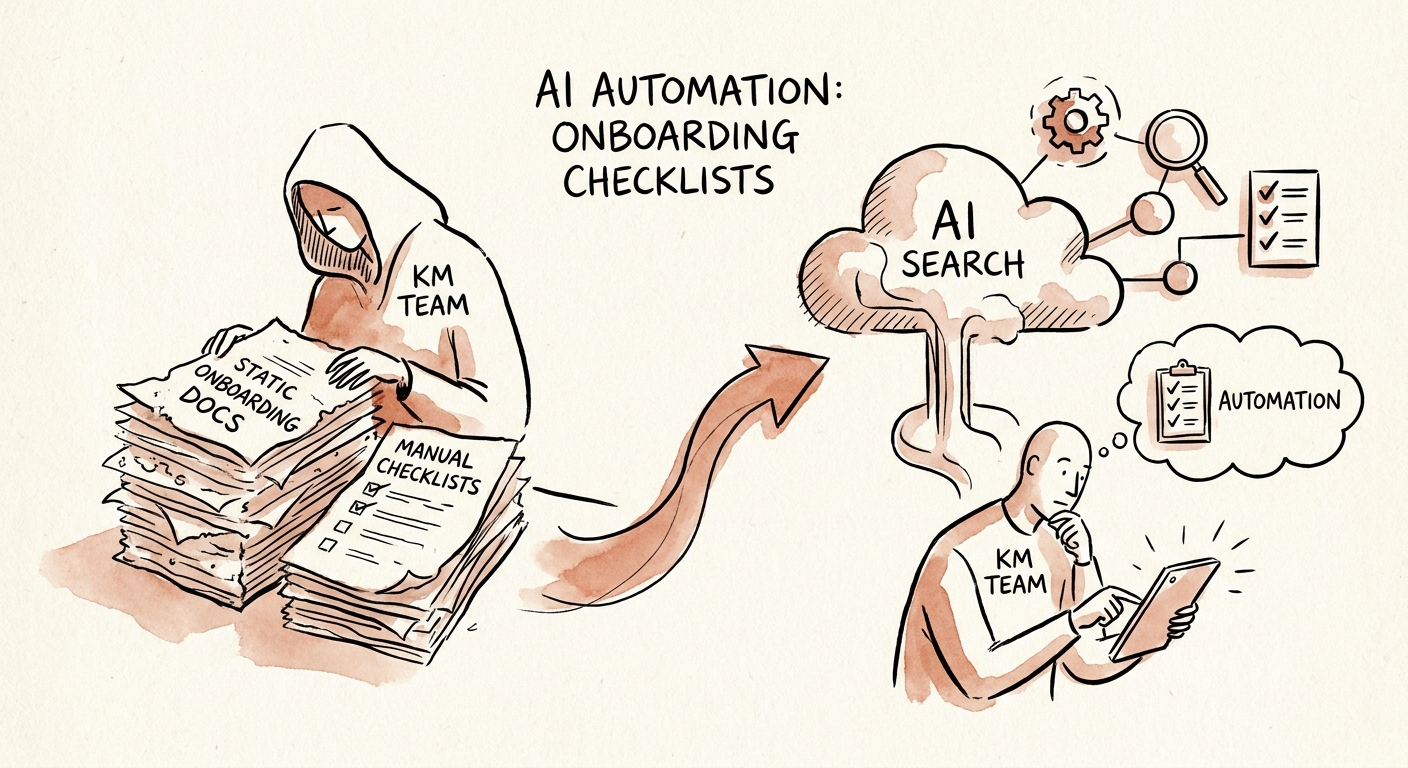
The new-hire packet that lives in seven places
Picture a 70-person professional services firm onboarding a new senior associate on a Monday. The "onboarding checklist" isn't one document. It's a stale wiki page, two Slack threads, a folder of templates someone last touched in 2024, a benefits PDF, and the unwritten knowledge in your head about which partner actually approves expense policy exceptions. The knowledge management team spends the first three days of every hire reassembling that packet by hand, and it comes out slightly different every time.
That mess is exactly why the onboarding checklist is the right first thing to hand to AI, not a flashy client-facing use case. It has a repeatable input (your existing docs and policies), a visible owner (whoever runs onboarding), and a baseline you can already feel: how many hours per hire, how many "where do I find X?" pings in week one, how often a new hire gets the wrong version of a policy. The Census Bureau reported in May 2026 that AI adoption is already real in the middle of the market, including 32% of firms with 100 to 249 employees. The firms pulling ahead aren't the ones running the boldest experiment. They're the ones who picked a workflow narrow enough to actually finish.
What "done" looks like, and how to catch it lying
The first version should do one job: assemble a correct, role-specific onboarding packet from your existing sources, with every claim citing the document it came from. It pulls the right policies for the role, drafts a structured checklist, routes anything ambiguous to a human, and flags what it isn't sure about. It does not invent a PTO policy because the real one was missing, and it does not quietly "update" a commitment a partner already made. If you can't tell where an answer came from, it's not ready.
Here's the part most teams skip: before you trust it, build a test set from your last ten real hires. For each, write down the packet a human would have produced and the correct answer to the questions that actually came up. Then run the AI against those ten and grade it on three things only: did it retrieve the right source, did it follow current policy, and did it raise its hand when uncertain. Deloitte's 2026 research found only 25% of leaders moved 40% or more of their AI pilots into production. The gap between a demo and production is almost always this evidence step. Keep governance practical, not theatrical: use the NIST AI Risk Management Framework to map, measure, and manage the workflow, and CISA's AI data security guidance to keep HR and comp data inside its permission boundaries. If a new hire's role can't see a document, the assistant building their packet can't either.
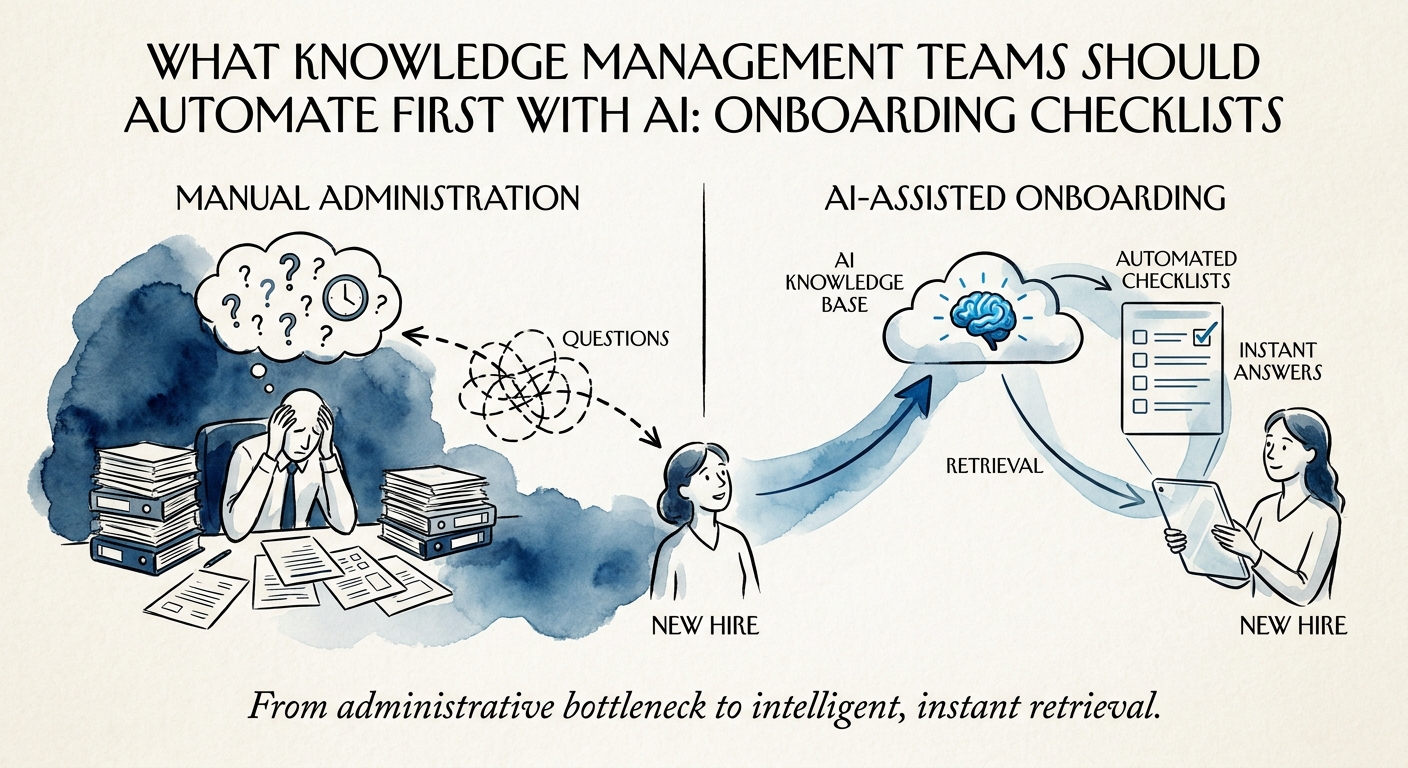
Ninety days from messy wiki to governed packet
Days 1 to 30: don't touch AI yet. Document the onboarding workflow as it actually runs and capture the baseline that matters for a KM team: hours per hire to assemble the packet, the count of week-one "where is this?" questions, rework when someone gets a stale version, and how often onboarding stalls waiting on an approval. Days 31 to 60: run the AI-built packet against real hires with a human reviewing every output and every citation before it reaches the new associate. By day 90, you make one of three honest calls: promote it to production, keep it as a supervised assistant that drafts but never sends, or reject it because your source docs are too disorganized to retrieve cleanly. That last outcome is a win too. It tells you the real bottleneck was never AI; it was a knowledge base nobody curated.
The Federal Reserve Bank of San Francisco's small-business AI research points the same direction: adoption sticks when leaders tie AI to a concrete operating need instead of a broad ambition. Start here, prove it on onboarding, then extend the same retrieval discipline into internal knowledge search and the pilot-to-production controls that let you scale safely. When you're ready to map the full sequence, the AI Transformation Blueprint turns one good workflow into a governed operating system.
