The 4:40 p.m. proposal is where firms get hurt
It's 4:40 p.m., the RFP is due at 5, and a senior consultant is doing what senior consultants always do under deadline: pasting the win-themes section from the last proposal they remember winning, swapping the client name, and trusting that the case-study numbers are still true. The references are eighteen months old. The "99.9% uptime" line came from an engagement that has since had two incidents. The scope paragraph quietly carries an exclusion that no longer matches how the team delivers. It goes out the door anyway, because polished beats accurate when the clock is the boss.
That is the exact moment professional services firms should hand to an AI workflow first — not because drafting is hard, but because the failure mode is expensive and invisible. When a model retrieves the approved, dated proof point and labels where it came from, the 4:40 p.m. paste turns from a guess into a sourced claim a reviewer can stand behind.
The adoption research backs the sequencing. The RSM middle-market AI survey and the OECD SME AI adoption report both show the firms getting value aren't the ones with the cleverest prompts — they're the ones who picked a workflow with a clear source of truth and an accountable owner. The San Francisco Fed small-business AI analysis makes the same point from the cost side: the payoff shows up when AI sits on top of records you already trust, not on top of someone's memory. Proposal drafting is the rare workflow where you already have the records — every prior proposal, every case study, every pricing model — they're just scattered across drives, inboxes, and people's heads.
The product isn't a draft. It's a versioned proof library.
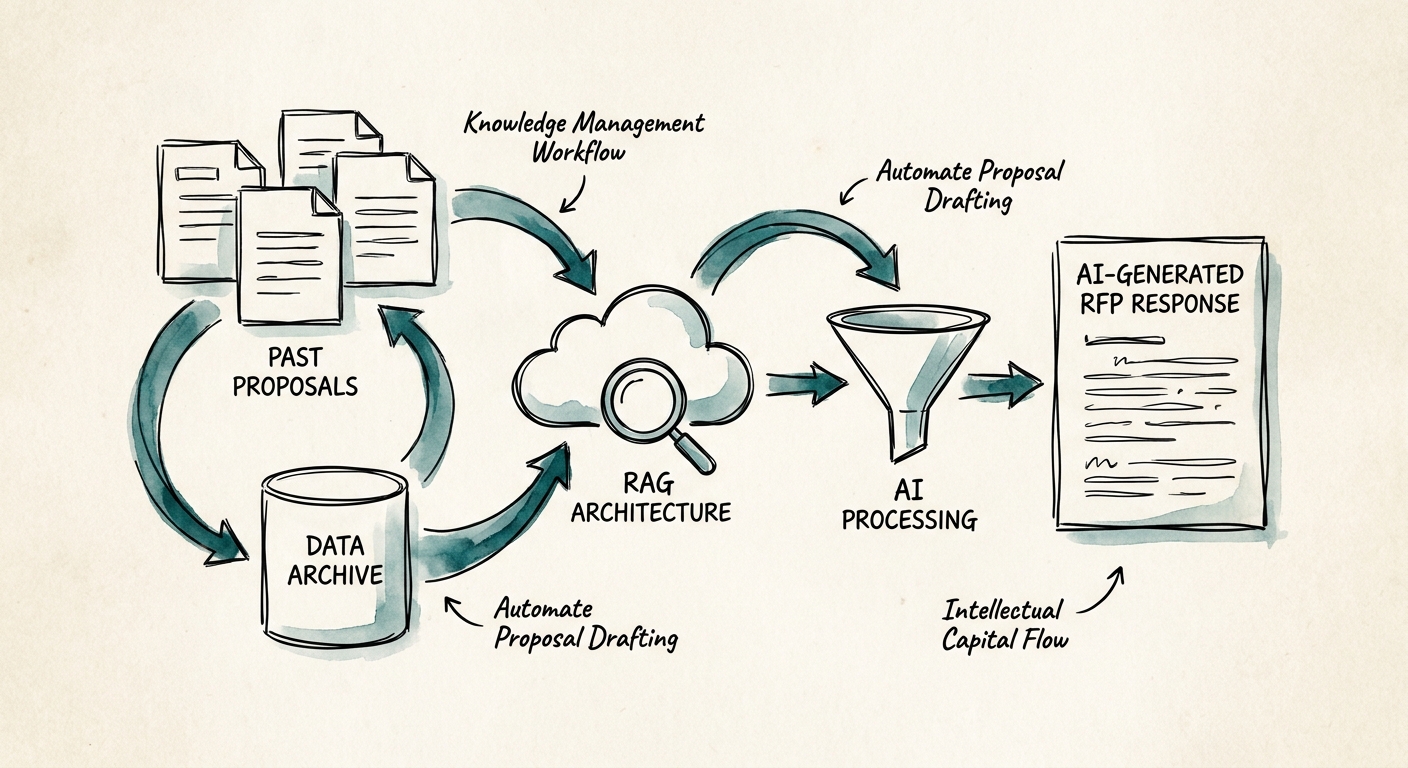
Most firms try to automate proposals by pointing a general assistant at a folder of old decks and asking it to "write a proposal for this client." That produces fluent fiction. The actual deliverable that makes AI safe here is upstream of the draft: a proof library where every reusable claim carries a status and a date.
Picture the smallest version of it — say a 60-person IT consultancy. Each entry is one claim or one section: a metric, a logo'd reference, a scope block, a pricing assumption. Each carries an approval status (approved / expired / never-public), a source date, and an owner who can answer "is this still true?" The NIST AI Risk Management Framework gives you the language for this: define the context, name the accountable reviewer, and make the risk measurable instead of vibes-based. The CISA AI Data Security Best Practices decide the harder question — which material the model is even allowed to retrieve. A reference client that hasn't signed off on being named, an internal margin assumption, a pricing floor: those get walled off from the drafting surface entirely, not just flagged after the fact.
So the rule splits cleanly. If the proposal is low-stakes and the firm is small, a general assistant drafting from approved blocks with mandatory human signoff is plenty — keep it in draft state and require a partner to release it. But the moment proposals carry compliance commitments (a stated certification, a data-residency promise, a regulated-industry attestation), you need deterministic checks wrapping the model: a hard stop if a draft asserts a credential the firm can't currently evidence. That check is worth more than any amount of prompt tuning, because it catches the one claim that turns a won deal into a breached one.
Measure rejected blocks, not just faster drafts
The Deloitte State of AI in the Enterprise 2026 reads as a warning to anyone tempted to declare victory on draft speed: the gap between firms running pilots and firms capturing real value is the gap between "we tried it" and "it changed an outcome we report on." For proposals, that outcome is winning more without promising things you can't deliver.
So time-to-first-draft is the vanity metric. The number that tells you the system is working is the rejected-block rate — how often a reviewer kills an AI-retrieved claim or section. Early on you want that rate high; it means the library is full of stale or risky material the model surfaced before it reached a client. As you fix the underlying entries, the rate should fall. A rejection rate that stays high after a quarter isn't an AI problem — it's a proof library nobody's maintaining. Track alongside it: approved-source reuse rate, unsupported-claim removals per proposal, and any pricing-exception that needed a partner's sign-off.
Start narrow. Pick your single highest-volume proposal type — the one your firm responds to twenty times a quarter — and tag only the proof and scope blocks that type uses. Use the manual-work scoring guide to confirm that proposal type is actually worth the build, then stage the cleanup, pilot, reviewer training, and scale decision with the 90-day AI implementation plan. Make every reviewer log one thing per section — accepted, edited, or rejected — for the first 90 days. By the end you'll know two things you didn't before: which proposal claims your firm can actually defend, and how much of your win rate was riding on luck at 4:40 p.m.