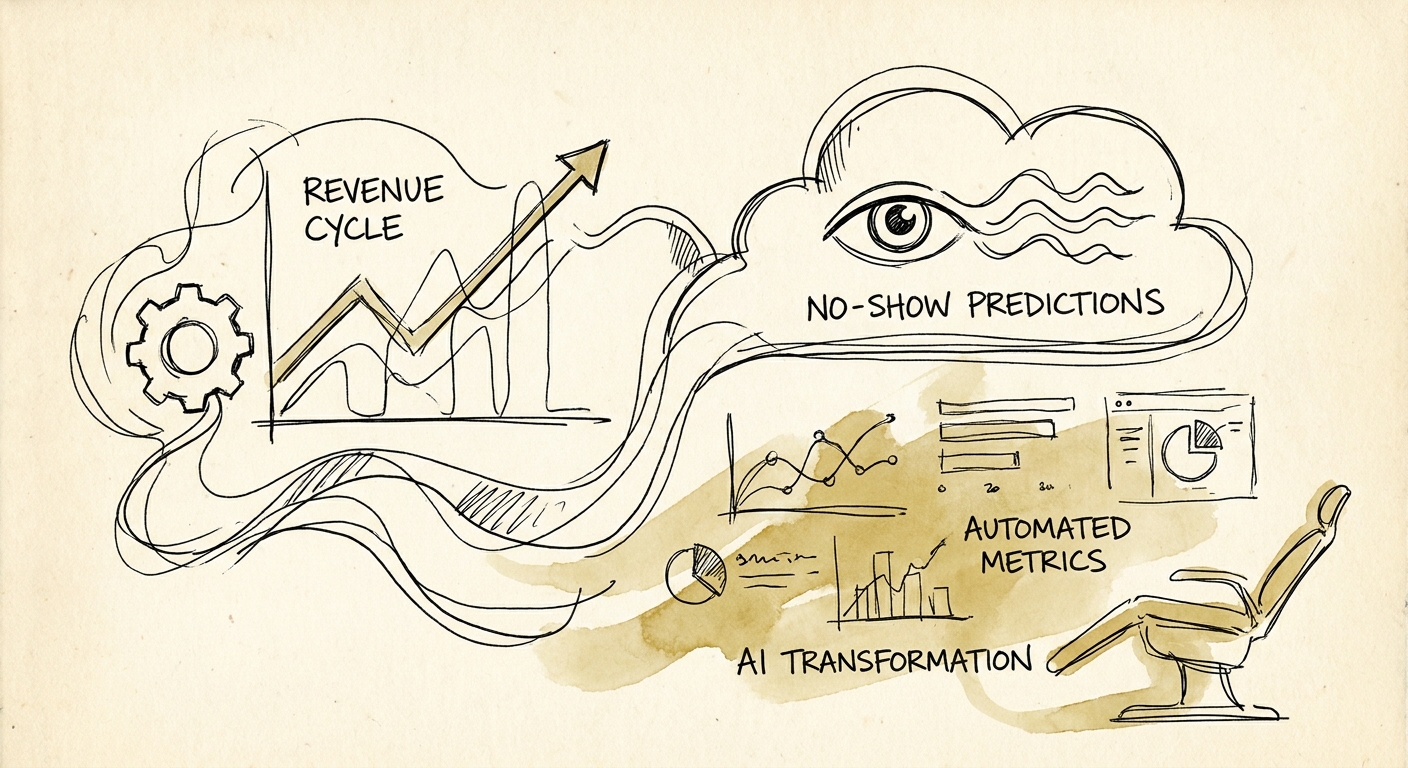
The eligibility check that takes nine minutes
Walk into the back office of a six-location dental group on a Monday and you will find a coordinator on hold with a payer, re-keying a member ID into a portal that times out, trying to confirm whether a crown is covered before a patient sits in the chair at 2pm. Multiply that by every new patient, every plan change, every quarter when employer benefits reset. That is where a dental group bleeds capacity — not in the operatory, where the dentistry is already good.
So when AI shows up at a dental group, point it at the work that is repetitive, text-heavy, and entirely administrative: insurance eligibility and benefit breakdowns, claim status follow-up, recall and reactivation outreach for the patients who fell off the hygiene schedule, schedule gap-filling across locations, and the pre-visit chart prep that pulls last visit notes, radiograph dates, and outstanding treatment plans into one packet. None of that touches a diagnosis. All of it eats hours.
The failure mode is the opposite instinct: standing up a patient-facing booking or symptom assistant first, on top of practice-management data that does not agree with itself. If location A logs a patient as "active recall" and location B has the same person flagged "inactive," automation does not fix that — it broadcasts it. External work from McKinsey's 2025 State of AI, the IBM Institute for Business Value, and PwC's 2025 Responsible AI survey keeps landing on the same point: the constraint on useful AI is rarely the model. It is whether the data and the approval rules are clean enough to trust the output.
Draw the line at clinical and coverage decisions
The rule that keeps a dental group out of trouble is simple to state and easy to forget under volume pressure: AI prepares, a licensed human decides. An assistant can draft the recall text, assemble the eligibility summary, flag that a patient's frequency limitation on prophylaxis hasn't reset yet, and queue a follow-up on a denied claim. It does not tell a patient what treatment they need, it does not promise coverage, and it does not finalize what goes on a claim. The hygienist, the dentist, the treatment coordinator, and the insurance lead own those calls.
That line matters more in dentistry than in most administrative settings because two of your outputs — clinical guidance and what a patient will owe — carry real liability. The American Dental Association's guidance on AI standards in dentistry frames the evaluation around transparency, safety, efficacy, and fairness; the NIST AI Risk Management Framework gives you the same discipline for the operational side. Practically, that means every AI-generated item carries its receipts: this benefit estimate came from the eligibility response dated last Tuesday; this recall reminder was triggered by a six-month interval on a completed prophy. When a front-desk lead can see the source behind a recommendation, they can correct a bad one in seconds instead of distrusting the whole system — which is also how Bain's 2025 work on agentic AI describes adoption actually sticking. If you want the administrative lift without surrendering compliance or patient experience, that is the job of AI for Healthcare Administration.
Prove it on one location, one workflow, one owner
Pick your highest-friction administrative workflow — for most groups that is insurance eligibility or recall reactivation — and run it at a single location with one named owner, usually a strong front-desk or revenue-cycle lead. Don't measure "hours saved," which nobody can audit. Measure things a practice manager already tracks: time-to-eligibility-confirmation, the rate of patients arriving without verified benefits, claim rework and denial-resync time, recall reactivation rate, unfilled chair time, and how often staff accept the AI's draft versus rewrite it. That last number is your honesty meter — if drafts get rewritten constantly, the workflow isn't ready to scale.
If the pilot cuts verification time and the missing-information rate without piling on rework, then you expand — to the next location, then to claim follow-up, then to scheduling. A multi-location group has a real advantage here: standardize the governed workflow once and roll the same approval rules across every office instead of letting each location reinvent it. Model the economics first with the AI ROI Calculator, then build the governed, source-cited process with AI Workflow Automation. Monday's move: list every place a coordinator is on hold with a payer or re-keying data between systems — that list is your roadmap.