
The practical answer
- Short answer
- Eight people reconciling Stripe against NetSuite by hand is not a staffing problem — it's a margin leak. How SaaS scale-ups break linear back-office hiring.
- Best fit
- Industry: B2B SaaS & Tech Services. Function: Operations
- Operating path
- Process Documentation → Operational Excellence → Transaction Execution Services
- Key metric
- 3.4 Excess administrative FTEs hired per $10M in revenue by tech companies lacking documented back-office processes.
Eight people, one VLOOKUP, and a broken cap on your multiple
The last $40M SaaS company I took apart had eight full-time people whose job, stripped of titles, was to make Stripe and NetSuite agree with each other. Every month they exported transaction data, ran VLOOKUPs against the invoice ledger, hunted down the deltas, and re-keyed the survivors by hand. Nobody called it that. On the org chart they were "billing analysts" and "revenue ops coordinators." In reality they were human glue between two systems that were never wired to talk.
This is the trap that catches founder-CEOs specifically, because it doesn't look like a problem — it looks like growth. You closed more deals, so you needed more hands to process them. But here's the part that should keep you up at night: that headcount scales linearly with revenue. If it takes three people to run order-to-cash on $10M in ARR, it will take six on $20M. You just lost the single thing that makes a software company worth a software multiple instead of a staffing-agency multiple — operating leverage. Bain's 2025 Back-Office Efficiency Benchmark puts a number on the drift: for every $10M in revenue, tech companies without documented administrative processes carry 3.4 excess back-office FTEs versus their optimized peers.
The reason it happens is almost always the same, and it's counterintuitive. You bought software to fix this. HubSpot for the funnel, Zendesk for support, NetSuite for finance, BambooHR for people. Each one is excellent in isolation. But buying ten SaaS tools doesn't give you an integrated back office — it gives you ten islands, and the bridges between them are people copy-pasting. Founders mistake the purchase order for the outcome. Adoption is not automation. The PDF contract still gets manually keyed into the CRM; the new-hire details still get re-typed from BambooHR into your directory; the Stripe payout still gets reconciled by someone with a spreadsheet open.
McKinsey's research on the next-generation operating model estimates that up to 60% of routine finance, HR, and IT admin can be fully automated with technology that already exists and is sitting in your stack. The typical mid-market tech firm runs closer to 15%. That gap — 15% to 60% — isn't a productivity statistic. It's payroll you're spending to do work your software was supposed to do, and every dollar of it comes straight out of the EBITDA line a buyer will eventually capitalize.
If three people process $10M in billings, six will process $20M — that's not a back office, that's a tax on every dollar of growth. Map the chaos before you write a line of code.
You can't automate what lives in your controller's head
Here's the move every founder makes next, and why it fails. Frustrated by the headcount, you buy an automation tool — Workato, UiPath, whatever the demo dazzled you with — hand it to a junior IT admin, and tell them to "automate the back office." Three months later you have a brittle web of integrations that breaks the first time Stripe ships an API change, and you've spent real money to make your reconciliation problem faster and more confusing instead of gone.
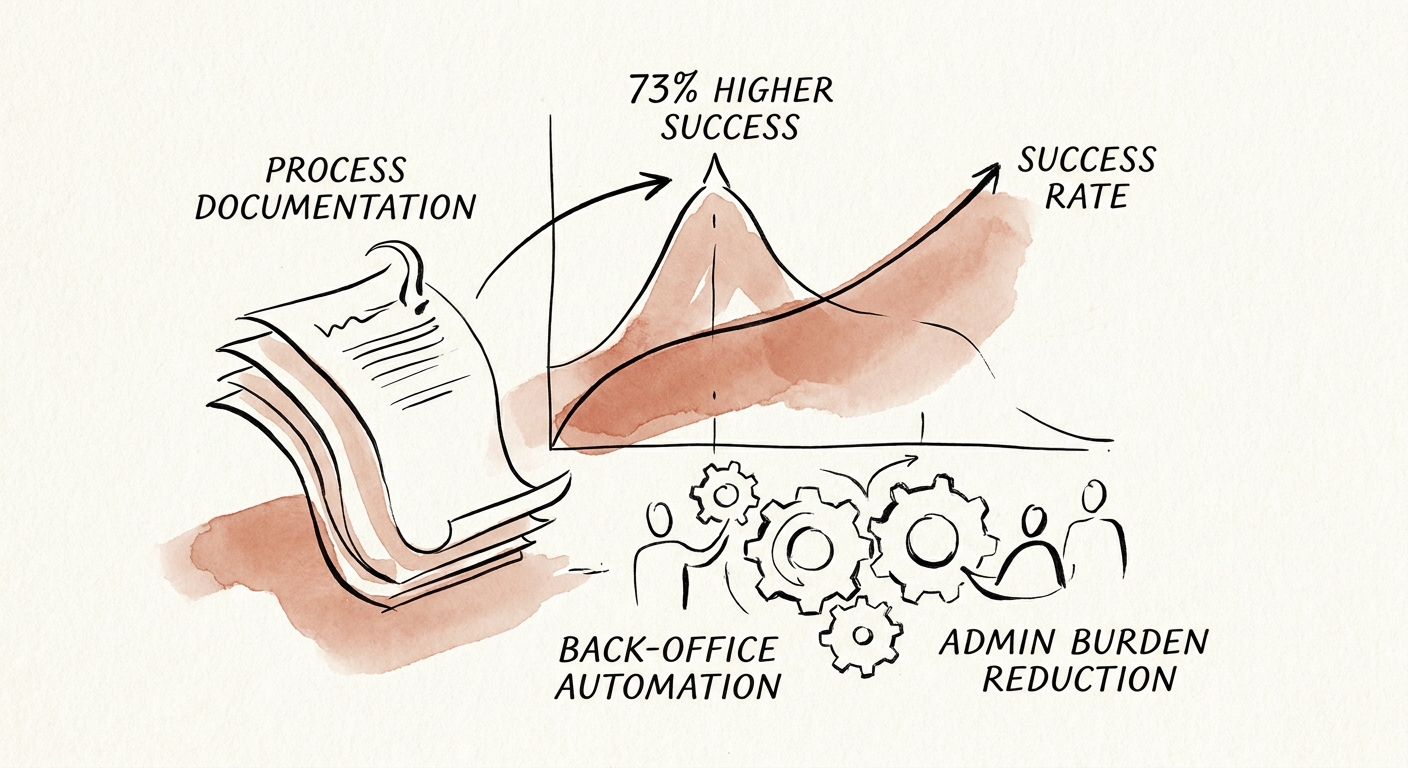
The failure isn't the tool. It's that you tried to automate a process that only exists as muscle memory. Watch what actually happens in an unmapped order-to-cash flow: the steps change depending on which AE closed the deal, whether the customer is annual or monthly, and which billing clerk happens to be in that Tuesday. Those aren't edge cases — they're the process. And no integration can encode a process that nobody can write down. Gartner's finance technology trends research found that 73% of RPA and workflow automation projects miss their projected ROI, and the dominant cause is exactly this: the underlying process was never formally documented or standardized before anyone deployed against it.
So before you touch an automation tool, map the thing. Not a fluffy flowchart — a step-by-step spec of every input, every decision rule, every exception path, and every output for each workflow. For Stripe-to-NetSuite that means: what triggers an invoice, how partial payments and refunds get matched, what happens to a failed charge, who approves a write-off and at what threshold. The discipline feels excessive to founders. It is also exactly what a private-equity buyer's diligence team goes looking for, because documented, repeatable operations are what let them underwrite scale without re-hiring your whole back office. I've walked through how that shows up in valuation in The ROI of Process Documentation: Measuring Exit Multiple Impact, and the foundational version in From Tribal Knowledge to Turnkey: Documenting Your Way to Higher Multiples.
The mapping pays for itself before you automate anything. Every time I've done this, roughly a third of the steps in a given admin workflow turn out to add zero value — they exist because someone built them around a vendor you no longer use, or a manager who left in 2022. Cut those first. Standardize what survives. The point of documenting isn't to preserve the chaos in higher resolution; it's to delete the exceptions so there's something clean enough to wire together. Refuse to do this, and you've made a decision — you've chosen to keep paying people to be the integration layer.
A 90-day plan that gets the humans out of the wires
Treat the back office like a product, because it is one — your employees are the users and operational velocity is the output. Run it in three phases over a quarter, starting with the highest-volume, lowest-judgment work: accounts payable, employee onboarding, and the CRM-to-ERP sync that's eating your billing team.
Phase one: freeze it. For two weeks, force everyone to follow the documented SOP exactly — no "I just handle that one differently." This is the part founders want to skip, and it's the part that matters most. Strict adherence flushes out the edge cases that would otherwise silently crash your scripts later. Deloitte's Global Shared Services and Outsourcing Survey found that standardizing processes before introducing automation cuts implementation timelines by 42% — you pay the freeze cost now or pay it tenfold in debugging.
Phase two: wire the systems. Stop humans from carrying data between tools. A closed deal in Salesforce should populate NetSuite with no keystroke in between; a hire in BambooHR should provision the directory automatically. This is the phase that retires the VLOOKUP — when the two systems write to each other, reconciliation stops being a job. Phase three: automate the decision, not just the data. This is where you kill the swivel-chair work. Intelligent document processing reads the incoming vendor invoice, matches it to the purchase order, and routes it for approval against your dollar thresholds — no human touch until the one click that releases payment. Buyers scrutinize exactly this kind of efficiency in diligence, which I break down in What Is Operational Due Diligence? The 2026 Playbook for Portfolio Ops.
The payoff outlasts the quarter. MIT Sloan's research on making automation initiatives succeed ties a genuinely automated back office to an 11% premium on enterprise value at exit, earned through margins that hold as you scale instead of degrading. So pull the report on your own back office this week: count the FTEs whose real job is moving data between two systems. That number is your starting line. Document the workflow, delete the exceptions, automate the execution — and stop hiring people to be the glue your software should be.