
The practical answer
- Short answer
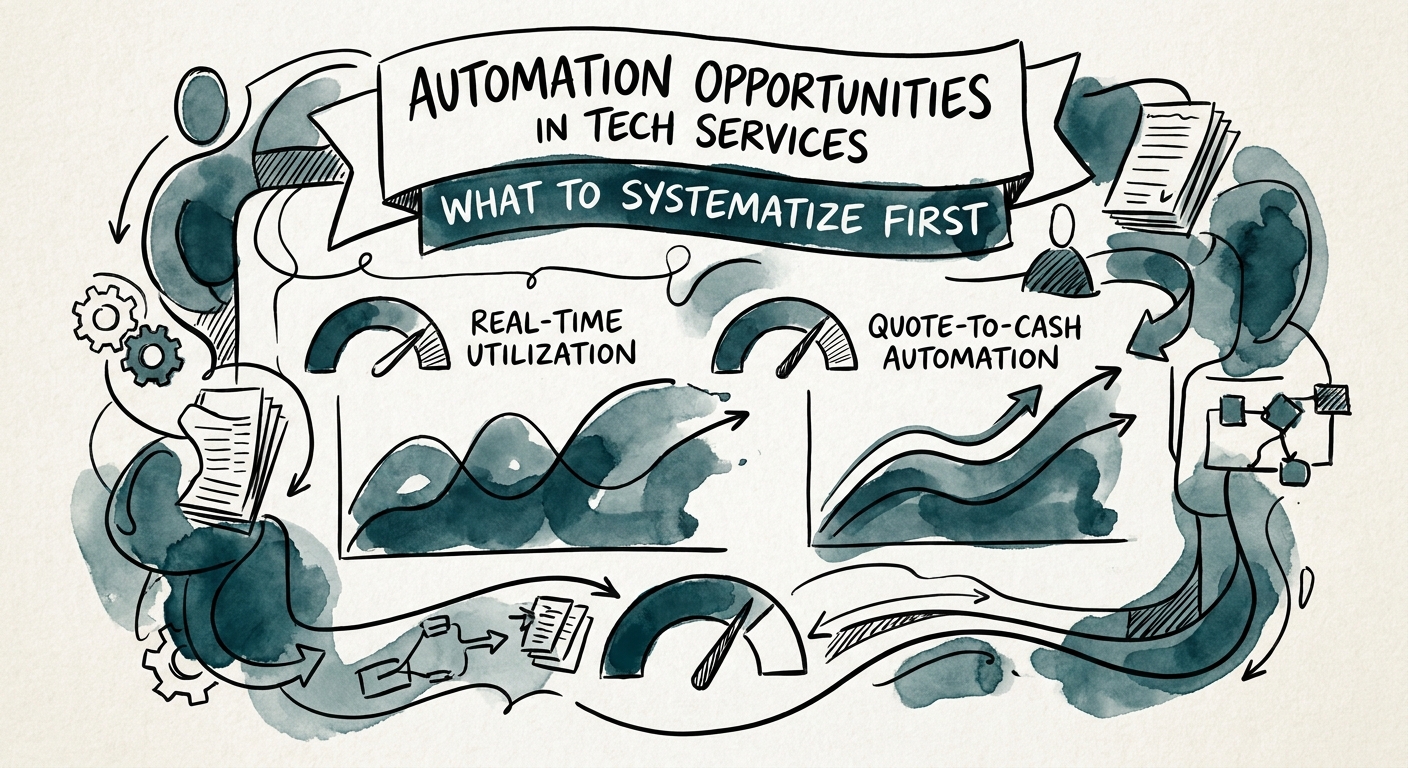
- Most tech services firms automate the wrong thing first. Here is the exact sequence — quote-to-cash, bench, onboarding — that protects margin and lifts your exit multiple.
- Best fit
- Industry: Technology Services. Function: Operations
- Operating path
- Process Documentation → Operational Excellence → Transaction Execution Services
- Key metric
- 65% Higher automation success rate when standard operating procedures are documented first.
Picture a $40M ServiceNow implementation partner I sat with last year. Smart founder, real engineers, a logo wall any PE buyer would respect. The leadership team had spent six months and roughly $450,000 building an AI bot to help scope and sequence client delivery. Meanwhile, three full-time people spent the last week of every month copying numbers out of Jira into NetSuite by hand to get invoices out the door. They were building a robot to do the interesting 10% of the work while the boring 90% — the part that actually turns into cash — ran on heroics and copy-paste.
This is the most common automation mistake I see in technology services firms, and it is almost always why they stall around $20M in revenue. Founders chase the automation that's fun to demo and fun to sell — agents that write code, configure platforms, draft SOWs — and ignore the back office, which is a swamp of spreadsheets and manual re-entry. The instinct is understandable and it is expensive. McKinsey's 2024 Digital Transformation Benchmark found that the majority of advanced delivery-automation efforts in professional services never return their cost of capital, mostly because the processes underneath them were broken before anyone wrote a line of automation.
The damage shows up in unit economics first. When your PMs spend Fridays chasing timesheets instead of managing scope, hours go unbilled, write-offs creep up, and your reported utilization stops meaning anything — the utilization rate lie in action. Gartner's 2025 IT Services Profitability Study points to manual time entry, fragmented invoicing, and disjointed staffing as a major source of annual revenue leakage. You cannot automate your way out of that by pointing AI at the consultants' jobs. You fix the plumbing first, then you automate the architecture. Here's the order I run it in.
If three people are retyping numbers out of Jira into your billing system every month, you don't have an AI problem. You have a sequencing problem. Automate the cash, not the cleverness.
Step one: close the gap between "deal signed" and "cash collected"
Before you automate anything, write the process down. Automating an undocumented process just makes a broken thing fail faster — and in a services firm, faster failure means faster margin decay. PwC's 2025 Operations Transformation Report found organizations hit a meaningfully higher automation success rate when they document standard operating procedures before they touch the technology. You cannot automate tribal knowledge; you have to make it legible first. That work — moving from tribal knowledge to turnkey operations — starts at the quote-to-cash seam, because that's where your money lives.
The handoff from closed-won to active project
The first thing to systematize is the moment a deal flips to closed-won in your CRM. That single event should automatically spin up the project shell in your PSA tool, set the baseline budget from the SOW, open the resource request against the required roles, and put a kickoff on the calendar — no human retyping anything. If your ops manager is still hand-building projects in an ERP every Monday morning, you are introducing data errors at the exact point where they later resurface as unbillable hours and angry change-order conversations. A buyer's operational diligence team will find that handoff in about an hour, and it will cost you.
Step two: forecast the bench before you touch delivery cleverness
Next is bench management. Running staffing off a master spreadsheet that one person updates is a margin risk pretending to be a process. Wire your PSA so it flags who rolls off in the next 30 days, tied to weighted pipeline, so you see the gap before it becomes an idle senior architect or a panic hire. When resource forecasting runs against the pipeline automatically, you trade reactive scrambling for actual capacity planning — and that's the only durable way to hold a healthy utilization rate without grinding down your best people. Notice that none of this touches client delivery. It touches the machine that turns delivery into predictable cash, which is a different and far more valuable thing.
Step three: get new hires billable faster — and why a buyer cares
Once quote-to-cash and staffing run themselves, the next target is onboarding. In a services business your inventory walks out the door every night, and the clock that matters is the one between a new consultant's first day and their first billable hour. Every day in that gap is fully loaded cost with zero revenue against it. Forrester's 2025 Tech Talent Onboarding Index found that standardizing and automating provisioning, access management, and knowledge transfer cuts consultant ramp time by roughly a third.
Run the math on your own firm. Say a senior cloud architect costs you $160,000 fully loaded. Shave a month off ramp and you've recovered something on the order of $13,000 in gross margin per hire — and if you're bringing on dozens of consultants a year, that recovered margin quietly funds the operations team you keep saying you can't afford. The mechanism is simple: new consultants shouldn't learn how your firm delivers by shadowing whichever principal happens to be free. They should move through a documented enablement track that checks competency before they touch a client environment, so day one is structured instead of improvised.
Here's the part founders miss until diligence forces it on them: this is exactly what a PE buyer is grading during Quality of Earnings and operational due diligence. They are not buying your clever delivery scripts — those leave with the people who wrote them. They are buying repeatability: can revenue be produced again next quarter without the founder in the room? Bain's 2026 Technology M&A Report ties highly systematized back-office and financial operations to a meaningfully higher EBITDA multiple at exit. Buyers pay up for predictability, full stop — which is also the ROI of documenting the process in the first place. So this Monday, don't scope the AI delivery bot. Pull the timesheet-to-invoice path apart, write down every manual handoff in it, and automate the first one. Build the system that makes your consultants reliably profitable — not the robot that tries to be them.