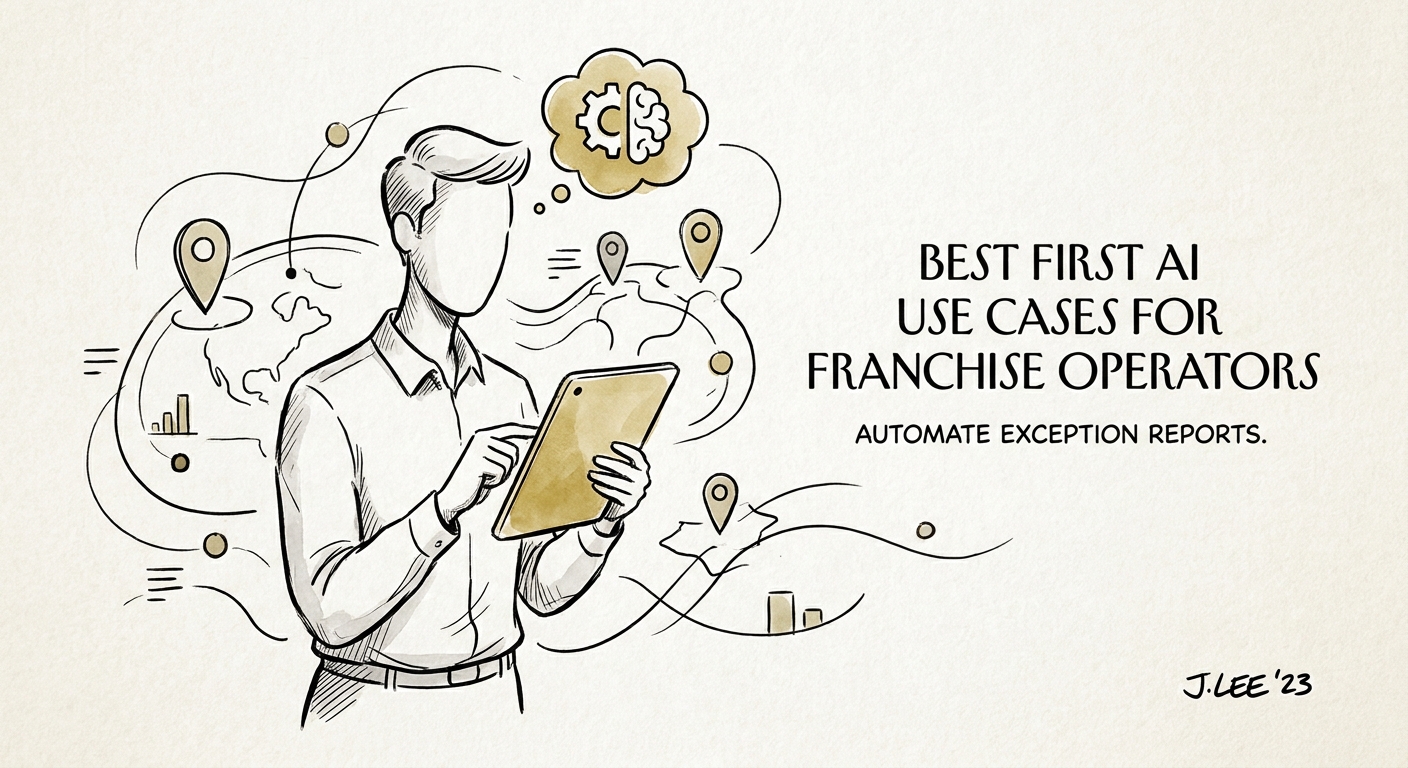
The 9pm text from a franchisee is the use case
Say you run 60 units. It's Friday at 9pm and a franchisee texts your field rep: "Corporate emailed a new opening checklist — is the old fryer cool-down step still in it or not?" Your rep doesn't actually know. So they guess, or they wait until Monday, and in the meantime that location is improvising on a brand standard. Multiply that by the inspection follow-ups, the training-update questions, and the "which version of the playbook is current" confusion across every unit, and you've found the real problem AI should attack first. It is not "roll out an assistant." It is "every location should get the same correct answer, fast, from the current document."
That framing matters because franchising has a fault line most businesses don't: the people asking the questions don't work for you. A franchisee runs their own P&L. When they get a stale or wrong answer about a brand standard, you can't just retrain an employee — you've created an inconsistency that an inspector, a customer, or a franchise-agreement dispute can later point to. The first AI workflow has to respect that the cost of a confident-but-wrong answer is higher in a multi-unit network than almost anywhere else.
The adoption pressure is real — Census Bureau data on AI use at U.S. businesses and OECD research on AI adoption by SMEs both show smaller multi-location operators feeling it. But Deloitte's State of AI in the Enterprise 2026 is blunt about why most pilots stall: a slick demo over "all our documents" is not a workflow you can measure. So scope it down hard. One queue — inbound franchisee operating questions and the answers field reps give back. One source boundary — the current operations manual, the live training updates, and active brand-standard bulletins, with version dates attached. And one thing the AI is explicitly forbidden to touch: anything that interprets the franchise agreement, sets a discipline or default action, or grants a brand-standard exception. Those stay with a human, every time.
Make the AI cite the manual, not its own confidence
Here's the test that separates a real franchise tool from a liability. When the AI answers a franchisee's question, the field rep should see four things before it goes back out: the answer, the exact document and version date it came from, what the AI did NOT find (the missing field), and a one-line reason for its confidence. "Fryer cool-down: still required — Ops Manual v4.2, effective 5/1, section 3.3" is an answer a rep can stand behind. "Yes, that step is still required" with no source is the thing that gets a unit cited during an inspection. If your tool can't produce the version trail, it isn't ready to touch a franchisee.
This is exactly the risk pattern the NIST AI Risk Management Framework describes: a sentence that's harmless in a draft becomes material the moment it crosses into the operating path of a unit. And because the records here include franchisee data, inspection notes, and proprietary brand standards, the permission boundary, retention rule, and access log should follow the CISA AI data-security best practices — especially the part about who in the field can see which franchisee's records. A franchisee in one market should not be able to surface another's inspection history through a loosely scoped assistant.
Don't measure this in "questions answered." Measure it where franchising actually leaks: field-question resolution time, the share of inspection findings that get closed on schedule, how fast a new playbook version reaches confirmed adoption across units, and franchisee escalation rate (the calls that jump past the field rep straight to you). The Federal Reserve Bank of San Francisco's early findings on small-business AI are a useful gut-check on staying grounded here: if those numbers don't move, the fix is almost never "give it more documents." It's that two versions of the same playbook are live at once, or the source nobody owns is feeding bad answers. When you see the same correction made three times, you've found a documentation problem wearing an AI costume.
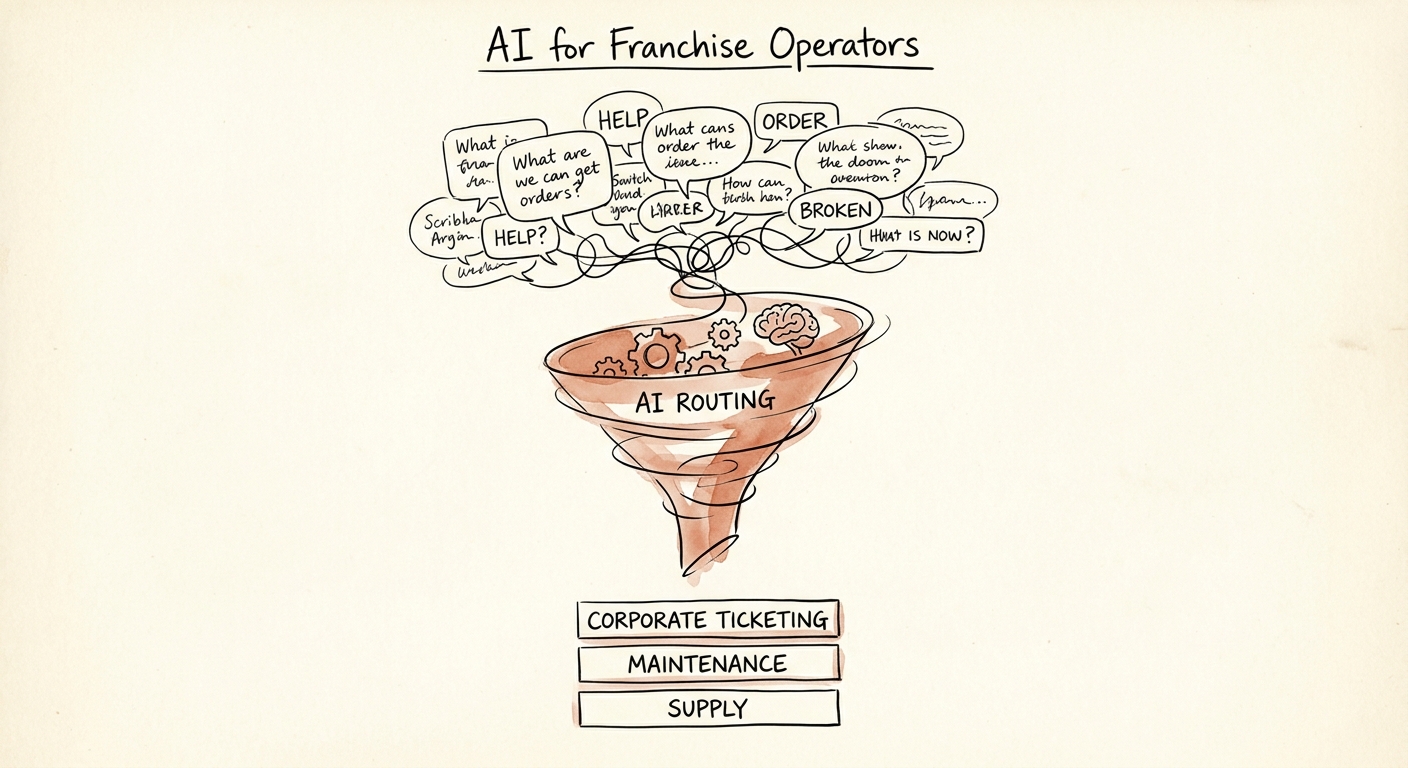
The 90-day read: did the network get quieter?
Run it on a clock. In the first 30 days, trace one path end to end — franchisee question in, source matched, rep reviews, answer out — and rip out any document the field leader won't personally defend as current. If three "opening checklists" are floating around, you have one job before any AI work: kill two of them. Days 31 to 60, put the AI's answer next to what your best multi-unit field rep would have said, side by side, and count the gaps. By day 90 you make a real call: scale to more of the franchisee question flow, narrow it to just the high-volume topics, or pause until the operations manual has a single owner and a single version.
A good scale decision in a franchise network feels boring, and that's the point. Fewer 9pm escalations. Fewer "which version is current" arguments. Reps closing inspection follow-ups without three rounds of clarification. A bad one looks impressive in a board deck and still has your area managers re-checking every answer by hand — which means you didn't remove a review queue, you added one. A 60-unit operator can't carry that. The whole appeal of franchising is leverage; an AI layer that needs babysitting is the opposite of leverage.
If you're weighing the franchisee-question queue against other starting points — reporting roll-ups, inspection scheduling, new-unit onboarding — run them through the AI Opportunity Score first to see which one actually clears the bar. Then, once the review path has produced real time-saved or error-reduced evidence (not before), pressure-test it with the AI ROI Calculator. Human Renaissance sequences that work inside the AI Transformation Blueprint, so you move from one trustworthy franchise workflow to the next without ever losing track of which playbook every location is running.