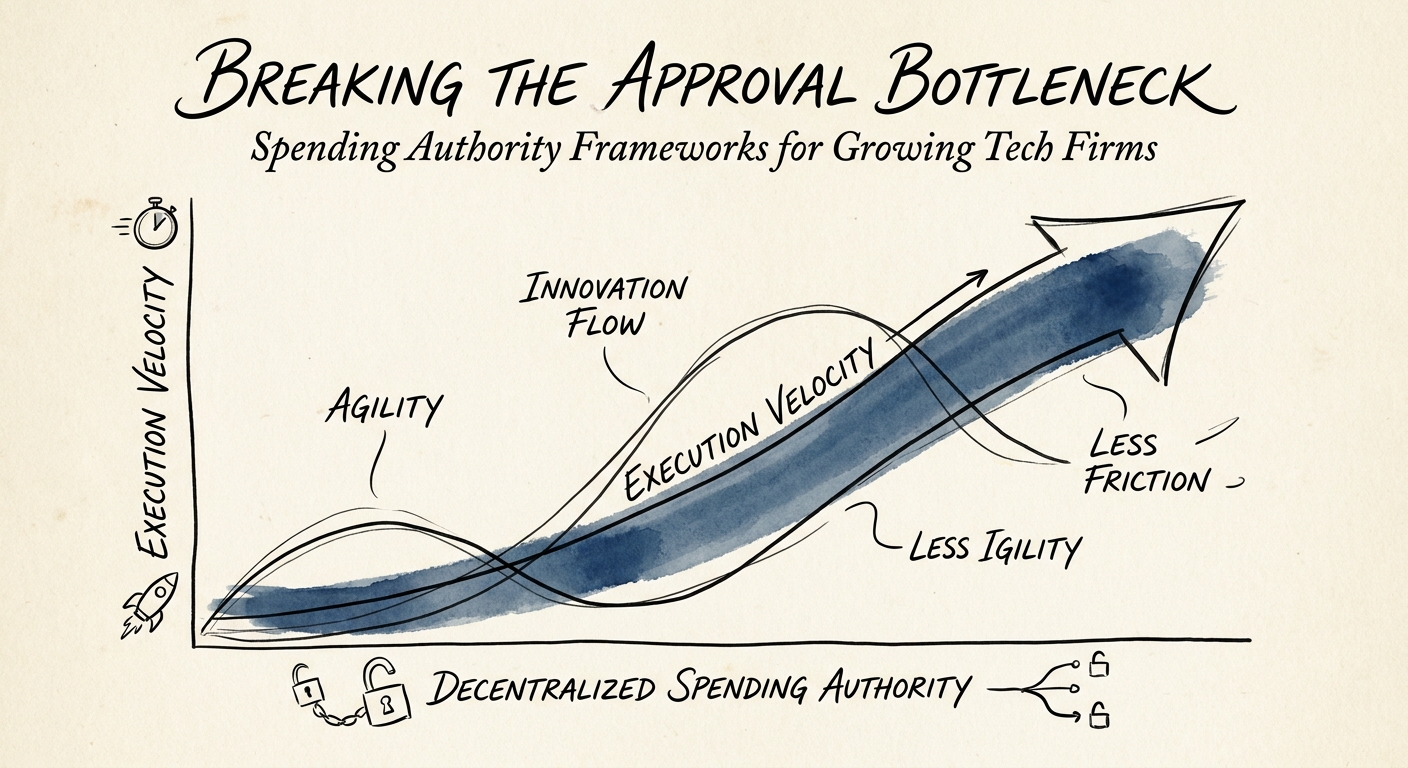
Tuesday, 9:14 a.m.: a $9,400 line item is waiting on you
It's a renewal for the observability tool your platform team has used for two years. The PO has been sitting in your approvals channel since Friday. You'll get to it after the board prep, the candidate debrief, and lunch. Meanwhile two senior engineers have throttled their incident dashboards to stay under a usage cap, and your on-call rotation is flying half-blind into a release week. The license costs less than four hours of those two engineers' loaded time. Your 72-hour signature delay just cost more than the thing you were trying to control.
I watch this exact scene play out at software companies the moment they cross roughly $20M ARR. The $5,000 approval cap that felt like prudent discipline at $3M ARR — when every dollar genuinely was yours — quiets nothing now except your own org's velocity. In a recent engagement with a scaling enterprise software company, I pulled the CEO out of the purchase-approval Slack channel entirely, because his queue had become the single longest-running blocker in the company. He thought he was protecting cash. He was metering it through a straw.
The drag is measurable, not theoretical. McKinsey's analysis on workflow bottlenecks ties slow approval chains to roughly a 30 percent increase in overall project cost — missed windows and idle labor, not invoice savings. Gartner's 2025 IT procurement benchmarks put the average IT procurement cycle under centralized, manual approval at 37 days. Thirty-seven days is longer than most of your sprints. You are not the last line of fiscal defense in that picture; you are the queue.
Replace the dollar threshold with a variance band
The fix is not a higher cap. Raising your personal sign-off from $5K to $25K just moves the bottleneck up a tier and trains your VPs to split purchases to duck under it. The fix is to stop approving dollar amounts and start governing variance against a budget the leader already owns.
Here is the model I install. Each department head gets a quarterly operating budget they helped build. As long as a purchase keeps them inside roughly 5 percent of that approved number, they execute the vendor agreement themselves — no signature, no channel, no wait. Spend only escalates to a human when it would breach the band. A VP of Engineering who needs to scale AWS for a customer migration doesn't ping you; the spend tracks to a pre-approved consumption profile, so the system clears it and flags you only on the exception. You've replaced "is this purchase OK?" with "is this leader still inside the plan they signed?" — a question software answers in milliseconds.
The reason most teams never get here is not tooling, it's nerve. McKinsey's 2024 finance automation survey found 98 percent of CFOs have invested in digitization, yet 41 percent say less than a quarter of their financial processes are actually automated. The gap is the founder who built the rules but won't let the rules run without him. Once the band governs the spend instead of your inbox, the math turns. Gartner's finance digitization data shows fully digitized procurement functions returning 300 to 500 percent ROI inside three years. That return is mostly recovered velocity — deals closed, hires onboarded, infrastructure provisioned in hours instead of weeks.
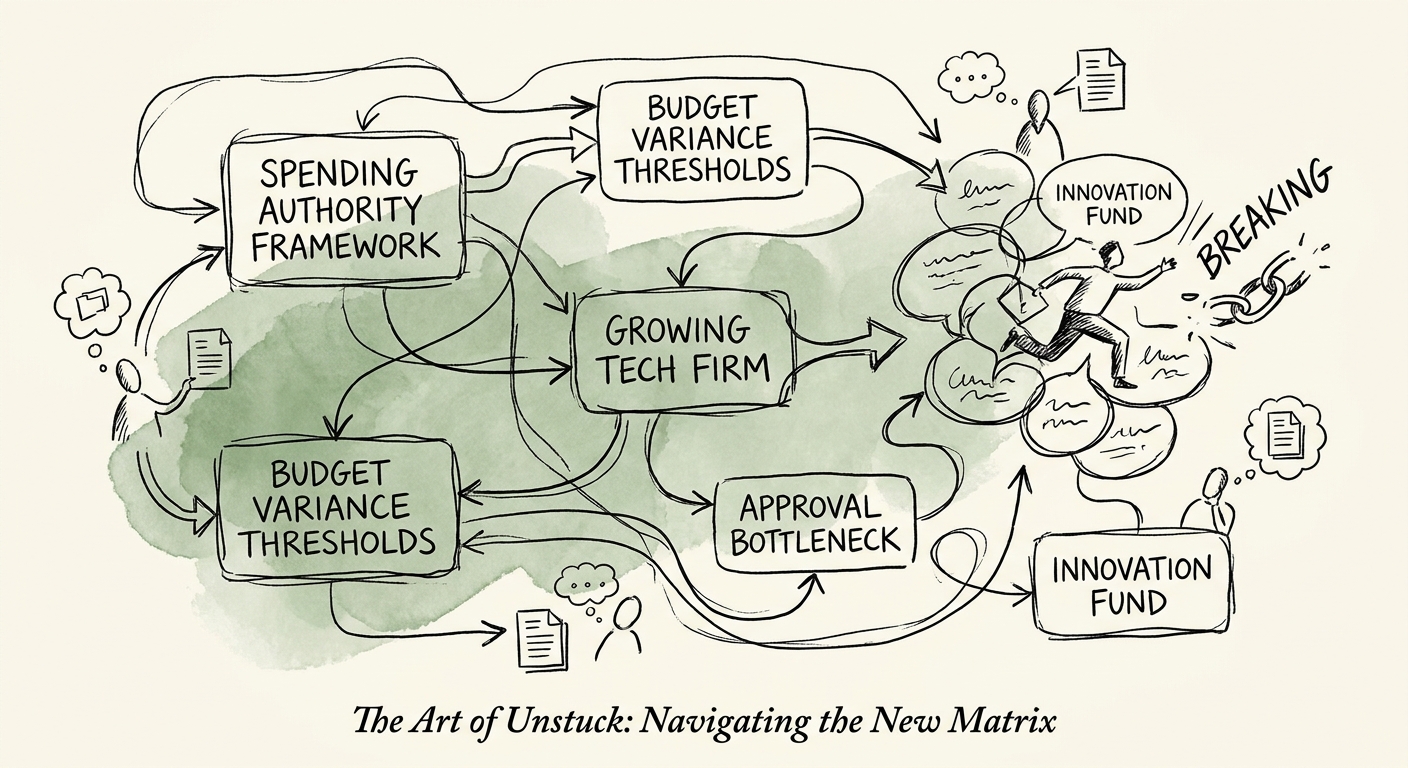
What a diligence team sees when they pull your purchase log
Here is the part founders underweight. When a private equity team runs diligence on your software company, they don't just read the P&L — they look at how decisions actually move. A purchase log where every line over $5K routes through the CEO tells them one thing: nothing happens here without you. They will price that. The cost of key-person dependency isn't abstract; it shaves real turns off the multiple, and I've written separately on quantifying the cost of key person dependency and the broader transition from founder dependency to scalable operations. A buyer modeling synergy targets has to assume your team freezes the day you stop answering Slack — and they discount accordingly.
Decentralized capital deployment isn't just a defensive de-risking move; it's how the rare durable companies operate. Bain & Company's value creation benchmarks show fewer than 20 percent of companies deliver both positive economic profit and real top-line growth in the same year. The ones that do can move money toward an opportunity without convening their founder. On the exit side, PwC's post-merger value creation data finds decentralized, tech-enabled procurement architectures cut integration friction by up to 25 percent and pull synergy realization forward — which is exactly the post-close speed a sponsor is paying for.
So do this Monday: pull your last quarter of approvals, sort by approver, and find the median dollar amount you personally signed. If that number is below your team's loaded daily cost, you are charging the company more in your delay than you're saving in oversight. Pick your two most trusted VPs, give each a budget band and unilateral authority inside it, and remove yourself from the approval channel for thirty days. I've rebuilt this exact matrix at three different software companies. The first week is uncomfortable. Every week after, the company moves faster than it did with you in the loop — and you finally get to architect the business instead of authorizing it.