The expensive silence between "signed" and "kicked off"
A deal closes on a Thursday. The account executive is already chasing next quarter's pipeline. The implementation lead doesn't know the deal exists until someone forwards a thread on Tuesday. By the time anyone reads the discovery notes, the customer has emailed twice asking when things start. Nine days of silence, and you haven't done a single thing wrong on paper — you just don't have a system that moves a closed deal into motion without a human remembering to.
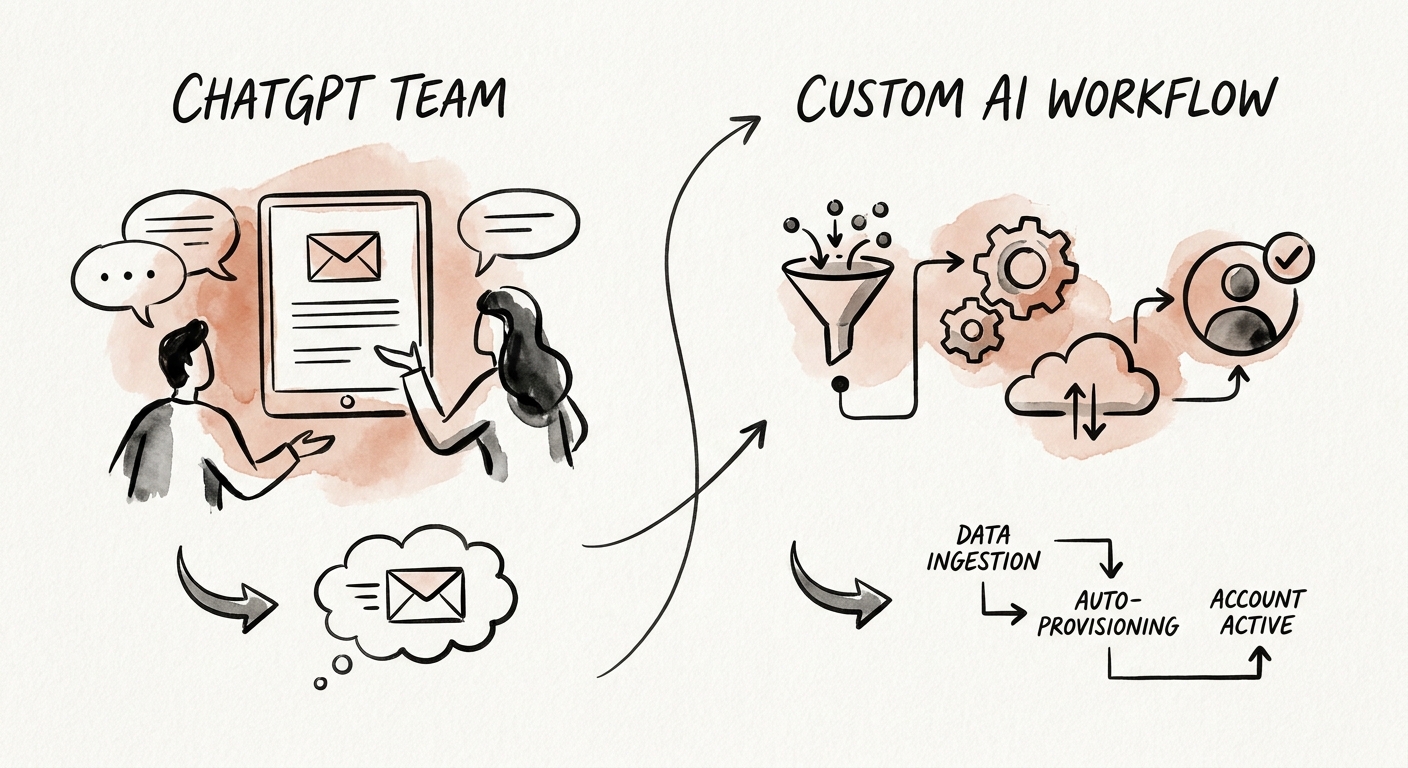
That gap is what you're actually evaluating when you ask "ChatGPT Business or a custom workflow for onboarding?" The question is rarely about who writes a better kickoff plan. It's about whether the handoff from sales to implementation to customer success happens on its own, with the right tasks landing on the right owners, or whether it depends on someone's memory and a forwarded email.
ChatGPT Business is genuinely good at the writing half. Paste in the discovery call notes and the signed scope, and it will draft a clean kickoff agenda, a customer-facing welcome summary, or a risk note flagging that the customer mentioned a hard go-live date three times. What it will not do is reach into your CRM, see that the opportunity flipped to Closed-Won, create the implementation tasks, assign the integration dependency to the right engineer, and ping the CS manager when day five arrives with no kickoff scheduled.
The adoption research points the same direction. RSM's middle-market survey, the San Francisco Fed's read on AI and small businesses, and the OECD's SME adoption report all land on a version of the same finding: smaller companies get real value when AI is aimed at a defined workflow with clear ownership, not when it's a clever assistant floating beside the work. Onboarding is the textbook case, because every milestone has an owner and every late owner has a name.
The line between "drafts the plan" and "runs the handoff"
Here's the test I'd run before spending a dollar on either option. Open your last ten onboardings and ask: where did time leak? If the answer is "we wrote slow, generic kickoff docs," ChatGPT Business solves that next week. OpenAI describes ChatGPT Business as a shared team workspace, and the enterprise privacy guidance covers how business data is handled — so it's a reasonable place for your CS team to draft and analyze, once you've decided which customer details are allowed in the workspace.
But if the answer is "the deal sat for a week before anyone picked it up," or "the data migration task wasn't created until the customer asked about it," no amount of better drafting touches the problem. That's a routing failure, and routing is where the custom threshold begins. A governed onboarding workflow validates the sales-to-success handoff the moment the deal closes, confirms the implementation prerequisites are present, creates the task chain, escalates a dependency that's aging past its target date, records the customer's stated commitments, and warns a manager before the promised first-value date slips — not after.
Two guardrails matter more in onboarding than almost anywhere else, because you're handling a customer who just trusted you with money. Use the NIST AI Risk Management Framework to pin down exactly what the workflow is allowed to recommend versus what a human must approve — you do not want an automation confirming a go-live date the implementation team never agreed to. And use CISA's AI data-security guidance wherever onboarding touches the sensitive stuff: customer configuration, contract terms, access credentials, integration secrets. A kickoff doc that accidentally surfaces another customer's setup notes is a breach, not a typo.
So don't grade onboarding AI on how polished the plan reads. Grade it on whether the source owner — the AE, the implementation lead — can look at the AI's output and say "no, that's not what we agreed," and whether the next system action is logged clearly enough that a manager can reconstruct what happened three weeks later when a customer disputes a commitment.
Let the late tasks tell you which one to build
Deloitte's State of AI in the Enterprise 2026 is useful here because it separates AI that's actually in production from the pile of half-finished experiments most companies are sitting on. For onboarding, production value has a specific shape: late tasks drop, kickoff rework falls, and customers hit first value with fewer fire drills from their CS manager.
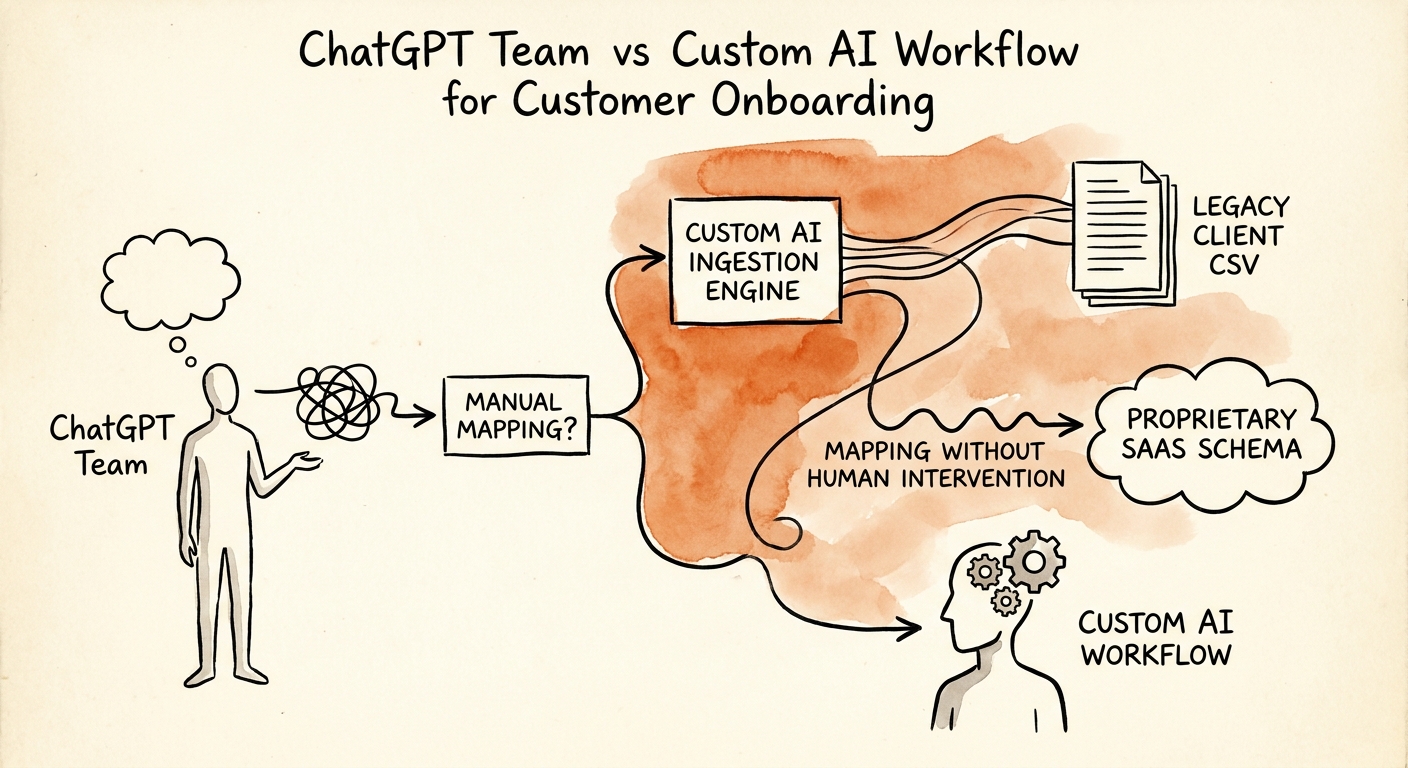
Instrument it before you decide. Pull six numbers from your last quarter of onboardings: time from signed to first value, late-task rate, how long open dependencies age before someone touches them, rework after kickoff, training completion, and how many times a manager had to manually unstick something. Now you have a verdict instead of a vibe. If those onboardings were slowed by weak planning conversations, ChatGPT Business is your answer and you're done. If they were slowed by dropped handoffs and tasks born late, the writing tool won't move the needle — build the workflow around your onboarding system of record.
If you build, ship narrow. One customer segment, one milestone chain — say, the standard mid-tier onboarding from Closed-Won through first successful login, nothing fancier. Use the AI transformation services guide to name who owns the workflow, then sequence the source cleanup and testing with the 90-day implementation plan. Write down the decision and the reason: kept in ChatGPT Business because the gap was writing speed; built custom because deals were sitting unrouted; or paused because the CRM handoff data was too messy to automate against yet.
Then expand only when the owner can point at the numbers and say what moved — first-value time down from sixteen days to nine, late-task rate cut in half — not when someone's impressed by a slick kickoff deck. The whole point of onboarding AI is to shorten the customer's path to value. If it isn't doing that, you've bought a better-looking version of the same nine-day silence.
