The afternoon a webinar became fourteen problems
Picture a marketing team of six at a 180-person software company. A product webinar wraps at noon. By five o'clock, someone has fed the transcript into ChatGPT Business and pulled out a recap blog, four LinkedIn posts, three sales-enablement one-liners, an email nurture sequence, and two paid-social variants. Fourteen assets, one afternoon, zero overtime. That is the demo everyone falls in love with.
Here is the part the demo skips. Somewhere in that webinar, a sales engineer said "we cut their onboarding time by 70 percent." It was a real number for one customer, never cleared for public use, and the deal isn't even referenceable. ChatGPT doesn't know that. So now "70 percent faster onboarding" is sitting in a blog headline, two LinkedIn posts, and an email subject line. The tool didn't make a mistake — it did exactly what you asked. It took your source and made more of it. That is the whole nature of repurposing: it is a fan-out function, and it fans out whatever you feed it, approved or not.
This is what separates repurposing from most AI marketing tasks. The failure mode isn't a bad draft you can fix. It's a single unverified claim that quietly replicates across channels faster than anyone reviews it. The constraint that actually matters is not output quality. It is provenance: can you trace every line back to a source that someone with authority approved for public use?
The pressure to move this fast is real and documented. RSM's middle-market AI research, the San Francisco Fed's analysis of AI and small businesses, and the OECD's SME adoption report all describe smaller companies under adoption pressure with thin resources. In a content shop, that pressure cuts one of two ways. It either pushes you toward one source of approved claims, or it pushes you toward fourteen-assets-by-five-o'clock with no idea where each line came from.
Where ChatGPT Business stops being enough
For a lot of repurposing, ChatGPT Business is genuinely the right tool, and you shouldn't over-engineer around it. OpenAI describes it as a shared workspace for teams, and the enterprise privacy commitments spell out the data controls for business use. If your team is adapting already-approved copy into channel formats — turning a cleared case study into three social posts, shortening an approved blog into an email — chat is fast, cheap, and good enough. Keep it light.
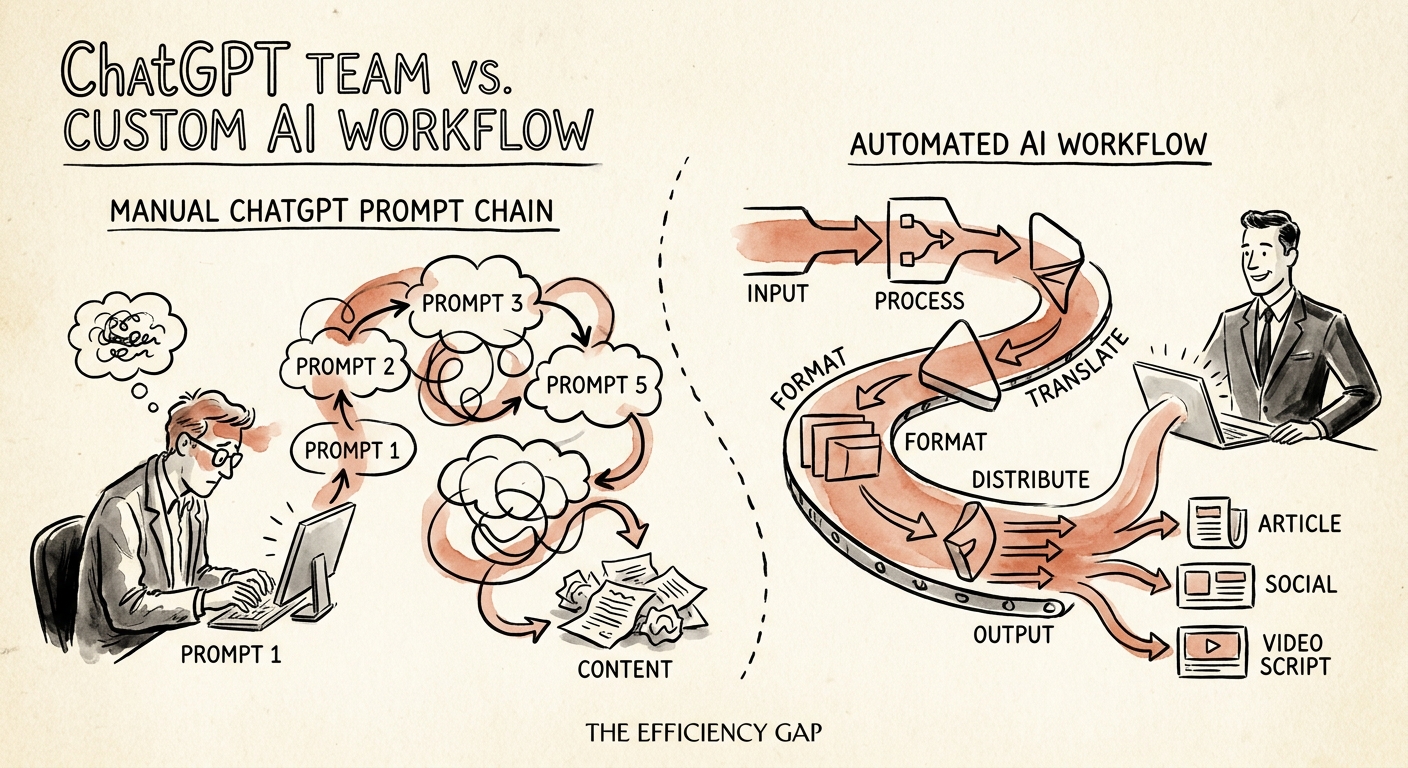
The line you should watch for is the moment a human becomes the only thing standing between an unapproved claim and a published asset. The instant your "review process" is a marketer eyeballing fourteen outputs and hoping they catch the unverified 70-percent stat, you have a control problem, not a tooling problem. That is the signal to consider building a real workflow around the content.
What "build" means here is concrete and narrow. A governed repurposing workflow starts from a message library where every claim has an owner and a status — approved, expired, customer-confidential, needs-substantiation. The AI can only draw from approved entries. Each generated asset carries the IDs of the claims it used, so you can answer "where did this number come from?" in one click instead of an archaeology session. Drafts route to whoever owns the affected claims, and publication stalls when an asset references something expired or never cleared. That is a different machine than a chat box that turns a transcript into posts.
Two frameworks are worth pinning to the wall when you scope this. NIST's AI Risk Management Framework gives you the language to name the actual risks in repurposing: misleading claims, stale proof points, brand drift, and customer references no one cleared. CISA's AI data-security guidance earns its keep the moment your source material includes raw sales notes, partner decks, or customer stories — exactly the inputs marketers reach for when they need a quote and grab whatever transcript is open. The hard call your workflow has to make is not "can AI write this," it is "which of these inputs is even allowed near a prompt."
Let the correction rate make the call for you
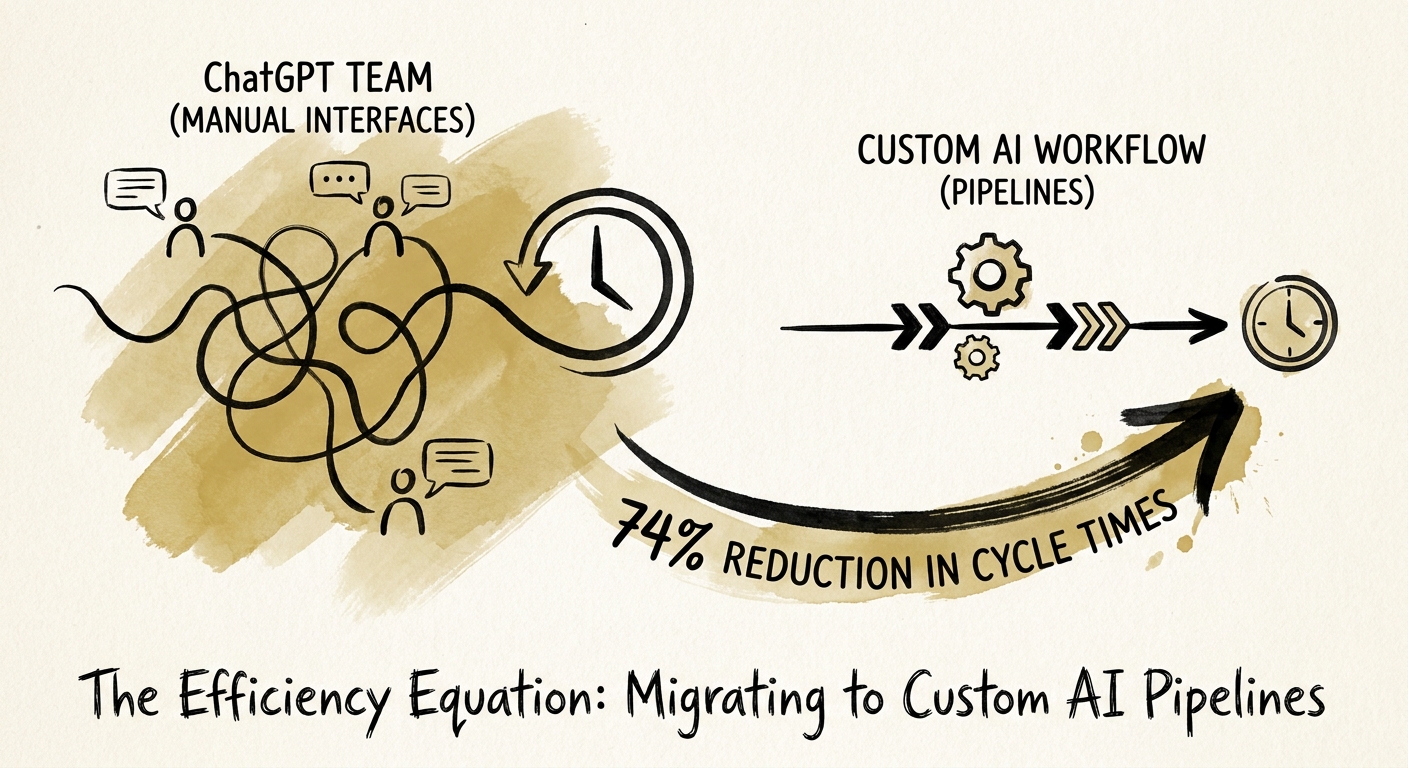
Deloitte's 2026 AI research lands on a test worth borrowing: value shows up when AI becomes part of how production work actually gets done, not when it produces impressive one-off demos. For repurposing, that translates into a single number you can track without a dashboard project — the claim correction rate. How often, in review, does someone catch a stat, customer reference, or product claim that should never have made it into a draft?
Watch four things over your next ten campaigns: how many edit rounds each asset takes, how long claim review actually adds to launch, how often a claim gets pulled or corrected after generation, and how many usable assets you get per approved source. If ChatGPT Business is producing clean variants from approved inputs and your correction rate stays near zero, you have no reason to build anything. Stay light and spend the budget elsewhere. If the correction rate keeps climbing — if every campaign turns up another unapproved number that slipped through — that climbing rate is your business case for a governed workflow. The build pays for itself in the brand cleanups it prevents.
Don't try to govern everything at once. Pick one lane — the webinar-to-campaign flow is a good first target because it's high-volume and rich with off-the-cuff customer claims. Score the manual review work with the workflow automation guide, then use the 90-day implementation plan to test three things on that one lane: claim tagging on your sources, automatic routing to claim owners, and a hard stop on expired or unapproved references. Prove it on webinars before you extend it to decks, blogs, and case studies.
When you write up the decision, keep it short and evidence-bound: we kept repurposing in ChatGPT Business, built a workflow around it, or paused to clean up the message library — because the claim correction rate was X, review added Y days, and we got Z usable assets per source. If you can't fill in those numbers yet, you're not ready to decide. The next move isn't a bigger AI program. It's running one webinar-to-campaign lane, with named claim owners, until the numbers tell you what to do.