The "Acme Corp" Problem
Open your CRM, your billing system, and your ERP at the same time and look up one customer. You will probably find "Acme Corp," "Acme Corporation," "ACME Corp Inc.," and a fourth spelling someone typed during a 2024 import. Three of those have different billing addresses. Two have an active owner. One is flagged delinquent in finance and current in sales. This is what data cleanup actually is in a 50-300 person company: not bad typing, but four systems that each believe they are right.
A model can spot those four rows in seconds. What it cannot do is tell you that billing wins on address, sales wins on owner, and finance wins on payment status. Those are business decisions, and until a human has made them, an AI that "cleans up Acme" is just picking a survivor at random and overwriting the other three. That is the difference between this task and summarizing an email thread: here the output gets written back into the systems that invoice your customers.
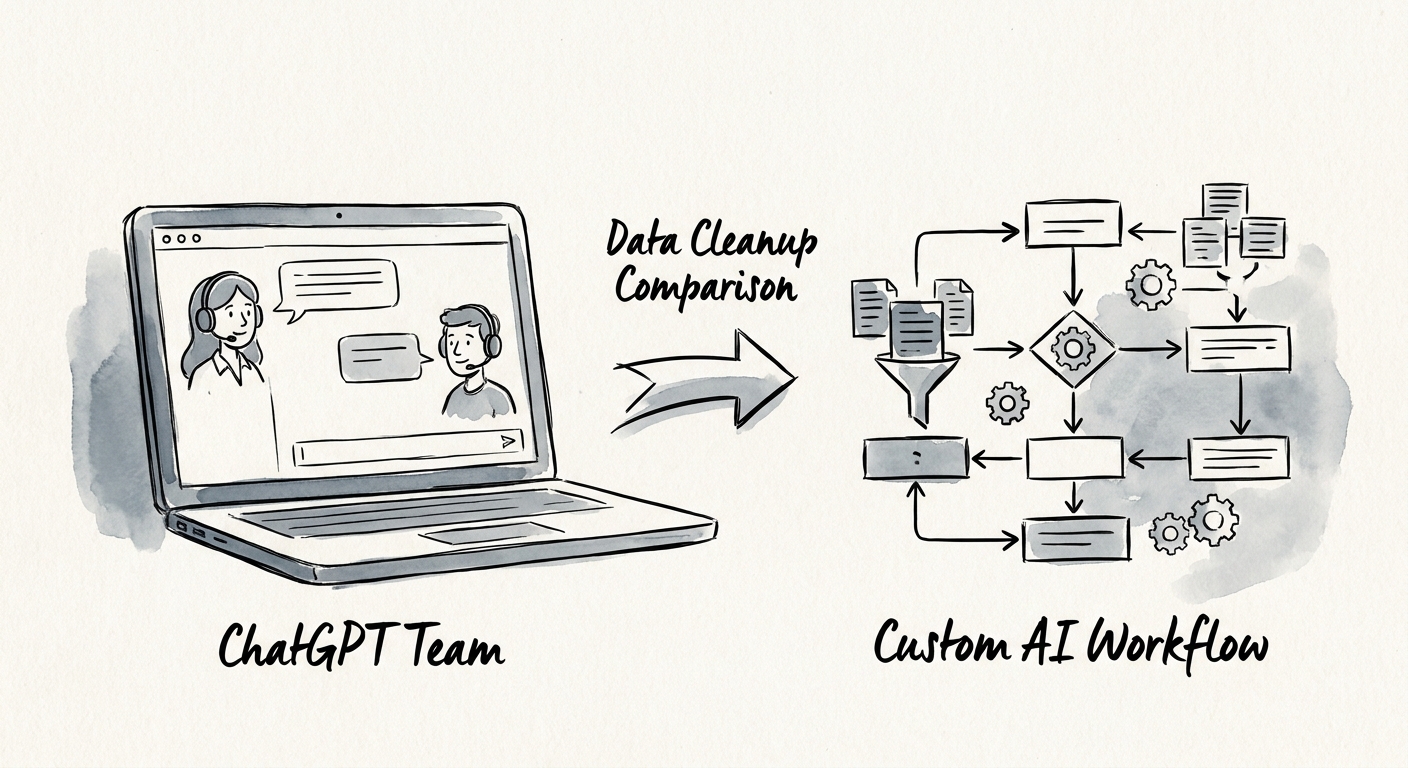
A shared ChatGPT Business workspace is genuinely good at the first half of this — profile an export, cluster the likely duplicates, draft the merge rules in plain English, explain to a skeptical controller why two records are probably the same company. That is diagnostic work, and it is where most teams should start. A custom workflow earns its keep only when those merge decisions repeat weekly and have to flow back into source systems without a person copy-pasting between tabs.
The grounding research is consistent on why this order matters. The RSM middle-market AI survey, the San Francisco Fed analysis of AI and small businesses, and the OECD report on AI adoption by smaller firms all land on the same constraint: adoption stalls not on model quality but on whether someone owns the rules. For cleanup, the rule that has to exist before anything else is the survivorship rule — which system wins which field.
Profiling Reads. Writeback Changes Reality.
Draw the line down the middle of the work. Reading is reversible: profiling an export, ranking duplicate clusters, sampling exception types, narrating to a reviewer why the "Acme" rows belong together. OpenAI's enterprise privacy controls let you do that read work on samples inside ChatGPT Business — emphasis on samples, not a full dump of regulated customer or financial records into a chat window.
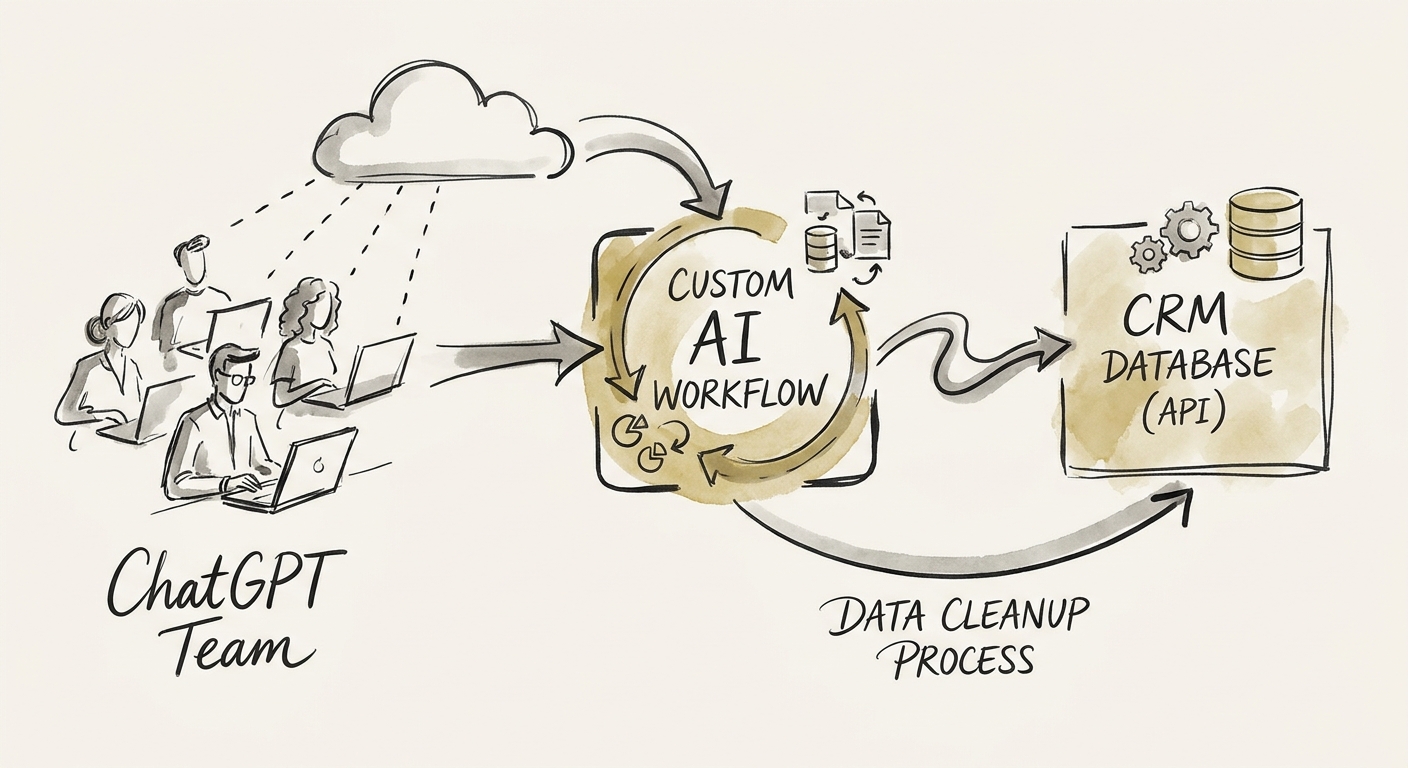
Writing is not reversible by default, and that is where a custom workflow has to live. A sane cleanup pipeline does five things in order: name the source of truth per field, compare the conflicting values, apply the steward-approved survivorship rule, route anything ambiguous to a human, and write back only after approval — while snapshotting the before value so a wrong merge can be undone. If your "AI cleanup" cannot reverse a bad merge, it is not a cleanup tool. It is a way to lose the original Acme records with confidence.
The risk vocabulary here is borrowed straight from the standards. The NIST AI Risk Management Framework names the failure modes precisely — wrong context, bad measurement, weak governance, uncontrolled change — and uncontrolled change is the one that bites data cleanup hardest, because the change lands in the system that runs payroll or billing. CISA's AI data-security guidance tells you where to put the guardrails: access scope, retention, and logging on every record the workflow touches.
So when someone demos a cleanup bot, do not grade it on how well it describes the mess. Ask three questions. Can the source owner challenge a proposed merge before it writes? Is the before-and-after value stored so a manager can audit it next quarter? And can you roll back yesterday's batch in one move? If the answer to any of those is no, you have a profiling toy that happens to have a write button — the most dangerous configuration there is.
Pick One Object Family. Watch the Recurrence Rate.
Do not "clean the data." Pick one object family where duplicates already cost you real rework — accounts, vendors, or products — and instrument it. The build signal is not how many duplicates exist today; it is whether they keep coming back. A one-time export-and-dedupe is a spreadsheet afternoon. A workflow is justified only when the same conflicts regenerate every week from the systems feeding them, which is exactly the recurring, rule-based, reviewable pattern that the Deloitte State of AI report ties to durable operational value.
Track six numbers and let them make the decision for you: duplicate recurrence rate, conflict-resolution cycle time, steward approval rate, rollback volume, writeback error rate, and whether your monthly reporting got more trustworthy. If recurrence stays flat and stewards approve in seconds, you have a candidate worth building. If approval rates are low or rollbacks are frequent, your survivorship rules are not settled yet — and no workflow fixes an unsettled rule, it just enforces a wrong one faster.
Write down the verdict in a sentence anyone can audit later: "Vendor dedupe stays in ChatGPT Business because volume is low," or "Account merges move to a governed workflow because we run 200 a week and stewards trust the rules," or "Product records are paused until finance and ops agree who owns the SKU field." The deciding evidence is recurrence rate, rollback volume, and writeback error rate — not enthusiasm.
If you do not yet have those numbers, that is the Monday task: instrument one object family before automating it. Use the CRM cleanup guide to set source-quality discipline first, and the AI ROI Calculator to put a dollar figure on the review time and rework you are actually trying to kill. Expand only when the owner can say, in plain language, what got faster and what got safer.