The lead that sits in the queue for nine days
Here is the failure that doesn't show up in a demo. A 120-person company runs paid search, webinars, and a content engine. Leads pour into the CRM. An AI assistant writes a clean qualification note on each one: company size, likely budget, a tidy paragraph on fit. The marketing dashboard looks great. Then a rep opens the lead, reads the note, and thinks "I don't know where this came from or whether anyone checked it" and moves to the next one. The lead sits. Speed-to-first-touch quietly degrades from hours to days, and nobody can point to where it broke.
That gap is the whole decision. Lead qualification is not "research a company and summarize it." It is a handoff that one human has to accept from another. The question is never whether ChatGPT Business can write a fluent fit summary, because it can. The question is whether the seller on the receiving end will act on it without re-doing the work, and a chat assistant has no opinion about that.
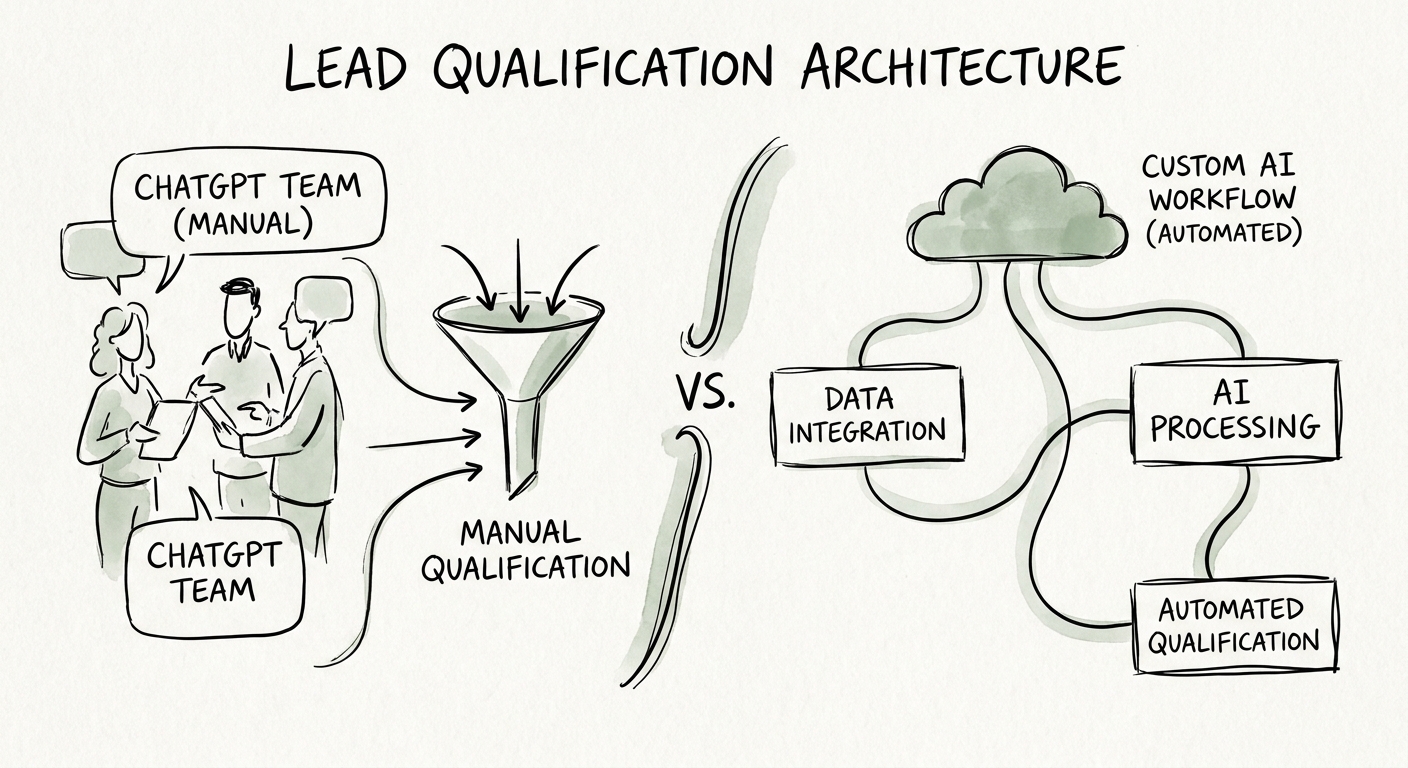
ChatGPT Business is genuinely good at a specific slice: a rep pasting in a company URL before a call, an SDR drafting three discovery questions, a manager spot-reviewing a batch of inbound notes. That is one-off, human-in-the-loop research. OpenAI describes ChatGPT Business as a shared team workspace, which is exactly what that slice needs and exactly what it isn't built to do automatically: pull the campaign source, check whether the enrichment is two days or two years old, apply your fit rules, and route to the right owner.
The adoption data is blunt about why this matters at your size. The RSM middle-market AI survey, San Francisco Fed research on AI and small businesses, and the OECD report on AI adoption among smaller enterprises all point at the same wall: the tool that nobody trusts gets ignored, no matter how good its output reads. For qualification, "trust" is concrete. It means the seller can see why this lead reached them and what they're supposed to do next.
What the note can't carry, and the workflow has to
Write down what actually has to travel with a qualified lead in a company your size, and the build-vs-buy line draws itself. A real qualification carries: the campaign that produced the lead, the form data the prospect submitted, a timestamp on when the enrichment was last refreshed, the fit rules that say target-account or not, any disqualifying signal (competitor, student, wrong region), the owner it routes to, and a reason code the rep can argue with later. ChatGPT Business can describe a company. It cannot hold that chain together or change the CRM record when the answer comes back.
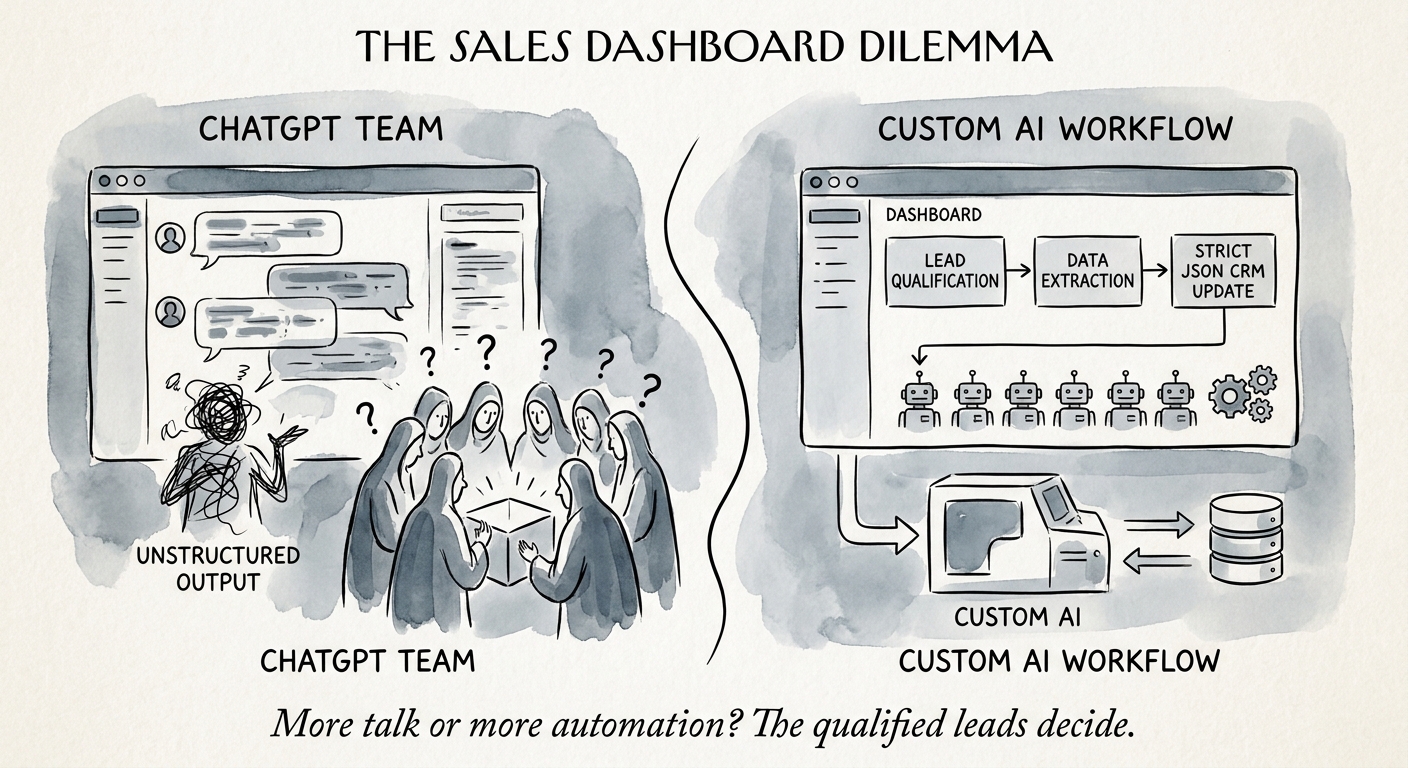
So a custom workflow isn't "the same thing but fancier." It does the parts the note can't: it reads the form source and campaign, flags enrichment that's gone stale, applies your disqualifiers, assigns an owner, stamps a reason code, and — the part that earns its keep — routes the genuinely uncertain ones to a human instead of guessing confidently. When a seller disputes a "qualified" tag, the record shows what evidence drove it.
Two things become non-optional once prospect data starts flowing through an automated pipe rather than a one-off chat. The NIST AI Risk Management Framework gives sales and marketing leaders a way to write down intended use, how you'll measure it, and who's accountable when a lead gets mis-routed. And CISA's AI data-security guidance matters the moment prospect, customer, or partner account data moves through the system — the workflow should expose source evidence to the reviewer while keeping unnecessary data out of the model's path. OpenAI's enterprise privacy material belongs in that same data-boundary review: it tells you what's reasonable to paste into a chat workspace versus what stays locked in the CRM and enrichment systems.
The control layer that makes a qualification workflow safe is short and specific: reason codes, a stale-enrichment flag, a routing SLA, a sales-acceptance signal back from the rep, and a recycle path for "not now." That list also settles the data argument — it draws the line between what a rep can drop into ChatGPT Business for color and what the automated workflow is allowed to touch.
Score it on the rep's behavior, not the note's prose
The trap is grading qualification on how good the AI's writing is. The only honest scoreboard is what the seller does next. Deloitte's 2026 State of AI research keeps hammering the same point: value shows up in production adoption, not pilot polish. For lead qualification, production value is measurable in five things — speed to first touch, sales acceptance rate, rework, accepted-to-opportunity conversion, and how often enrichment was stale when the lead was scored.
So here's the Monday move. Pick one inbound lane — say, webinar registrants or paid-search demo requests — and instrument it. For one month, track those five numbers with whatever you have today. If your reps are happily acting on chat-assisted notes and the bottleneck is just research speed, keep it in ChatGPT Business and stop there; you don't need a build. If leads are sitting because reps don't trust the source, or enrichment is silently stale, or routing depends on someone's memory of who owns which territory — that's the signal to build the workflow, because the value lives in the routing and the CRM state change, not the prose.
To wire that one lane to pipeline instead of novelty, the lead-qualification knowledge-management guide covers how to keep fit rules and source evidence in one place, and the CRM cleanup ROI guide shows how to tie the change to pipeline velocity you can defend in a forecast review.
Then write the one-paragraph decision: we kept qualification in ChatGPT Business, built a custom workflow, or paused to clean up the source data — and here is the speed-to-first-touch and accepted-to-opportunity number that decided it. Expand to a second lane only when the owner can say, in plain terms, what got faster and which leads stopped falling through. Without that, a broader rollout just scales the nine-day queue.