The 4,000 duplicate accounts are the symptom, not the disease
Say you run revenue operations at a 120-person company. You export the CRM and find 4,000 duplicate account records, a few hundred deals with no owner, and a "Lead Source" field that's blank on a third of everything closed last quarter. The instinct is to throw it at AI and let it merge. Resist that instinct for about ten minutes, because CRM cleanup isn't a data problem. It's a question of who gets credit, who gets the renewal, and whether your sales managers will still believe the pipeline number after the dust settles.
This is what makes CRM cleanup different from cleaning a spreadsheet of expense codes. Every duplicate you merge collapses two histories into one. Every owner you reassign moves a commission. Every lifecycle stage you "correct" changes a forecast a manager already committed to. ChatGPT Business can read your export, spot the duplicate clusters, and draft a merge rule in minutes — but it has no idea that merging "Acme Corp" and "ACME Corporation" hands a closed-won deal from one rep to another, and that the losing rep will quietly stop trusting the system that did it.
The pressure to use AI here is real and well documented. RSM's middle-market AI survey, the San Francisco Fed, and the OECD's work on AI adoption by smaller firms all describe the same squeeze: companies your size are expected to make AI pay off without hiring an ops army to babysit it. CRM cleanup looks like the perfect first win — high volume, obvious mess, clear before-and-after. It is, as long as you separate the part AI is genuinely good at from the part that touches money.
Two jobs that feel like one: finding the mess vs. changing the record
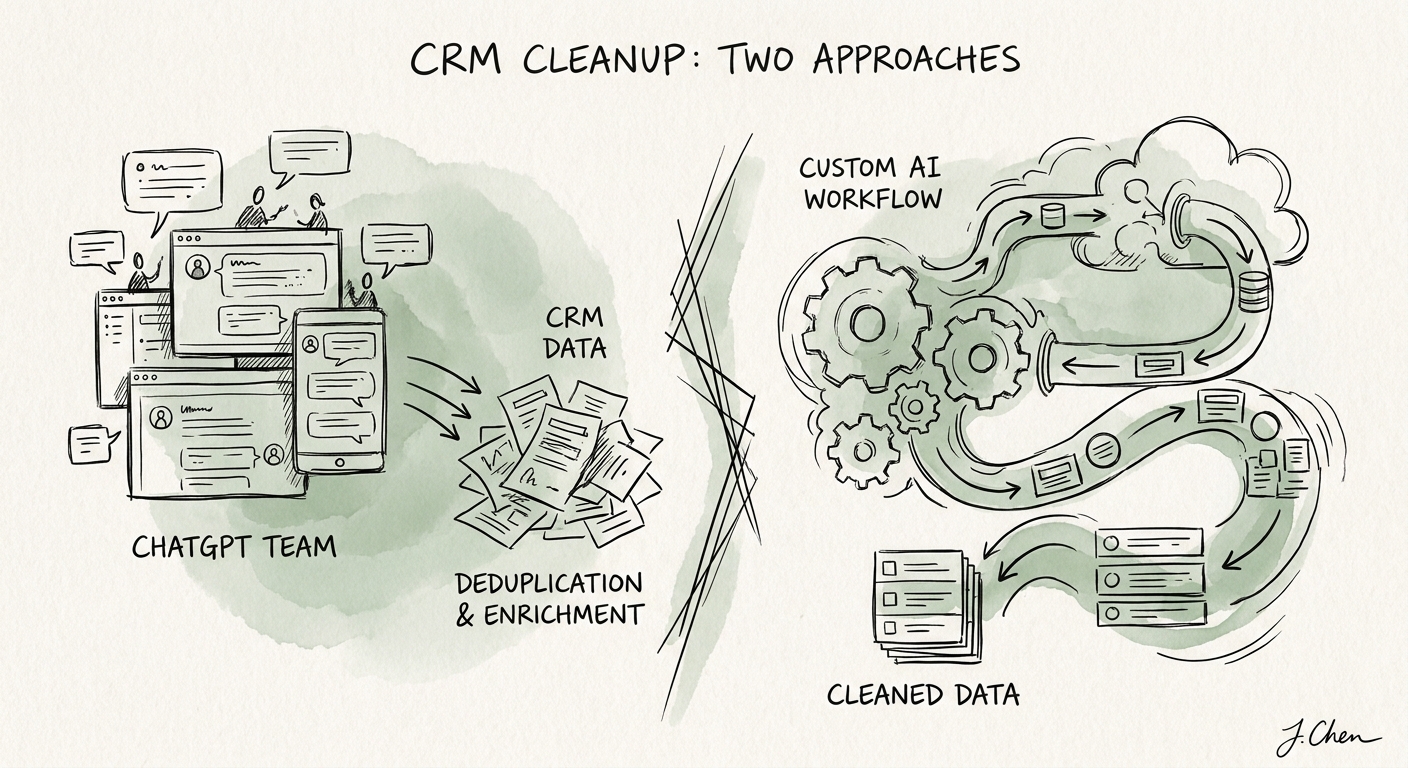
The cleanest way to scope this is to split CRM cleanup into two jobs that everyone treats as one.
Job one is detection and proposal: profile the export, cluster the duplicates, flag the orphaned deals, draft the dedupe logic, write the "if blank, infer from email domain" rule for Lead Source. This is reading and reasoning over data you exported. ChatGPT Business is good at it, and within the workspace controls described in OpenAI's enterprise privacy guidance, it's a defensible place to do it on a sample. Drop in 500 account rows, ask it to find the merge candidates and explain its confidence on each, and you'll have a working ruleset by lunch. Nothing has changed in the CRM yet, so nothing has broken.
Job two is the writeback: actually merging the records, reassigning the owner, stamping the corrected stage, pushing it through the API. This is where a chat tool is the wrong instrument — not because the model is dumb, but because the failure mode isn't a hallucination. It's a confidently-wrong operating decision that corrupts the forecast and gets discovered three weeks later. NIST's AI Risk Management Framework is useful precisely because it pushes you to govern the decision, not just the output. And since you're moving real customer and prospect data, CISA's data-security guidance should shape what gets exported, what gets retained, and who can see it.
So the architecture question answers itself: keep job one in ChatGPT Business; build job two as a controlled workflow only when the writebacks recur often enough to justify it. A real cleanup workflow needs a field-level validation gate, a confidence threshold below which the AI proposes but never writes, owner-conflict routing (when a merge would move a deal across reps, it goes to a human before it goes to the API), a safe writeback step, and a rollback log that lets a manager ask "what changed Acme last Tuesday?" and get an answer. Score the build on that control layer — not on how clever the merge suggestions read.
The metric that tells you which one you actually need
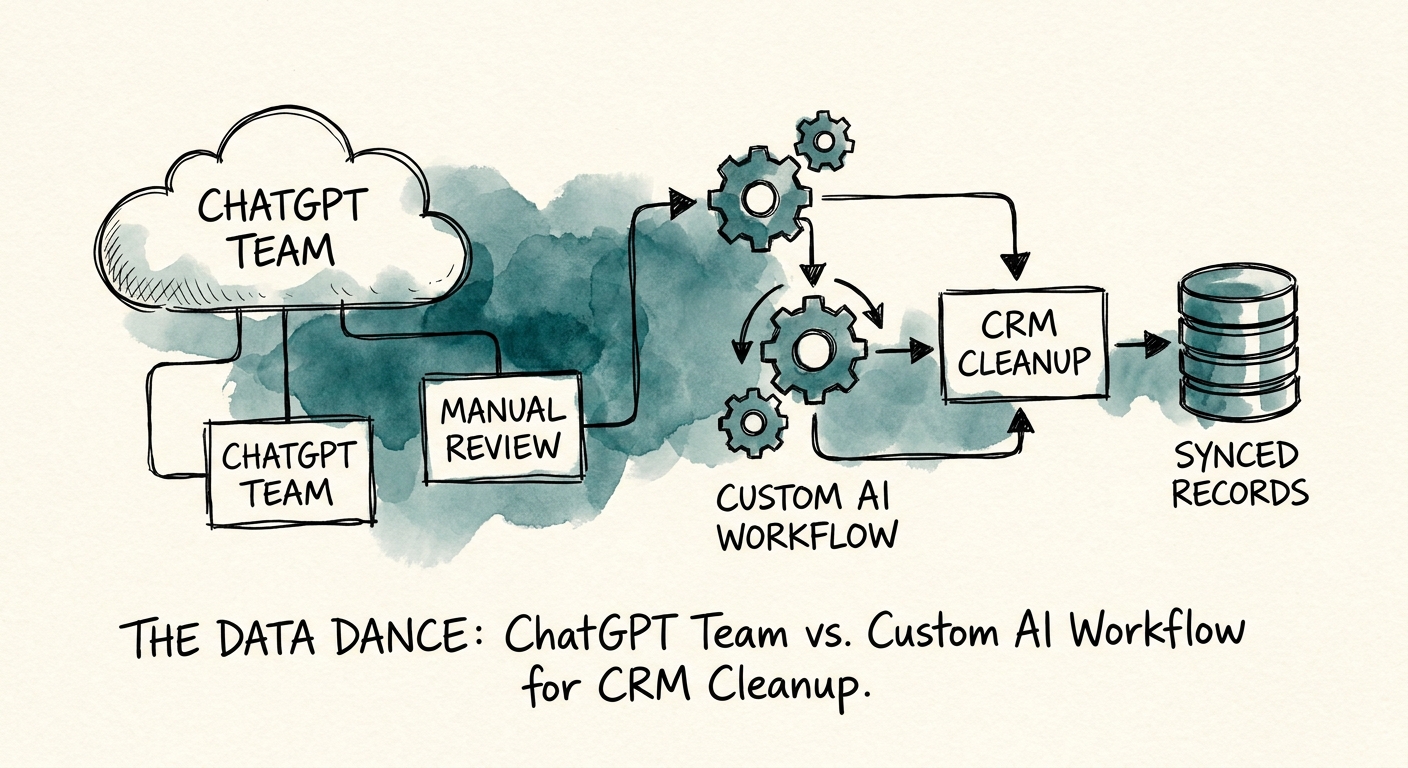
Here's the test that settles the build-vs-buy argument better than any vendor demo: track duplicate recurrence, not duplicate count. Anyone can run a one-time merge and report "we cleaned 4,000 dupes." The question is whether 600 new ones reappear next month because the intake forms and the enrichment tool still create them. If the mess regenerates, you don't have a cleanup project — you have a continuous process, and a continuous process is what justifies building the governed workflow with API writes and rollback. If it was a one-time pile from a migration, a ChatGPT Business analysis session plus a careful manual merge sprint is the cheaper, smarter answer.
Alongside recurrence, watch owner-conflict volume (how often a proposed merge crosses reps), field-error recurrence, and the one that matters most — whether your sales managers act on the cleaned pipeline without re-checking it by hand. Deloitte's State of AI in the Enterprise 2026 keeps pulling the conversation back to production adoption for a reason: a cleanup that managers don't trust isn't in production, no matter how good the dedupe logic is.
Start narrow on Monday. Pick one object and one field family — say, just duplicate Accounts, or just the orphaned-owner deals — and run the detection pass in ChatGPT Business this week. Use the AI Opportunity Score to confirm the pain is big enough to formalize, and the AI ROI Calculator to weigh review time and forecast-quality lift against the cost of building the writeback layer. Then write down, in two sentences, why you kept it in chat, built the workflow, or paused to fix the intake forms first. That sentence — backed by your recurrence number and your managers' acceptance — is the difference between a cleaner CRM and a more expensive mess.