The new hire shows up Monday with no laptop
Here is the failure mode every operations lead knows. A new account manager starts on the first of the month. The offer letter went out, HR built a beautiful onboarding checklist in a shared doc, and ChatGPT Business even helped tailor it to the role. Then Monday arrives and there is no laptop, the CRM seat was never requested, and the security training nobody assigned is now blocking the VPN. The checklist was perfect. Nothing on it actually fired.
That gap is the whole question for a 50-300 person company. ChatGPT Business is genuinely good at the writing part: turning a generic template into a role-specific checklist for a field tech versus a controller, summarizing a manager's free-text notes into clean tasks, drafting a "first 90 days" plan a hiring manager can edit. RSM's middle-market survey, the San Francisco Fed's work on small businesses, and the OECD's review of SME adoption all point the same direction: the early wins are drafting and summarizing, not orchestration.
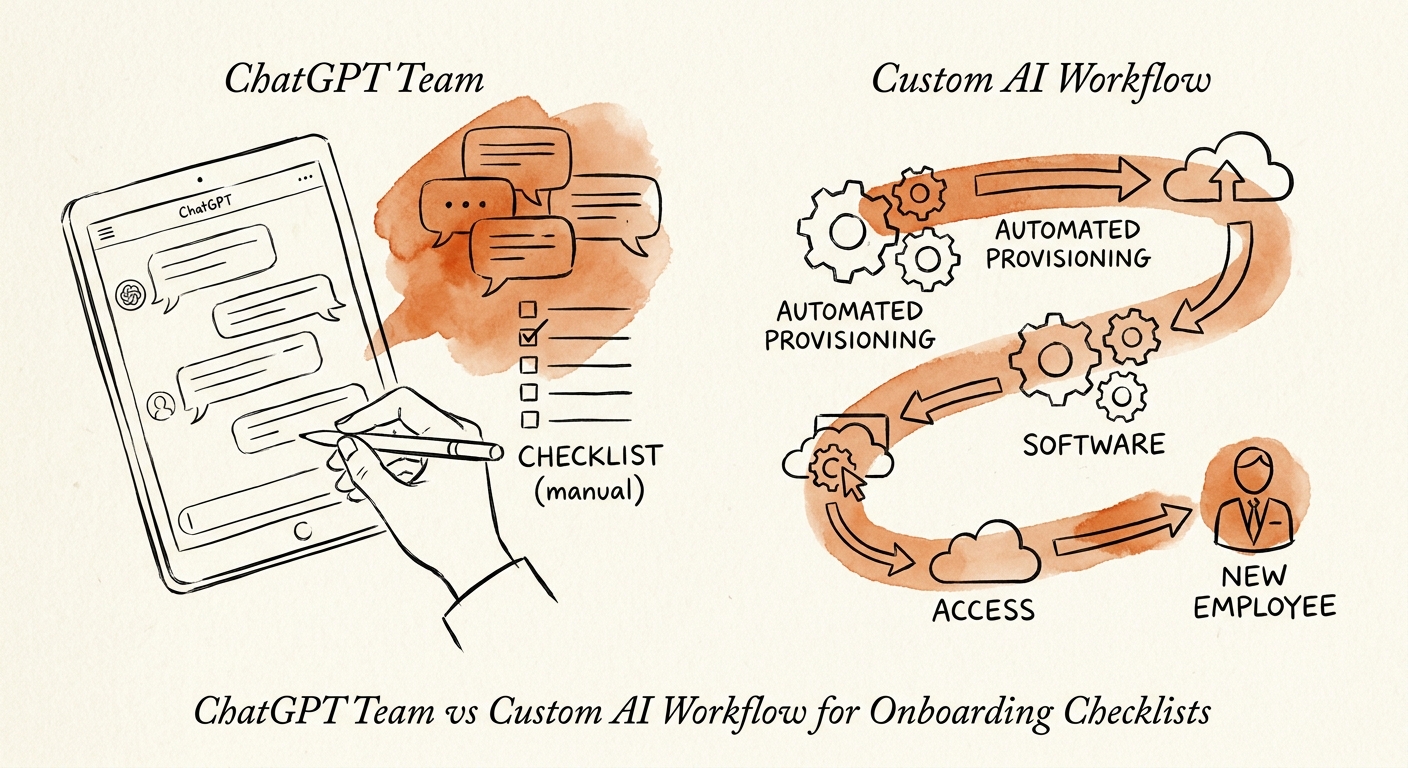
What a chat tool cannot do is make checklist completion mean something. It cannot open a ticket to IT to image a laptop, hold the start date open until background-check evidence is attached, or page the hiring manager when day-three training is overdue. Onboarding is unusual among document types because it has a hard deadline somebody else picked — the start date — and a chain of dependencies where each missed step pushes the next. A misworded sentence costs nothing. A missed access gate costs a person sitting idle on payroll.
Pick the track first, because the gates are not the same
"Onboarding checklist" hides at least three different machines, and the build-vs-buy answer differs for each. Decide which one you are automating before you touch a tool.
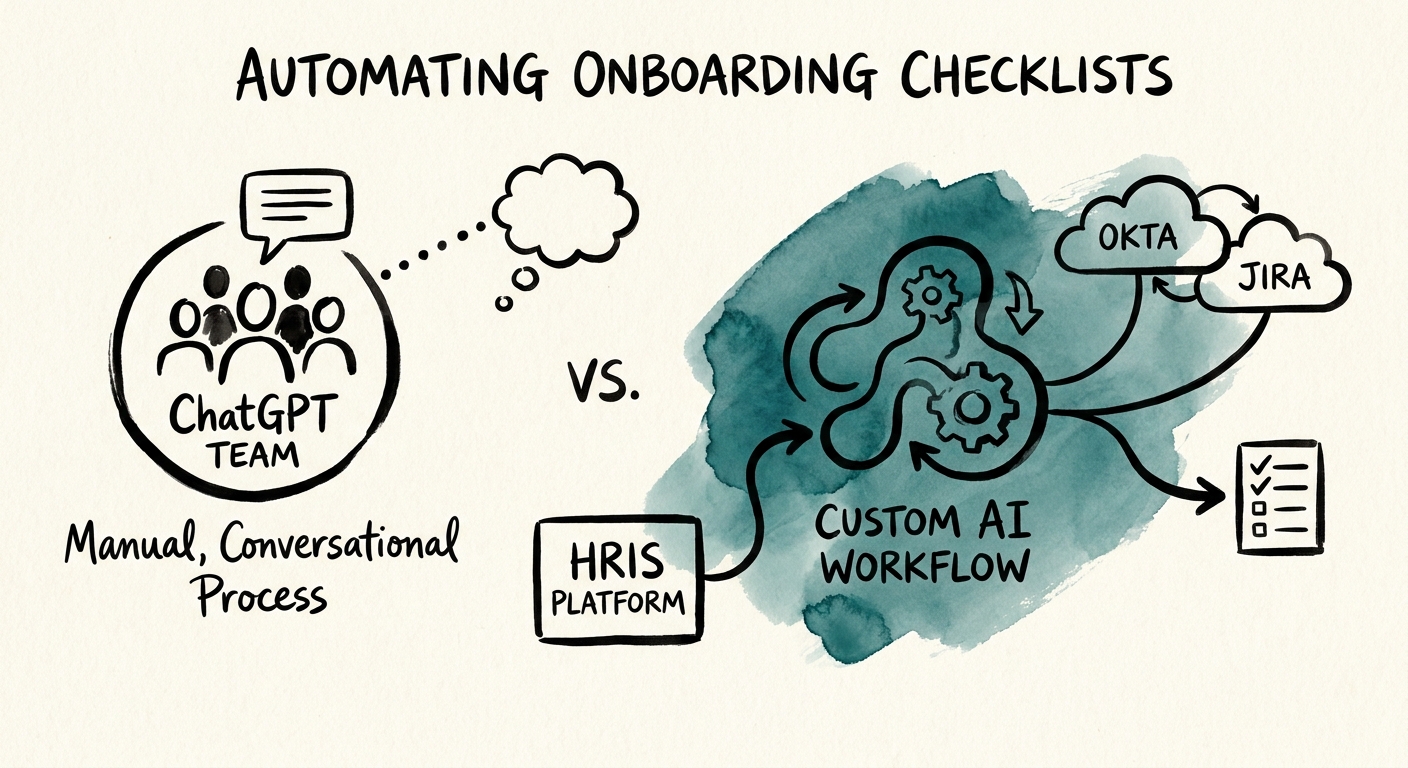
Employee onboarding lives across your HRIS, IT provisioning, payroll, and the LMS. The gates that matter are evidence gates: signed forms, background-check clearance, equipment delivered, accounts provisioned, mandatory training completed before access is granted. Customer onboarding lives in the CRM and your project tooling. The gates are dependency gates: kickoff held, integration credentials received from the customer, data migrated, first-value milestone hit, go-live signed off. Implementation go-live is the same shape but the slippage is yours to own publicly. Mixing these into one "AI onboarding assistant" is how you end up with a tool that writes about all three and enforces none.
For the employee track specifically, the line is clean. Keep it in ChatGPT Business when the work is producing the checklist — variants by role, a manager-reviewed plan, a tidy summary of what a new hire asked in week one. Move to a custom workflow the moment a checked box is supposed to trigger something: a provisioning ticket, a training assignment, a hold on the start date, an escalation when a gate goes overdue. The NIST AI Risk Management Framework is a useful lens here for naming intended use and who is accountable for each gate. And the data side is not optional: onboarding records carry SSNs, comp, customer credentials, and integration secrets, which is exactly what CISA's AI data-security guidance and OpenAI's enterprise privacy controls are about. The drafting can happen in ChatGPT Business; the social-security number does not belong in a chat thread.
Let your overdue gates tell you how much to build
You do not need a strategy offsite to size this. Pull last quarter's hires and count: how many started without a laptop or a working account, how many had a mandatory training still incomplete on day one, how many start dates slipped, how many manager corrections HR had to chase. On the customer side, count go-lives that slipped because a dependency aged out unnoticed. Deloitte's 2026 research keeps landing on the same point: the value shows up when the AI is wired into where work completes, not where it gets drafted. Onboarding gives you that number for free, because every missed gate has a name and a date attached.
If those counts are near zero, your checklists are fine — keep using ChatGPT Business to write them faster and move on. If they are ugly, build one workflow for one track. Wire a single chain end to end: checklist item, the system that has to act, the evidence required to close it, the owner, the overdue alarm. Resist the urge to automate employee, customer, and implementation onboarding at once. Prove the employee track holds a start date for a month before you go near customer go-live.
Write down the decision and the reason: kept in ChatGPT Business because the only pain was wording, built as a workflow because gates were silently slipping, or paused because the source templates were a mess that no automation would fix. When the first track works, expand only when the owner can say in plain numbers what improved — fewer day-one idle hires, fewer access delays, fewer slipped go-lives. If you want a structure for that first build, the onboarding-checklist automation guide and the 90-day implementation plan both start with ownership, evidence, and escalation rather than with the model.