The recap that invented a discount
Picture a renewal call. The account manager says, "We can probably look at something on price if you commit to two years." The customer says, "Interesting, send me what that looks like." The AI summary lands in the shared inbox an hour later: "Agreed to a multi-year discount; AM to send revised pricing." Nobody agreed to anything. But now it's written down, it's in the follow-up email draft, and three people downstream treat it as fact.
That is the exact seam where meeting summary follow-up stops being a note-taking convenience and becomes an operational handoff. A clean transcript summary is genuinely one of the best uses of a general assistant — humans already skim notes and rewrite next steps. The trouble starts the moment a summary line turns into a customer commitment, a pricing promise, a project dependency, or an owner assignment that someone acts on without re-checking the source.
For 50-300 employee companies, the adoption pressure is real. RSM's middle-market survey, San Francisco Fed research on AI and small businesses, and the OECD's work on AI adoption among smaller firms all point the same direction: smaller companies want something practical, fast. For meeting follow-up, practical does not mean prettier notes. It means fewer dropped commitments and faster next steps — without pretending a transcript is always accurate or that an enthusiastic "interesting" is a yes.
The test: can a summary touch a system of record by itself?
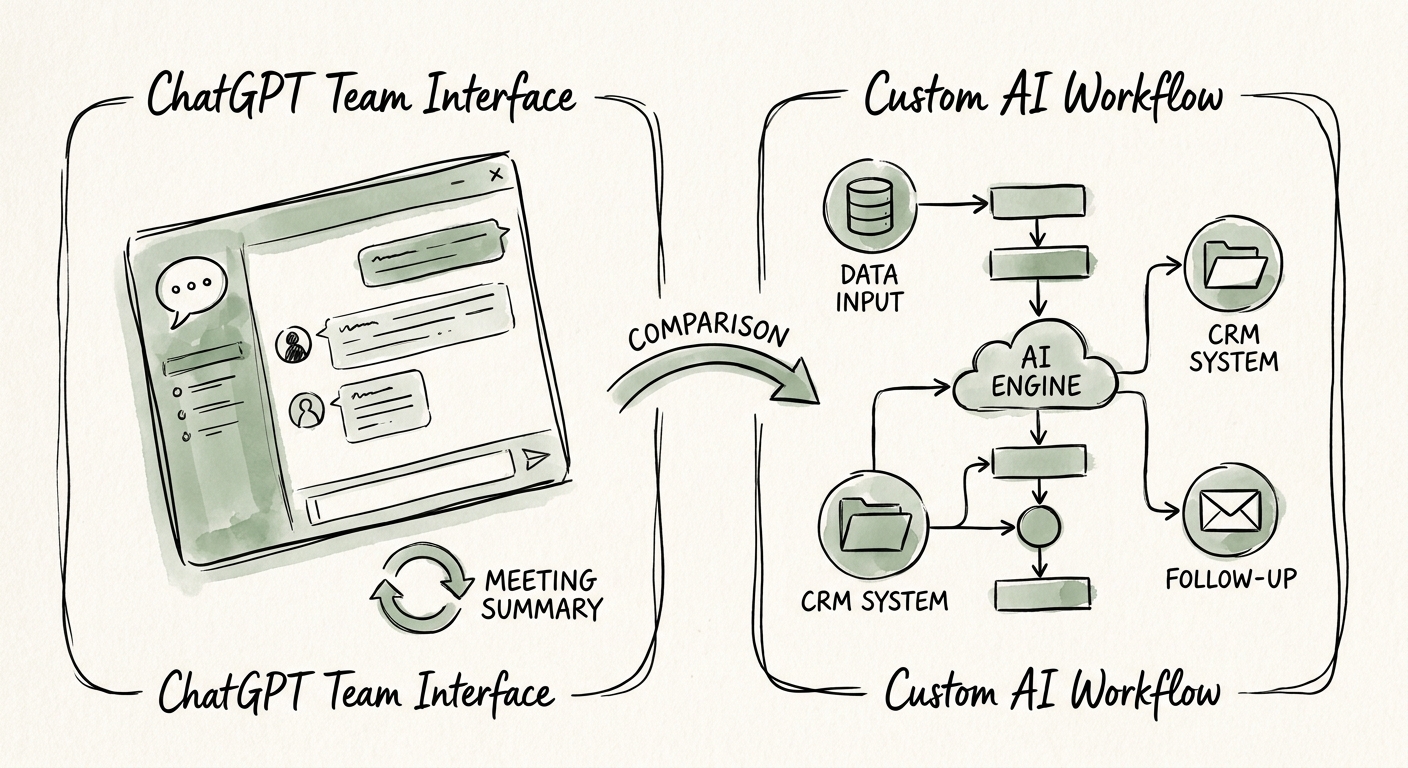
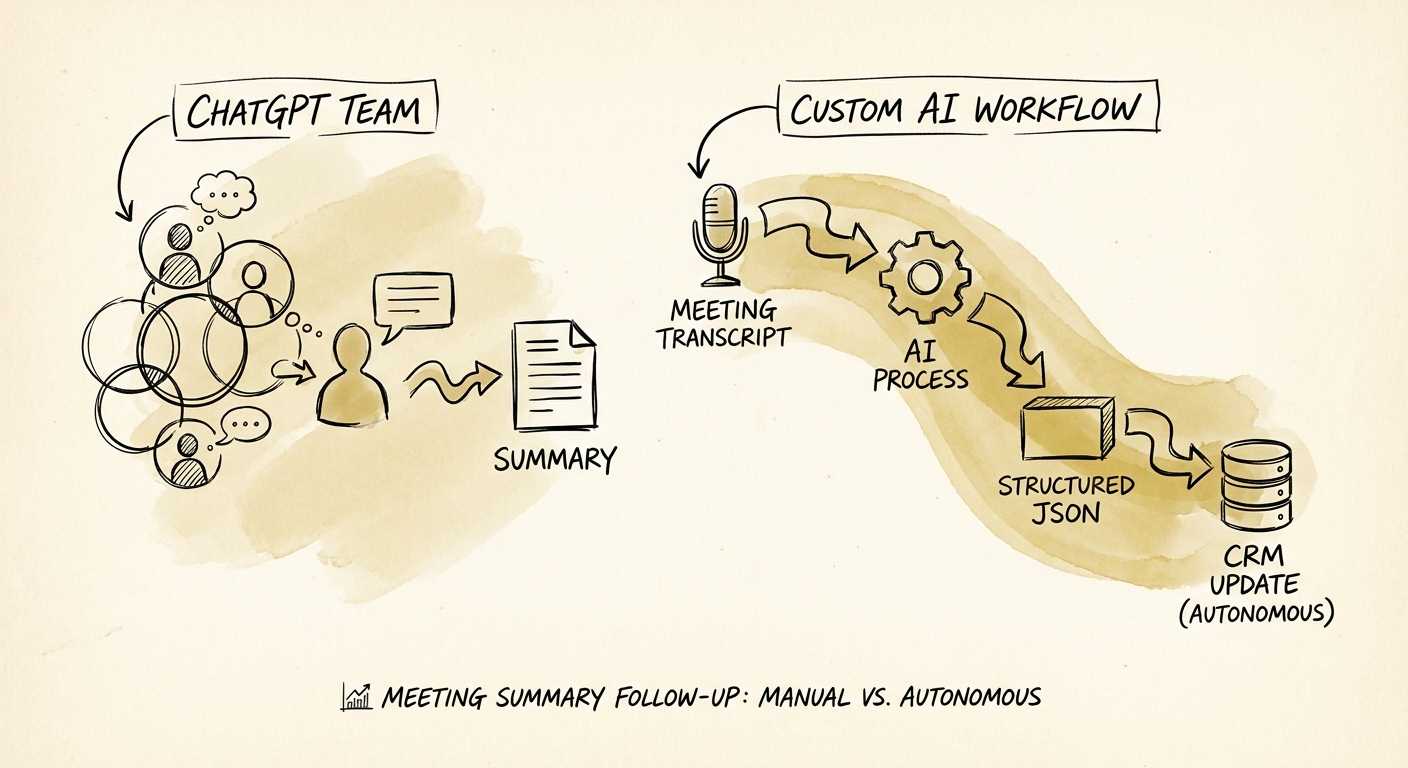
Here is the line that decides which tool you need. If the meeting summary's job ends when a human reads it and decides what to do, ChatGPT Business in a shared workspace is plenty — drafting, action-item extraction, prep notes, a tidy recap email a person sends. But the moment a summary is supposed to update a CRM field, create a task with an owner, flag a renewal at risk, or log a commitment that finance or delivery will rely on, you've crossed into territory a chat window was never built to police.
A custom follow-up workflow does the unglamorous part a general assistant skips. It keeps the transcript source attached to every extracted item. It separates a suggestion ("we should probably loop in their security team") from an agreed action ("they will send the security questionnaire by Friday"). It assigns an owner, writes the task, updates the field — and when a statement is ambiguous, it routes the line to a human instead of guessing. The non-negotiable rule: it never manufactures a commitment because the sentence reads like one.
Two pieces of guidance map cleanly onto this. The NIST AI Risk Management Framework gives you the vocabulary for context, accountability, and monitoring — who owns the output, who can challenge it, how you'd catch a bad extraction. And CISA's AI data-security guidance matters more here than on most workflows, because a meeting transcript is a grab bag of customer, pricing, employee, and confidential project content all in one file. Before any of that flows into a workspace, decide recording consent, retention, and which conversations are simply too sensitive to summarize at scale — OpenAI's enterprise privacy controls are part of that conversation, not the whole of it.
The practical control layer for meeting follow-up is short and specific: commitment extraction with source attached, owner assignment, an ambiguity-review path, the system update, and a record of what got escalated. If you can't draw that on a whiteboard for one meeting type, you're not ready to wire it to your CRM.
Score it on commitments closed, not summaries written
The most common mistake is grading meeting-summary AI on how good the notes read. Notes are an input. Deloitte's State of AI in the Enterprise 2026 is most useful exactly where it pushes past pilots toward production value — and for this workflow, value is measurable: action items captured, owners actually assigned, follow-ups completed, CRM fields updated correctly, customer-response time, and how often a human reviewer had to correct an extraction. That last number is the honest one. If reviewers are constantly fixing invented or misattributed commitments, the workflow is creating risk, not removing it.
Run this on one recurring meeting type, not your whole calendar. Renewal calls and implementation standups are the sharpest place to start, because both produce commitments with real downstream consequences and a clear owner who'll notice if something's wrong. The scheduling-coordination ROI guide and the 90-day implementation plan walk through how to test source handling, task routing, and completion before you commit budget.
Then write down the decision and why: kept in ChatGPT Business because a person reviews and acts; built as a custom workflow because summaries now drive system updates; or paused because the inputs aren't clean enough yet. The deciding evidence is follow-up completion, CRM accuracy, and reviewer corrections — three numbers, not a vibe. Expand to a second meeting type only when the owner can explain what got faster, what got more reliable, and where the human still has to look. That discipline keeps the program tied to commitments that actually closed, not a folder of impressive recaps nobody acted on. When you're ready to map which workflows are worth building versus buying, build the AI roadmap around that same evidence.