
The practical answer
- Short answer
- A diagnostic framework for PE buyers to quantify contingent liabilities in tech M&A. Covers AI indemnity, escrow benchmarks, and the 2026 shift in risk allocation.
- Best fit
- Industry: Private Equity / Technology M&A. Function: Due Diligence
- Operating path
- Exit Readiness → Operational Excellence → Transaction Advisory Services
- Key metric
- 3 Technical liability areas to diligence: AI provenance, open-source licensing, and data/privacy exposure.
The New 'Silent Killers' of Deal Value in 2026
In the high-velocity tech M&A market of 2026, the definition of 'liability' has shifted. While traditional due diligence focuses on pending litigation or tax nexus issues, the real valuation risks are now embedded in the code and data itself. Clean assets can command stronger terms, while those with unquantified contingent liabilities face re-trades, escrows, or specific indemnities.
A significant emerging risk is AI-Generated Intellectual Property (IP) Contamination. With 87% of cybersecurity leaders identifying AI vulnerabilities as their fastest-growing risk, acquirers are now facing codebases where ownership and training-data rights may be legally ambiguous. If a target's core product relies on AI-generated code or training data without clear policies, the IP valuation may become contingent on remediation, representations, and counsel review.
Furthermore, open-source risk has evolved. It is no longer just about GPL violations; it is about security debt disguised as technical debt. Unpatched vulnerabilities in open-source dependencies are operational and legal risk. In 2026, an undisclosed data breach can become a valuation event that triggers indemnity demands or Material Adverse Effect clauses.
In 2026, you are not just buying code; you are underwriting provenance, licensing, and data risk. If you cannot quantify those exposures, you cannot price the asset cleanly.
The Diagnostic: Quantifying the 'Indemnity Gap'
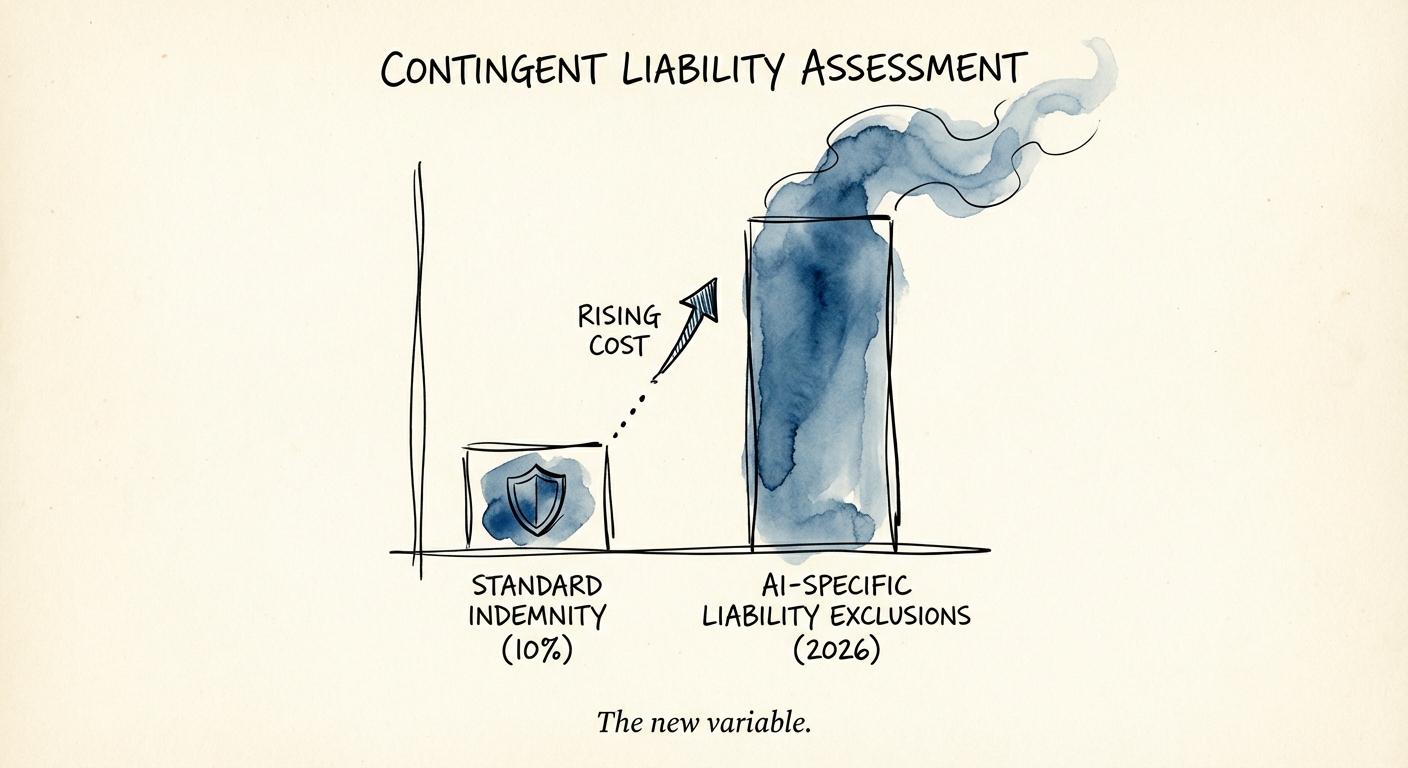
Quantifying contingent liability requires moving beyond the balance sheet to a risk-adjusted valuation model. The primary mechanism for managing this risk remains the indemnification cap, which for lower middle-market tech deals ($10M–$50M) has stabilized at 10% to 20% of the purchase price. However, the structure of these caps is where deals are won or lost.
The 'Basket' vs. The 'Cap'
Smart acquirers are tightening the 'Basket'—the threshold of losses that must be reached before the seller is liable. Current data indicates a market standard basket of 0.5% to 1% of transaction value. If you are a buyer, pushing for a 'tipping basket' (where you recover the first dollar once the threshold is met) rather than a 'deductible' (where you only recover the excess) is a critical lever for covering frequent, low-severity tech liabilities like minor license non-compliance.
The RWI Reality Check
While Representations and Warranty Insurance (RWI) has become ubiquitous, 2026 has seen insurers aggressively excluding AI-specific risks. Policy exclusions for 'data provenance,' 'model performance,' and 'AI hallucination' are becoming standard. This creates an 'Indemnity Gap'—risks that are insured by neither the seller (due to caps) nor the insurer (due to exclusions). To bridge this, buyers must demand specific indemnities—separate from the general cap—for identified high-risk technical areas.
Strategic Mitigation: The 2026 Playbook
To protect deal value, Portfolio Operating Partners must execute a rigorous technical and legal pre-close assessment. This goes beyond the standard Quality of Earnings (QofE) report.
1. The 'Code Provenance' Audit
Demand a line-by-line attribution of the codebase. Use automated scanning tools and engineering interviews to identify AI-generated code, open-source components, and unclear ownership history. If a meaningful portion of core IP lacks clear provenance, require remediation, a specific indemnity, or a targeted escrow.
2. Structuring the Escrow
With nearly 90% of private-target deals now including an escrow, the standard holdback is your primary defense. For tech deals with high IP risk, push for a special indemnity escrow of 5-10% specifically tied to IP and privacy representations, with a survival period extending to 24 months (double the median 12-month standard) to allow for the discovery of 'sleeping' liabilities.
3. The 'Data Room' Interrogation
Do not accept generic disclosures. Ask: 'What is your documented policy for AI tool usage by engineering teams?' and 'List all open-source libraries with copyleft or network-copyleft license characteristics.' If these answers are vague, you are buying unquantified risk. Negotiate your indemnity caps accordingly and consider walking away if the technical debt assessment reveals systemic negligence.