The practical answer
- Short answer
- Transform your Palo Alto Networks practice from a firewall reseller to a high-margin MSSP. Learn the unit economics, service architecture, and valuation drivers of a Cortex-led security practice.
- Best fit
- Industry: Cybersecurity / IT Services. Function: Revenue Architecture
- Operating path
- Revenue Architecture → Commercial Performance → Office of the CFO
- Key metric
- 45% Target Gross Margin for a mature Palo Alto Networks MSSP practice, driven by Cortex XSOAR automation.
The Valuation Gap: Why Resale is a Dead End
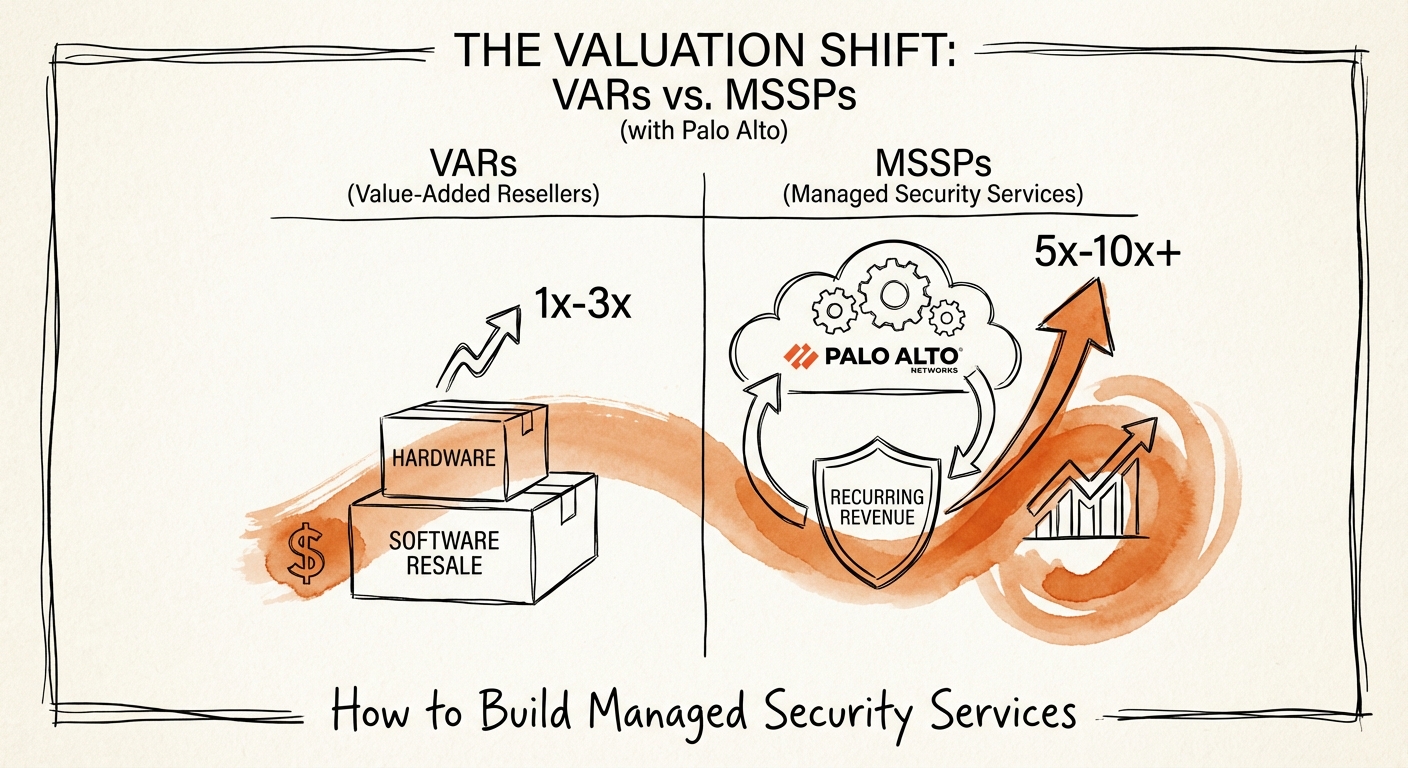
For two decades, the Palo Alto Networks partner ecosystem was defined by the firewall. The business model was simple: sell the hardware (CAPEX), attach a support contract (OpEx), and move on. In 2026, this "box mover" model is a valuation trap. Private equity firms and strategic acquirers have bifurcated the market: traditional Value-Added Resellers (VARs) trade at 4x to 6x EBITDA, while specialized Managed Security Service Providers (MSSPs) command 12x to 15x EBITDA.
The math behind this gap is brutal. Resale margins have compressed to 10-15%, forcing VARs to rely on volume to cover overhead. In contrast, a well-architected MSSP practice targeting 45%+ gross margins builds compounding enterprise value through recurring revenue. The market no longer rewards partners for shipping Strata firewalls; it rewards partners for managing the risk associated with the traffic flowing through them.
This shift isn't just financial; it's existential. As Palo Alto Networks aggressively pushes "platformization"—consolidating point solutions into Strata, Prisma, and Cortex—the partner's role must evolve from fulfillment to operation. The partners who fail to make this pivot will find themselves competing with broadline distributors for single-digit margins, while those who build proprietary managed services on top of the stack will own the customer relationship and the premium valuation that comes with it. For a deeper dive on how security specialization drives multiples, see our analysis on The SecOps Specialist Premium.
The market has stopped paying for 'effort' in cybersecurity. It now only pays for 'outcomes.' If your service report says 'we escalated 500 tickets,' you're a cost center. If it says 'we neutralized 50 threats while you slept,' you're a strategic asset.
Service Architecture: Beyond 'Monitor Only'
The most common failure mode for aspiring MSSPs is building a "Monitor Only" service. This model—often essentially a glorified email forwarding service that passes raw alerts to the client—creates noise, not value. To command premium pricing and retention, your service architecture must be built on Managed Detection and Response (MDR) and Secure Access Service Edge (SASE) management.
In the Palo Alto ecosystem, this means shifting the center of gravity from the firewall to the Cortex and Prisma portfolios. A modern MSSP offering should be structured around three pillars:
- Cortex XDR Management: Do not just sell the licenses. Your service wrap must include 24/7 threat hunting, alert triage, and remediation. You are selling the outcome of "clean endpoints," not the tool.
- Managed Prisma SASE: As hybrid work becomes permanent, the perimeter has dissolved. Managing Prisma Access and SD-WAN allows you to own the connectivity layer, making your service sticky and critical to the client's daily operations.
- Automation via Cortex XSOAR: This is your internal margin defense. Without orchestration and automation, your labor costs will scale linearly with revenue, destroying your unit economics.
Partners who achieve the NextWave MSSP Innovator status are effectively signaling that they have crossed this chasm. They aren't just logging tickets; they are remediating threats. This distinction is what allows specialized firms to trade at premiums similar to those seen in The Azure Security Premium analysis.
The Unit Economics of the SOC: Protecting Your Margins
Building a Security Operations Center (SOC) is capital intensive. The "follow the sun" model, requiring three shifts of Tier 1-3 analysts, can burn through $2M+ annually in payroll alone. To build a profitable MSSP practice, you must solve the "Analyst Efficiency" equation.
Target Gross Margin: 45-55%. If your managed security gross margins are below 40%, you are likely over-servicing or under-pricing. The lever to fix this is not cheaper talent; it is aggressive automation. Successful Palo Alto MSSPs use Cortex XSOAR to automate Tier 1 triage. If an alert comes in for a known malware hash, the playbook should isolate the host and ticket the analyst for review—reducing a 30-minute task to 30 seconds.
Furthermore, pricing must be aligned with value, not devices. Legacy pricing models (per firewall) fail to capture the complexity of cloud and endpoint security. Shift to Per-User or Per-Endpoint pricing models that scale automatically as the customer grows. This aligns your revenue with the customer's headcount growth and protects your downside as hardware footprints shrink in favor of cloud adoption. For more on valuation drivers in managed services, review MSP Valuation Factors.