
The practical answer
- Short answer
- Disorganized data rooms extend due diligence by 30% and kill deal momentum. Here is the diagnostic framework for organizing a VDR that protects valuation.
- Best fit
- Industry: Technology / SaaS / Private Equity. Function: Operations / Finance / Legal
- Operating path
- Process Documentation → Operational Excellence → Transaction Execution Services
- Key metric
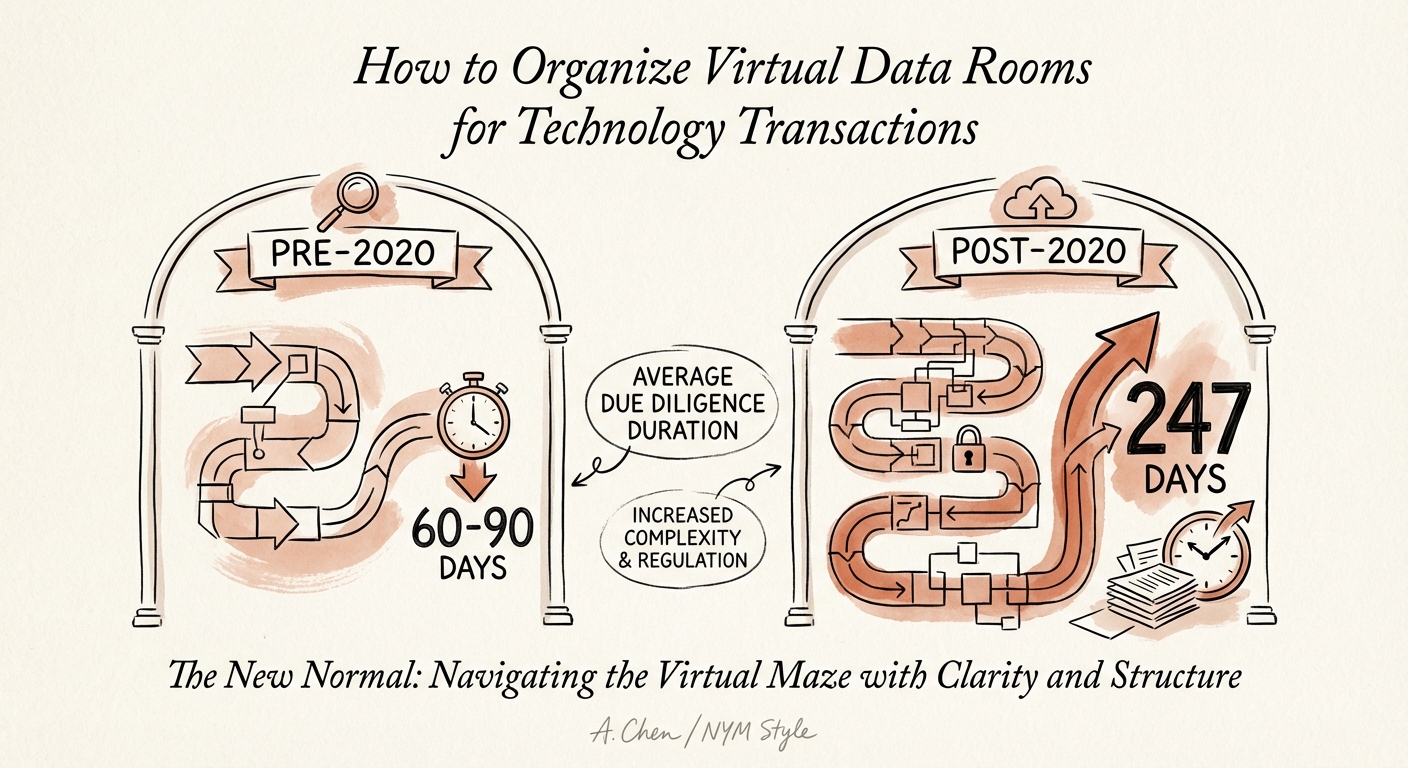
- 247 Average days for M&A due diligence in the post-2020 era, up from 189 days.
The VDR Is Your First Product Demo
In technology transactions, the Virtual Data Room (VDR) is not merely a repository; it is a diagnostic signal. When a Private Equity associate or a strategic acquirer logs into your VDR, they are not just looking for contracts and IP assignments; they are assessing your operational maturity. A disorganized VDR—characterized by unstructured folders, mislabeled files, and incomplete data sets—signals "operational debt" just as clearly as spaghetti code signals technical debt.
The stakes have never been higher. According to SS&C Intralinks, the average due diligence period has lengthened significantly, rising from 189 days pre-2020 to 247 days in the post-pandemic era. Every additional day in diligence increases the risk of deal fatigue, market shifts, or a "re-trade" where the buyer lowers their offer based on perceived risks. In our experience across mid-market tech deals, a chaotic VDR is the primary catalyst for these delays.
We call this the "Confidence Gap." If a buyer cannot find your SOC 2 Type II report within three clicks, they assume your security posture is weak. If your customer contracts are dumped into a single folder without naming conventions, they assume your revenue quality is suspect. You are essentially telling the buyer: "We don't know where our own assets are." This perception allows buyers to justify a "chaos discount"—often shaving 10-15% off the enterprise value under the guise of "integration risk."
If a buyer cannot find your SOC 2 report within three clicks, they assume your security posture is weak. You are essentially telling them: 'We don't know where our own assets are.'
The Tiered Access Framework: A Structural Defense
The most common mistake founders make is the "Data Dump"—uploading every document they have into a flat structure on Day 1. This exposes you to unnecessary risk and overwhelms the buyer. Instead, organize your VDR using a Tiered Access Strategy that aligns with the deal lifecycle.
Level 1: The "Teaser" & CIM (Pre-LOI)
At this stage, you are selling the vision, not the source code. Your VDR should be lightweight, containing only high-level financial summaries, the Confidential Information Memorandum (CIM), and blinded customer data. The goal is to generate interest without compromising competitive sensitivity.
Level 2: The "Validation" Layer (Post-LOI, Pre-Exclusivity)
Once a Letter of Intent (LOI) is signed, you open the second tier. This includes:
- Corporate Matters: Articles of Incorporation, Cap Table (anonymized if necessary), and Board Minutes.
- Financials: Detailed P&L, Balance Sheet, and Cash Flow statements (monthly, for the last 3 years).
- Commercial: Top 20 customer contracts (redacted), pipeline data, and churn analysis.
- Technology (High Level): Architecture diagrams, stack overview, and disaster recovery plans.
Level 3: The "Deep Dive" (Exclusivity / Confirmatory Diligence)
This is where the "Confidence Gap" is won or lost. This tier opens only to the final bidder and their third-party advisors (legal, tax, tech). It must contain:
- IP Chain of Title: Every PIIA (Proprietary Information and Inventions Agreement) for every employee and contractor, past and present. Missing just one can kill a deal.
- Source Code Scans: Black Duck or similar open-source analysis reports. Do not upload raw source code unless utilizing a clean room environment.
- Granular Employee Data: Compensation history, benefits, and org charts (often restricted to HR diligence teams only).
For a detailed breakdown of what technical buyers look for, refer to our guide on Technology Due Diligence Red Flags.
Common Pitfalls That Kill Deal Momentum
1. The "Q&A Death Spiral"
A disorganized VDR invariably leads to a flood of Request for Information (RFI) trackers. If a document exists but is misfiled, the buyer will ask for it. If you have to answer "It's in folder 4.2.1" five hundred times, you burn out your management team and annoy the buyer. The Fix: Create a "Master Index" document. This is a spreadsheet that maps every item in the buyer's diligence checklist to a specific folder and file number in the VDR. Update it weekly.
2. The Redaction Trap
Redacting too much breeds suspicion; redacting too little breeds liability. We often see founders redacting standard commercial terms in customer contracts, which prevents the buyer from verifying revenue quality. Conversely, failing to redact PII (Personally Identifiable Information) in employee files violates GDPR/CCPA and flags you as a compliance risk. The Fix: Use VDR tools with dynamic redaction capabilities that allow you to "unmask" data for specific users (e.g., outside counsel) without re-uploading documents.
3. The "Version Control" Nightmare
Uploading "Financials_Final_v3_UPDATED_REAL.xlsx" destroys confidence. The Fix: Maintain a strict "Clean Room" policy internally. Only one person (the Deal Lead) should have upload rights to the VDR. All documents must be finalized, PDF'd (unless Excel is required for modeling), and clearly named before upload. See our Quality of Earnings guide for how to present financial data that stands up to scrutiny.