The practical answer
- Short answer
- A 115% NRR can hide a 68% logo retention rate. Here's the divergence math PE buyers run in week one of diligence — and how to fix it 18 months out.
- Best fit
- Industry: Software / SaaS. Function: Revenue Operations
- Operating path
- Unit Economics → Commercial Performance → Transaction Advisory Services
- Key metric
- 500-800 Ideal basis point gap between GRR and Logo Retention for elite SaaS businesses.
Three numbers, three different companies
Picture a $30M ARR SaaS company walking into a sell-side process with a board deck that opens on a single slide: 115% net revenue retention. The room nods. NRR over 110 is the number that prints multiples. Then a diligence analyst pulls the cohort export, sorts logos by start year, and counts heads instead of dollars. Last year the company served 1,040 accounts. This year it serves 760. The revenue is flat-to-up. The customer base shrank by 27%.
That gap is the entire ballgame, and almost no founder is watching it. You can run three retention metrics on the exact same book of business and tell three completely different stories. Net revenue retention says you're a rocket. Gross revenue retention — strip out the expansions, keep the downgrades and churn — might say 92%, still respectable. Logo retention, the rawest count of "did this customer renew at all," can sit at 68% while the first two numbers glow green. One company, three narratives. The buyer only believes the one that counts heads.
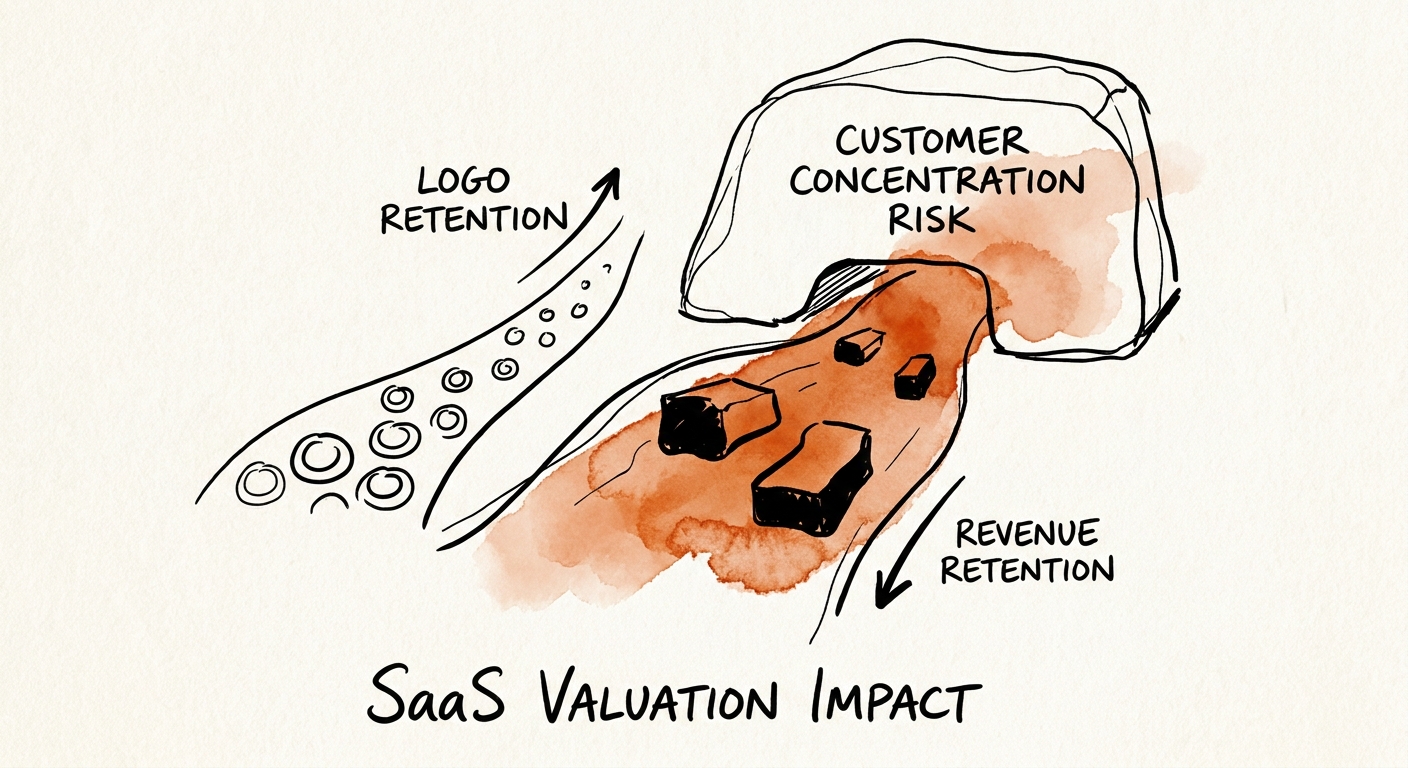
The reason the divergence happens at $10M-$50M ARR specifically is structural. At that stage a SaaS company usually has a fat base of self-serve and small-team accounts paying $8K-$25K a year, plus a thin top layer of six- and seven-figure logos that landed in the last 24 months. When two of those whales renew with a seat expansion, the dollars they add can fully mask 150 small accounts walking out the door. The CEO reads that as an "upmarket migration." It isn't a migration. It's attrition at the bottom papered over by lumpiness at the top — and lumpiness is exactly what a private equity buyer prices as risk.
I have watched this exact divergence trigger the concentration penalty in real time during sell-side prep. A buyer who sees revenue holding while the logo count craters does not conclude "they're going premium." They conclude your forecast depends on a handful of accounts that could each evaporate in one budget cycle, and they reach straight for a customer concentration discount. The expansion that made your NRR beautiful is the same expansion that makes your revenue fragile.
Net revenue retention is a story you tell. Logo retention is the story your customers are telling about you. When the two diverge by more than fifteen points, a buyer believes the customers.
What the gap is supposed to look like — and what it costs when it doesn't
There is a healthy band, and it's narrower than most founders assume. The Bessemer Venture Partners State of the Cloud framing puts elite recurring-revenue businesses with logo retention running roughly 500 to 800 basis points below their gross revenue retention. In plain terms: if your GRR is 92%, a healthy logo retention sits somewhere around 84% to 87%. The dollars you keep should slightly exceed the customers you keep, because your bigger accounts are stickier than your small ones. A little gap is normal and even good. A 24-point gap is not a gap — it's a hole, and the buyer's data team will find it.
Watch the second-order damage, because it's where the multiple actually erodes. When logo count bleeds, sales and marketing have to re-acquire just to stand still, and your payback period stretches. The KeyBanc Capital Markets SaaS Survey consistently shows companies fighting elevated logo churn carry materially worse CAC payback than their steadier peers — you are spending enterprise-grade acquisition dollars to replace mid-market accounts you already paid to win once. The leaky bucket isn't a metaphor here; it's a line item that quietly doubles your cost of revenue stability.
The deeper trap is that high NRR built on a few upgrades is brittle by construction. Run the stress test the buyer runs: freeze the budgets of your top three accounts, or assume the champion who signed each of them leaves. Your 115% NRR doesn't drift down — it snaps. That's why a sharp acquirer doesn't take blended retention at face value. They isolate the top decile of your customers, set them aside, and re-run every metric on what's left. The logo retention of your long tail is your real baseline health, and it's usually a brutal number. That re-run is the heart of how a revenue-quality assessment reprices a deal in the first few weeks.
So here's the uncomfortable ranking. A company at 88% GRR and 85% logo retention will out-value a company at 95% GRR propped up by 65% logo retention, every time, because acquirers pay for predictability, not headline magnitude. The shrinking-base company can't forecast — each enterprise renewal becomes a P&L event the size of a small earthquake, and volatility that large gets discounted hard against enterprise value.
The fix is an 18-month job, and it starts with one subtraction
You cannot repair this in the quarter before a deal, because the cohorts that prove your repair have to actually age. Start now, and start with the simplest possible instrument on your exec dashboard: gross revenue retention minus logo retention. One subtraction, tracked monthly, next to the metrics you already love. When that number crosses 10 points, you stop celebrating and open an operational review of exactly which segments are leaving. When it crosses 15, treat it as a fire.
Then segment logo retention by annual contract value band — say, under $15K, $15K-$50K, and above $50K — and look at each band's renewal rate on its own. This is the move that lets you walk into diligence with a story instead of an excuse. There is a real difference between "we deliberately sunset an unprofitable starter tier and accepted the logo loss" and "our mid-market accounts are defecting to a cheaper competitor and we didn't notice." The first is a defensible business decision a buyer can underwrite. The second is the systemic rejection that Bain's Global Private Equity Report describes diligence teams hunting for with dedicated data-science benches during quality-of-earnings work. They will find the hole. Your job is to be the person who already documented why it exists and what's sealing it.
Be honest about the most common root cause, too. A lot of these divergences trace back to a price increase that pulled forward revenue and pushed out logos. If you raised prices 40%, lost 30% of your accounts, and held revenue flat, you did not create value — you mortgaged future renewals and shrank your funnel of future expansion accounts. Decompose your NRR into its real drivers so you can tell expansion apart from contraction apart from churn, and so you stop mistaking one for the others.
Last, change who owns the number. As long as customer success and account managers are compensated purely on net dollar retention, every incentive points at babysitting the one $500K logo while fifty $10K accounts quietly lapse — which is precisely the behavior that produces the divergence. Put logo count in their comp. Penalize logo churn explicitly. Make protecting the mid-market base someone's job, with their bonus attached. A high-multiple exit is a bet on repeatability, and nothing reads as less repeatable than a customer base that's shrinking behind a few enormous invoices. Close the gap on your own terms, or a diligence team will close it on theirs — using your enterprise value as the adjustment.