
The practical answer
- Short answer
- Blended CAC hides a paid-channel bleed at $10M-$100M ARR SaaS. Here's how to unblend your channels, find the real payback, and reallocate before diligence does it for you.
- Best fit
- Industry: B2B SaaS. Function: Go-To-Market / Revenue Operations
- Operating path
- Unit Economics → Commercial Performance → Transaction Advisory Services
- Key metric
- 19 Months average CAC payback period for B2B SaaS
One number on your dashboard is doing all the lying
Open the marketing slide in almost any $10M-$100M ARR SaaS board deck and you'll find a single, reassuring figure: blended CAC. Total sales-and-marketing spend, divided by total new customers, across every channel at once. It is the most comfortable number in the building, and at scaling SaaS it is almost always the most misleading — because it averages a cheap, compounding organic channel together with an expensive, rented paid channel and reports the middle as if the middle were real.
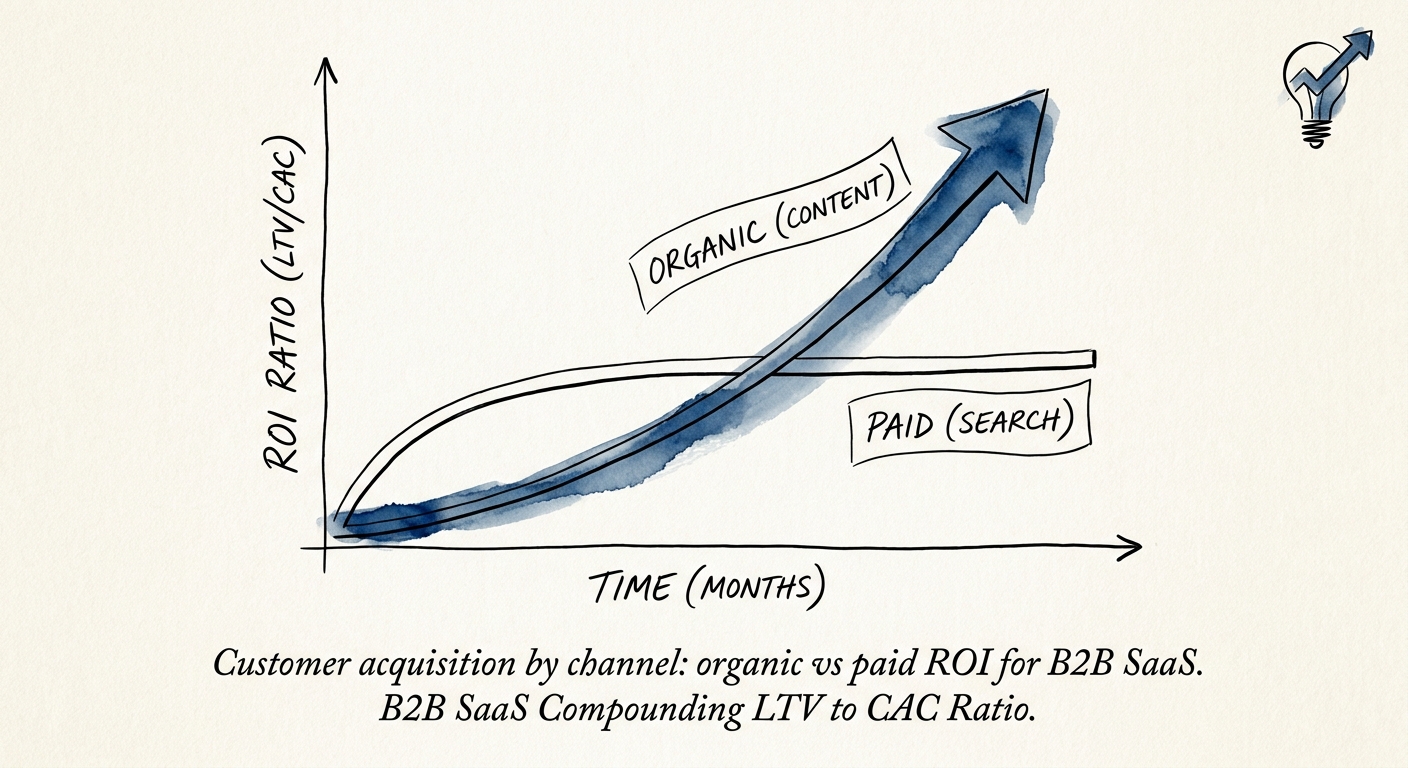
Picture a hypothetical 60-person SaaS company at $40M ARR. Blended CAC payback looks like a healthy 19 months — squarely in the range you'd expect, given that SaaS Capital's 2025 SaaS Marketing Budget Benchmarks peg median marketing spend for private B2B SaaS at roughly 8% of ARR. Then you split the channels apart. Organic-sourced customers pay back in well under a year and renew at a rate that quietly carries the whole company. Paid-search-sourced customers pay back somewhere north of two years and churn months sooner. The blended average isn't describing a business — it's describing two businesses, one of which is subsidizing the other's losses.
This matters more every quarter because the price of the rented half keeps climbing. Dentsu's Global Ad Spend Forecasts project global digital ad spend reaching $936 billion by 2029, and more advertisers bidding on the same finite intent inventory means your cost-per-click only moves one direction. You can absorb that with venture funding for a while. You cannot absorb it through a diligence process — a buyer's quality-of-earnings team unblends your channels as a matter of routine, and the same growth-quality scrutiny we cover in The Weighted Rule of 40: Why PE Buyers Discount 'Growth at All Costs' in 2026 turns a flattering blended number into a discounted multiple the moment it comes apart.
Blended CAC is the number you show the board. The number a buyer's diligence team calculates is the one that sets your multiple — and they always unblend.
Why the same customer costs less and stays longer when they find you
The instinct is to read this as "organic is free, paid is expensive." It isn't, and treating it that way is how leaders talk themselves out of organic in the first place. Organic carries a real, lumpy cost — editorial, technical infrastructure, the months before a single asset ranks. The difference isn't the price; it's the shape. A paid placement is a lease: visibility lasts exactly as long as the daily budget, and the meter resets at zero every morning. An organic asset is owned inventory that keeps producing pipeline at near-zero marginal cost long after it's built. Two customers, identical contract value, radically different cost curves behind them.
There's a second difference that shows up in retention, and it traces back to how B2B software actually gets bought. Forrester's 2024 State of Business Buying Report finds the typical B2B purchase now involves around 13 stakeholders. A paid click captures exactly one of them — a single person, in a single moment of intent, who still has to go win over the other twelve internally with whatever they can cobble together. Deep organic content does that selling for them: it hands your champion the data, the framing, and the proof they need to carry the room. A buyer who arrives already convinced of your worldview signs faster and churns slower, which is why the gap between channels isn't just acquisition cost — it's lifetime value on both ends of the equation.
That combination is what produces an organic LTV:CAC closer to 4.5:1 while paid campaigns scrape against the 3:1 floor a healthy SaaS business needs to clear. And it's not abstract during a sale. Acquirers can tell the difference between a company that owns its demand and one renting it, and they price the durability accordingly. The vertical-by-vertical spread in what this rented demand actually costs is laid out in The 'Acquisition Tax' is Rising: 2025 CAC Benchmarks by Vertical — worth reading before you assume your paid mix is normal for your category.
What to actually do Monday: the unblending test, then the reallocation
Start by running the unblending test before you touch a budget. Pull last twelve months of new logos, tag each one by sourcing channel, and compute payback and net revenue retention separately for organic-sourced versus paid-sourced cohorts. If your organic cohort pays back materially faster and retains better — and at this ARR band it usually does — you've just found the line item that's quietly cross-subsidizing your paid spend. That single split does more for your next valuation conversation than any dashboard tweak, and it pairs directly with the method in How to Calculate True CAC Payback Period.
Then face the constraint honestly. McKinsey's analysis of software business models shows sales and marketing eating 50% or more of operating expenses for scaling SaaS, while Gartner's 2025 CMO Spend Survey found marketing budgets flatlined at 7.7% of revenue for a second straight year. The budget isn't growing. So every dollar locked in a mid-funnel paid campaign that pays back in two years is a dollar not building an asset that compounds for five. The framing we use with operators is blunt: paid buys velocity, organic buys value. Keep paid for the deals you need to close this quarter; stop using it to manufacture top-of-funnel volume an organic asset would generate for free in eighteen months.
Concretely: cap paid at the spend level where its own cohort still clears 3:1, cut the low-converting top-of-funnel keywords feeding the blended illusion, and route the recovered budget into the two or three organic assets your champions actually forward internally. You won't see the swing in 30 days — that's the nature of owned inventory. But you'll have replaced a number that flatters the board with one that survives a buyer's diligence, which is the only acquisition metric that sets your multiple.