
The practical answer
- Short answer
- A single blended gross margin hides which of your engagements actually make money. Here are the 2026 margin floors for strategy, implementation, and managed services.
- Best fit
- Industry: IT Consulting & Professional Services. Function: Finance & Operations
- Operating path
- Unit Economics → Commercial Performance → Transaction Advisory Services
- Key metric
- 55% Minimum gross margin threshold for Strategy & Advisory engagements in 2026.
The $35M firm that thought it was healthy
A founder pulls up the P&L for his NetSuite implementation practice. Top line is good, the team is busy, and the gross margin reads 42% — comfortably inside the range every consulting blog tells him is "healthy." He's about to raise from a private equity sponsor and he thinks this number is his ticket. It isn't. It's the reason the diligence process is going to stall.
Here's what one blended percentage buries. Split that same firm into its real revenue streams and the picture inverts. The advisory work — architecture sessions, roadmaps, system selection — was printing at roughly 60%. The core implementations, once you fully loaded the non-billable project management, the rework on blown scope, and the senior engineers idling between phases, were barely above breakeven. The 42% wasn't a margin. It was the arithmetic mean of a cash machine and a slow leak, presented as if it were a single, governable business.
This is the most common reason a services-firm acquisition dies in diligence: the founder cannot disaggregate margin by engagement type. A buyer doesn't want to know what the whole firm averages. They want to know which engagement they can pour capital into and which one they'll have to fix. If you can't tell them, they'll assume the worst and price accordingly. Gartner's 2025 IT Services Margin Benchmark puts pure-play implementation margins across the mid-market at 28% — meaning the firm targeting a uniform 40% is, in practice, running a money-loser inside a profitable wrapper and calling the combination fine.
A blended margin is an average of a winner and a loser. PE buyers don't pay for averages — they pay for the segment they can scale, and they discount the segment that's quietly bleeding.
Three businesses wearing one logo
A mid-market IT services firm doesn't run one engine. It runs three, and each obeys different physics. Manage them as one and you'll over-discount the work that should command a premium while subsidizing the work that's dragging you down.
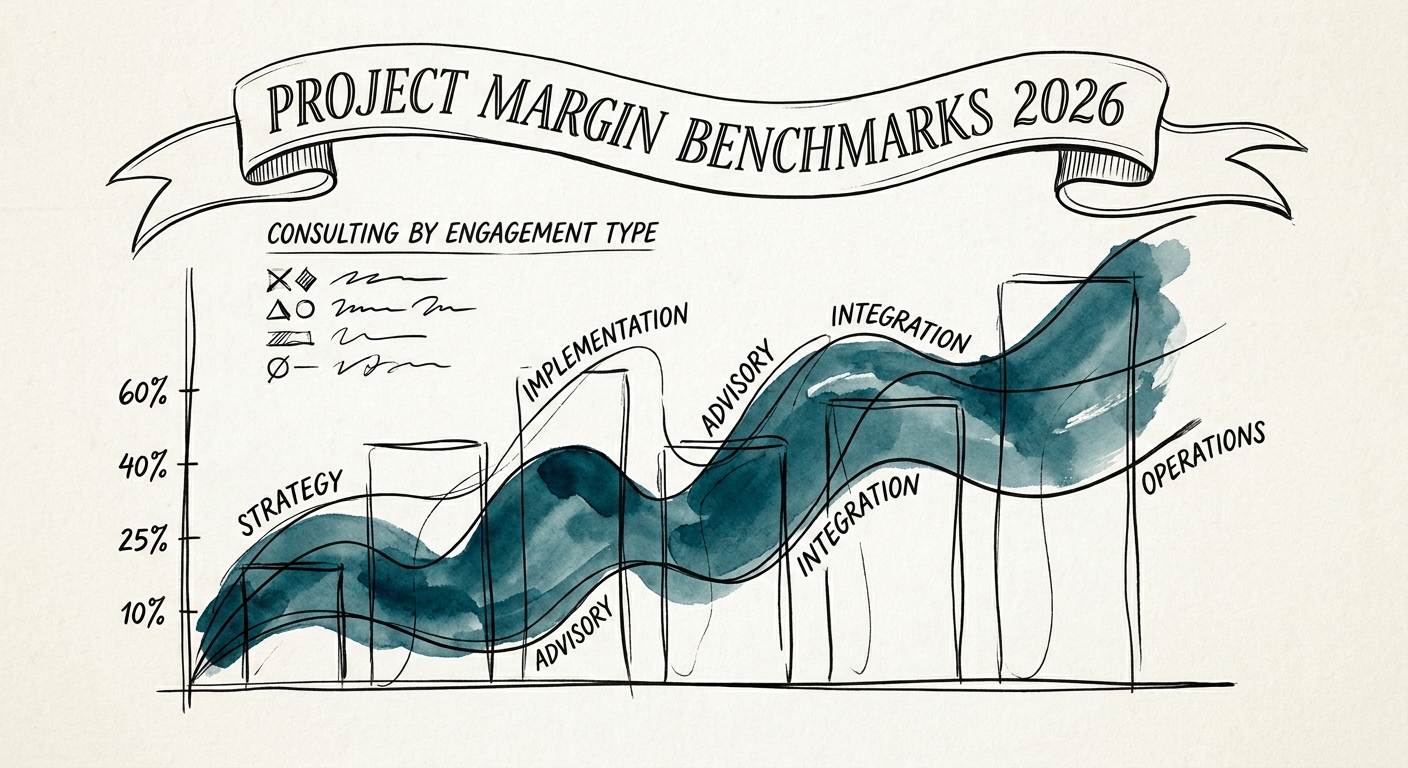
Strategy and advisory: floor of 55%
Short-duration, high-value, almost no delivery risk. You staff it with your most expensive people — enterprise architects, senior strategists — but there's no six-month build to overrun, no integration that fails on go-live weekend. Bain & Company's 2026 Technology Consulting Economics Study puts advisory at 55% on the low end, often past 65% in specialized platform ecosystems. If your roadmap and architecture work is coming in under 50%, you are mispricing the smartest hours in the building — usually because you've quietly folded them into a fixed-fee implementation as "discovery."
Implementation: the 32–35% truth
This is the foundational revenue engine and the most dangerous line on the P&L. It carries execution risk, heavy PM overhead, and the chronic scope creep that turns a 45% model into a 25% actual the moment requirements shift. Pitchbook's Q1 2026 PE Services Multiples Report finds firms that track segmented margin land at an average implementation gross margin of 32–35%. The instinct is to claw it back by pushing utilization — which is exactly why 85% utilization is a valuation trap. Grind your delivery engineers to inflate this number and you trade a margin point now for an attrition spike and a rework bill later.
Managed services: 48% recurring baseline
Post-go-live optimization and support contracts are what buyers actually pay a premium for — but the unit economics only work with a different staffing shape entirely, leaning on junior and nearshore talent rather than the senior bench. McKinsey's 2025 Professional Services Benchmarks shows managed services need to hit 48% to cover the acquisition cost and the always-on infrastructure of a 24/7 model. Below that, recurring revenue isn't an asset — it's a commitment you're funding out of project profit.
What you can start Monday
Stop reporting one margin. Tag every active engagement as strategy, implementation, or managed services, and recompute gross margin three ways — fully loaded with the non-billable hours you currently ignore. Most founders find one stream they thought was their core business is actually their drag, and one they treated as a giveaway is carrying the firm. That single view changes how you price the next ten proposals.
Then put a margin floor on each engagement type and enforce it before the statement of work goes out. The floor isn't a hard veto — sometimes a 30% implementation is worth signing because it locks in a 48% managed services contract behind it. But that has to be a decision someone made on purpose, with the trade-off written down, not a number that drifted because nobody was watching the segment.
The structural lever is resource mix. A 35% implementation margin is unreachable with an all-senior, all-onshore team; EY's 2026 Consulting Gross Margin Report shows firms that route at least 40% of repetitive build work to nearshore or offshore hubs recover implementation margin to around 38%. Pair that with the discipline of charging for discovery and the roadmap instead of bundling them into the build — you're otherwise diluting your highest-margin service into your lowest. This separation is the mechanism behind why MSPs trade near 10x while project shops sit closer to 5x. Segment the engagements, price each to its own risk profile, and measure them independently. That's what turns a stalled diligence process into a clean one — and a blended average into a number a buyer will actually pay for.