
The practical answer
- Short answer
- Generalist Shopify agencies trade at 6x. International commerce specialists trade at 12x. Here is the diagnostic to pivot your practice toward the cross-border premium.
- Best fit
- Industry: Digital Agency / IT Services. Function: Strategy / M&A
- Operating path
- Exit Readiness → Operational Excellence → Transaction Advisory Services
- Key metric
- 12x EBITDA multiple for Shopify agencies with verified 'Cross-Border' technical specialization.
The Generalist Trap in a $18.6 Trillion Market
For the last five years, the playbook for Shopify agencies was simple: design beautiful themes, master Liquid code, and ride the wave of DTC migration. That wave has crested. In 2026, generalist "theme shops" are a commodity, trading at 5x to 7x EBITDA with declining retention rates as AI automates basic development tasks.
The smart money in M&A has shifted entirely to complexity. Specifically, the complexity of cross-border trade. While domestic e-commerce growth stabilizes, the cross-border market is projected to reach $18.6 trillion by 2033. This isn't just about shipping to Canada; it's about solving the "three-dimensional chess" of global commerce: multi-currency transactions, localized logistics, duty drawbacks, and the Merchant of Record (MoR) liability shield.
Significant research from the 2025 holiday season reveals that 15% of all global Shopify purchases were cross-border. For enterprise merchants, this figure often exceeds 30%. Yet, fewer than 1 in 20 Shopify partners have true proficiency in the Shopify Markets Pro stack. This supply-demand imbalance has created a massive valuation arbitrage.
The "Complexity Moat"
Why does this drive valuation? Because international setups are sticky. A merchant can fire a design agency overnight. They cannot easily rip out a partner who has integrated their ERP with Global-e, configured their tax nexus in 13 EU jurisdictions, and optimized their 3PL routing for APAC. This stickiness transforms "project revenue" into "quasi-recurring revenue," a distinction that doubles exit multiples.
A merchant can fire a design agency overnight. They cannot easily rip out a partner who has configured their tax nexus in 13 EU jurisdictions. Complexity is your retention strategy.
The Valuation Delta: Why Complexity Commands a Premium
In our analysis of 2025 M&A transaction data, a clear bifurcation has emerged in the Shopify ecosystem. We are seeing a "Cross-Border Premium" that separates the elite from the average.
- Generalist Agencies (6x - 8x EBITDA): Focus on frontend UX, theme customization, and standard app integrations. High competition, low switching costs.
- International Specialists (10x - 14x EBITDA): Focus on backend orchestration, Shopify Markets Pro implementation, and multi-subsidiary architecture. Low competition, high switching costs.
The Unit Economics of Globalization
The premium isn't just speculative; it's mathematical. Partners who successfully implement Managed Markets solutions are delivering tangible ROI that justifies higher retainers. Case in point: Managed Services providers utilizing international capabilities are seeing client outcomes like those of Made by Mary, which reported a 90% increase in international orders and a 180% increase in conversion rates after optimizing for cross-border friction.
Private Equity buyers are scrutinizing "Defensible Revenue." A retainer based on "monthly design tweaks" is the first thing cut during a downturn. A retainer based on "managing global tax compliance and cross-border logistics" is operational infrastructure. According to Capstone Partners' 2025 M&A update, buyers are specifically targeting "high-quality, defensible businesses" that can navigate tariff volatility and supply chain diversification. If your agency is the one navigating that volatility for clients, you are the asset they want.
The Diagnostic: Are You an International Specialist or Just 'Global-Curious'?
To command a 12x multiple, you cannot simply claim to "support international clients." You must demonstrate structural competency. We assess this using the Global Commerce Maturity Matrix. If you are preparing for exit, audit your practice against these three pillars:
1. The Merchant of Record (MoR) Capability
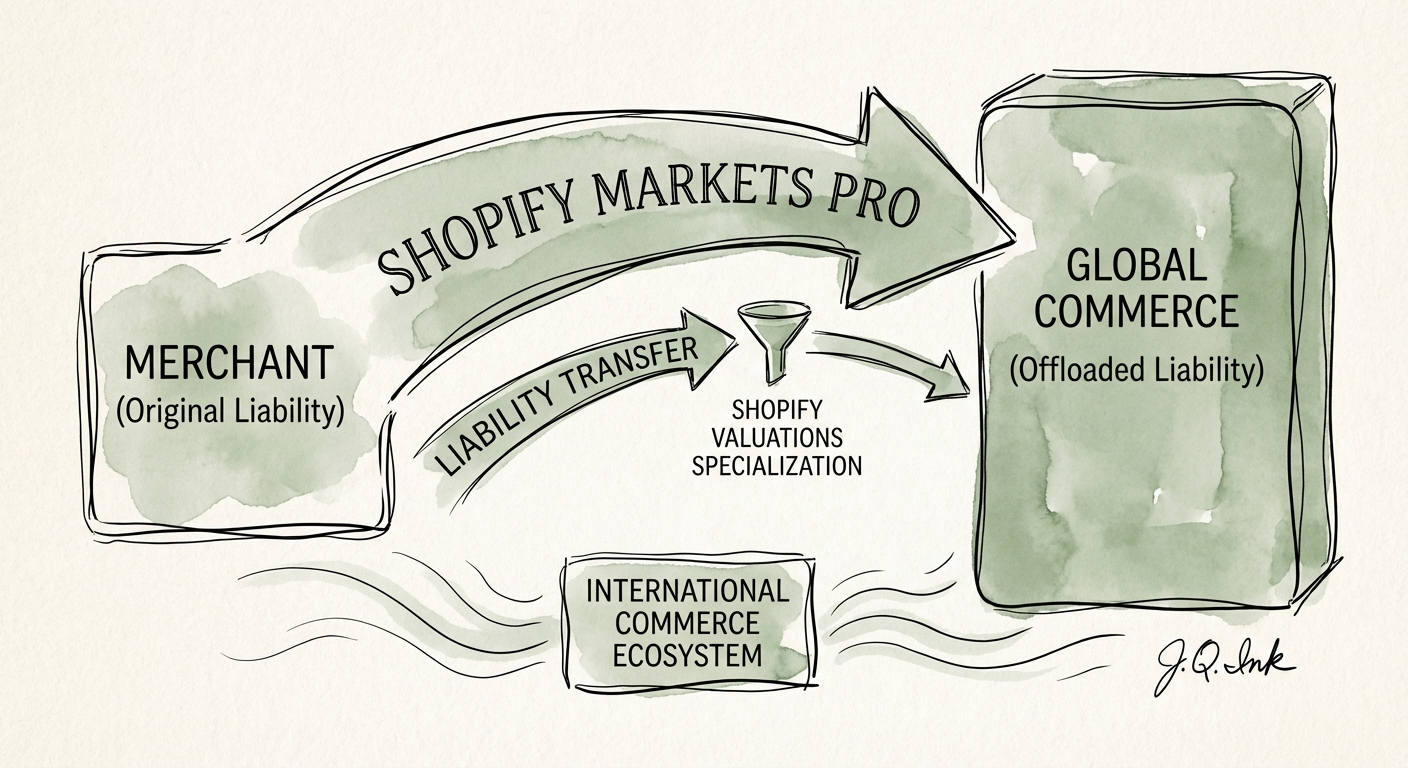
Generalists let clients figure out the legalities. Specialists implement MoR solutions (like Shopify Managed Markets or Global-e) that offload liability. Diagnostic Question: Do your SOWs include specific implementation phases for duty drawback configuration and HS code classification? If not, you are leaving valuation on the table.
2. The B2B Cross-Border Nexus
Shopify's 2025 B2B updates focused heavily on internationalization—multi-currency invoicing, region-specific price lists, and tax compliance. Diagnostic Question: Can your team architect a solution where a US-based manufacturer sells B2B to a German distributor in Euros, with automated VAT deduction and inventory syncing from a Netherlands 3PL? This is the "Enterprise" standard.
3. Localization Beyond Translation
Simply installing a translation app is not a strategy. True specialization involves "cultural UX"—adjusting payment gateways (e.g., iDEAL in Netherlands, Pix in Brazil) and checkout flows to match local expectations. Diagnostic Question: Does your retention reporting track "International Conversion Rate Delta" separate from domestic? If you aren't measuring it, you can't sell the value to an acquirer.