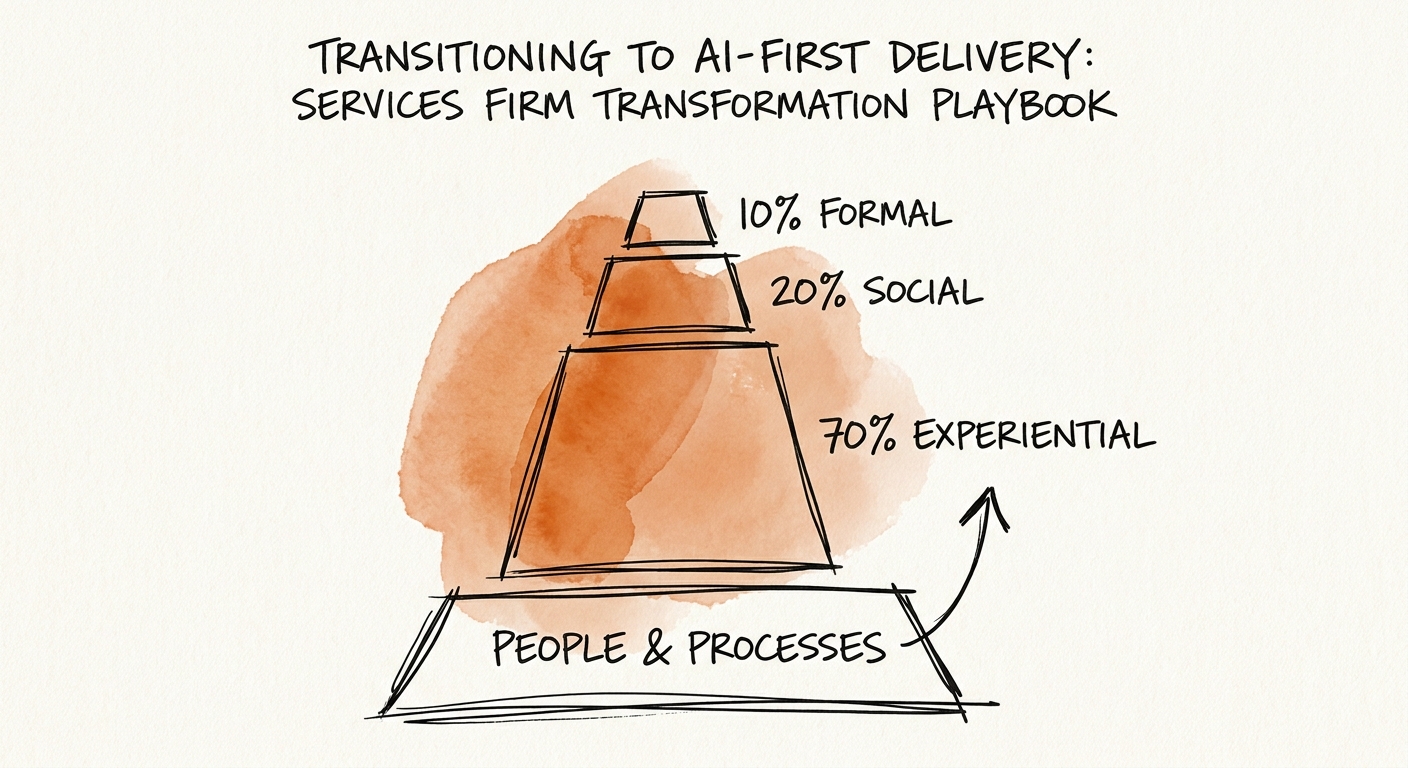
The trap: you bill hours, and you just automated them
Here is the math nobody wants to say out loud at the partner meeting. Say a 30-person consultancy bills a research-and-report engagement at 80 hours. AI now does the first draft of that research and report in a fraction of the time. Congratulations — you've just engineered a 50% revenue cut on your own flagship deliverable, because the engagement letter still ties your fee to hours you no longer spend. That's the difference between a product company and a services firm adopting AI. A product company keeps the price and pockets the gain. A services firm whose entire economic model is "leverage times realized rate times hours" can automate itself straight into a smaller invoice.
This is why "AI-first delivery" cannot start as a tool rollout, and it definitely cannot start as a marketing line. McKinsey's State of AI research and the IBM Institute for Business Value AI capabilities research both keep landing on the same unglamorous truth: value comes from redesigning the workflow, getting the data ready, and building real capability — not from buying seats. For a services firm, the workflow being redesigned is the actual product: how you scope an engagement, how you do the discovery research, how a senior drafts, how a reviewer signs off, how it gets handed to the client. Decide how AI rewires that production line before you tell a prospect you're "AI-first." The slide is the last thing you build, not the first.
Pick one lane: the same deliverable, fifty times
Don't transform the firm. Transform one repeatable output. Choose the deliverable you produce most often and most similarly — the discovery memo, the monthly reporting package, the SOW-driven assessment, the build-vs-buy analysis. The one a manager could describe in their sleep. That repetition is the whole point: it's where AI's draft quality is most predictable and where you can actually see, across dozens of runs, what got faster and what got fragile.
Inside that one lane, name four things on a single page before anyone touches a model. What AI is allowed to draft (the first 70% of a research synthesis, yes; the client recommendation, no). What a human expert must review and own — and at what point, not "at the end." Which sources are approved, because a hallucinated benchmark in a client deliverable is a liability, not a typo. And how client data is handled — what goes into the tool, what never does. The PwC Responsible AI survey and the NIST AI Risk Management Framework are worth reading here for one reason: in a services firm, the review standard isn't compliance paperwork bolted on afterward — it is the product. The thing the client pays you for is judgment they trust. If you can't articulate exactly how an AI-assisted deliverable gets checked, you don't have an AI-first service. You have a faster way to ship work you can't stand behind.
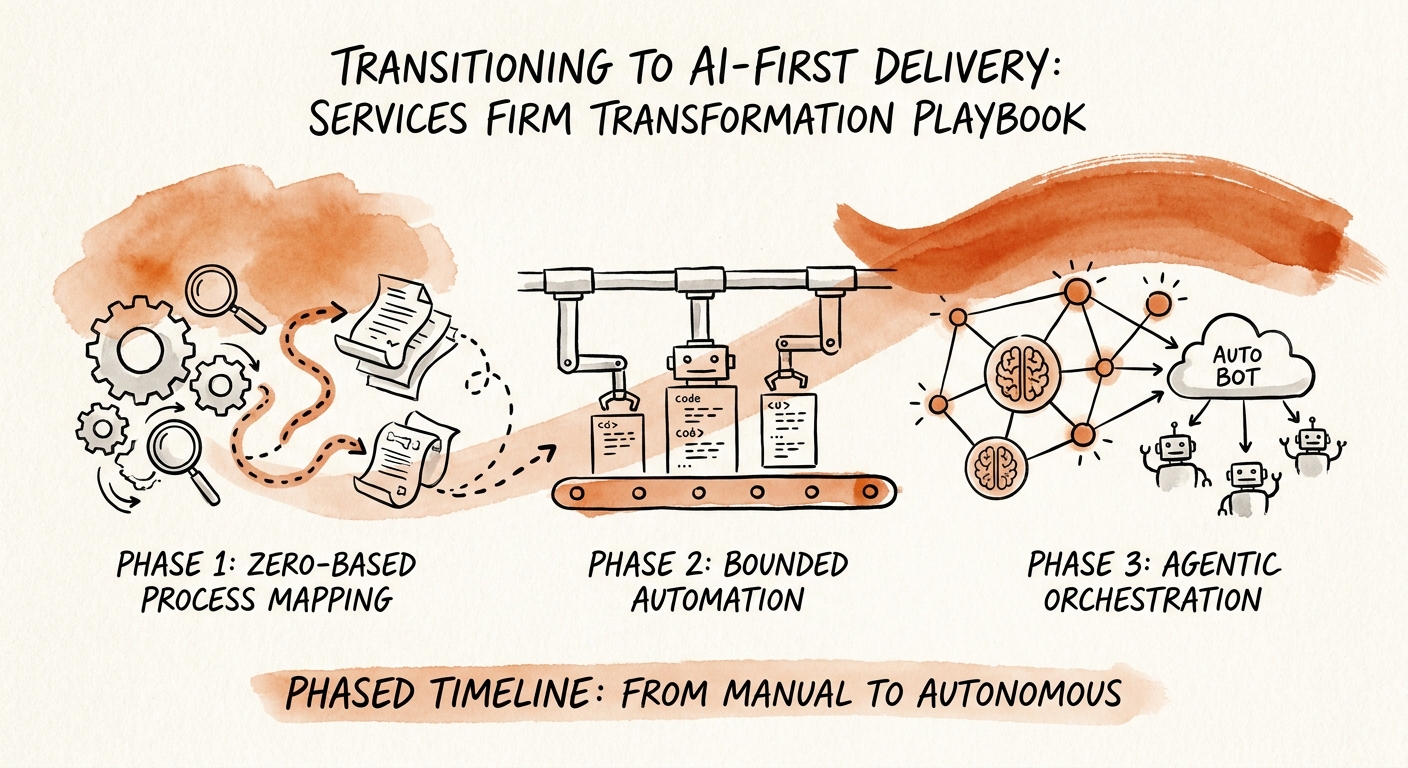
Change the price tag before you scale the lane
Once that one lane works, you face the real decision — and it's commercial, not technical. The work now takes a senior eight hours instead of twenty. You have three honest options, and you must pick one on purpose: bill the old hours and quietly inflate your effective rate (clients will eventually notice), drop the price and pass the savings through (you'll win on speed and lose on margin), or move that deliverable to a fixed fee tied to the outcome and keep the productivity gain as profit. Most firms drift into option one by accident and then act surprised when a procurement team asks why a "two-week" deliverable arrived in three days. Bain's agentic AI transformation research frames the operating design — tools, permissions, monitoring, exception handling — that makes this repeatable; for a services firm, that design only pays off if it connects to how you capture value, plan capacity, and reset what clients expect a "fast turnaround" to cost.
So on Monday: open the books on your single most-repeated deliverable. Time it as it runs today, lane by lane — scope, research, draft, review, handoff. That baseline is the only thing that tells you whether AI is creating margin or just relocating it. Then map the redesigned lane with the AI Transformation Blueprint and run the before-and-after through the AI ROI Calculator to confirm the new economics hold up before you bet the firm's positioning on them.