
The practical answer
- Short answer
- Why 85% utilization is a red flag for UiPath partners. Discover the 2026 benchmarks for USN (UiPath Services Network) eligibility, margin impacts, and the Agentic AI pivot.
- Best fit
- Industry: Intelligent Automation / RPA. Function: Operations & Finance
- Operating path
- Unit Economics → Commercial Performance → Transaction Advisory Services
- Key metric
- 68.9% Average global professional services utilization in 2025 (SPI Research), signaling a shift away from the 80%+ burnout model.
The 85% Utilization Myth in Intelligent Automation
In the traditional IT services playbook, 85% billable utilization is the holy grail. It signals efficiency, demand, and hard-working consultants. But in the UiPath ecosystem of 2026, consistent 85% utilization is a distress signal. It typically indicates a firm trapped in the "Break-Fix Loop"—consultants spending 40 hours a week patching fragile bots rather than architecting resilient Agentic AI workflows.
Data from the 2025 Professional Services Maturity™ Benchmark reveals a startling trend: average billable utilization across the sector has dropped to 68.9%, yet the most profitable firms (those with 20%+ EBITDA) maintain utilization closer to 72-75%. Why this discrepancy?
The "USN" Premium: Innovation Over Exhaustion
Elite partners—specifically those in the UiPath Services Network (USN)—deliberately cap utilization to preserve capacity for upskilling. UiPath’s aggressive pivot toward Agentic Automation and AI Center requires continuous learning. A developer billing 40 hours a week on legacy Studio scripts cannot master Document Understanding or Test Suite. Professional Services Utilization Rate Benchmarks 2025 show that firms pushing for 85% suffer from 22% higher attrition, effectively bleeding institutional knowledge every 14 months.
For Private Equity sponsors and Founders, the diagnostic question is simple: Is your high utilization a result of strong demand, or technical debt? If your revenue is derived primarily from maintenance hours on breaking bots, your multiple is at risk. Smart acquirers discount this "bad revenue" by up to 40%.
If your Architects are billing 90%, you are not building a practice; you are renting out bodies. This prevents the development of proprietary IP that drives 12x multiples.
Benchmarking Your Mix: The "Builder" vs. The "Fixer"
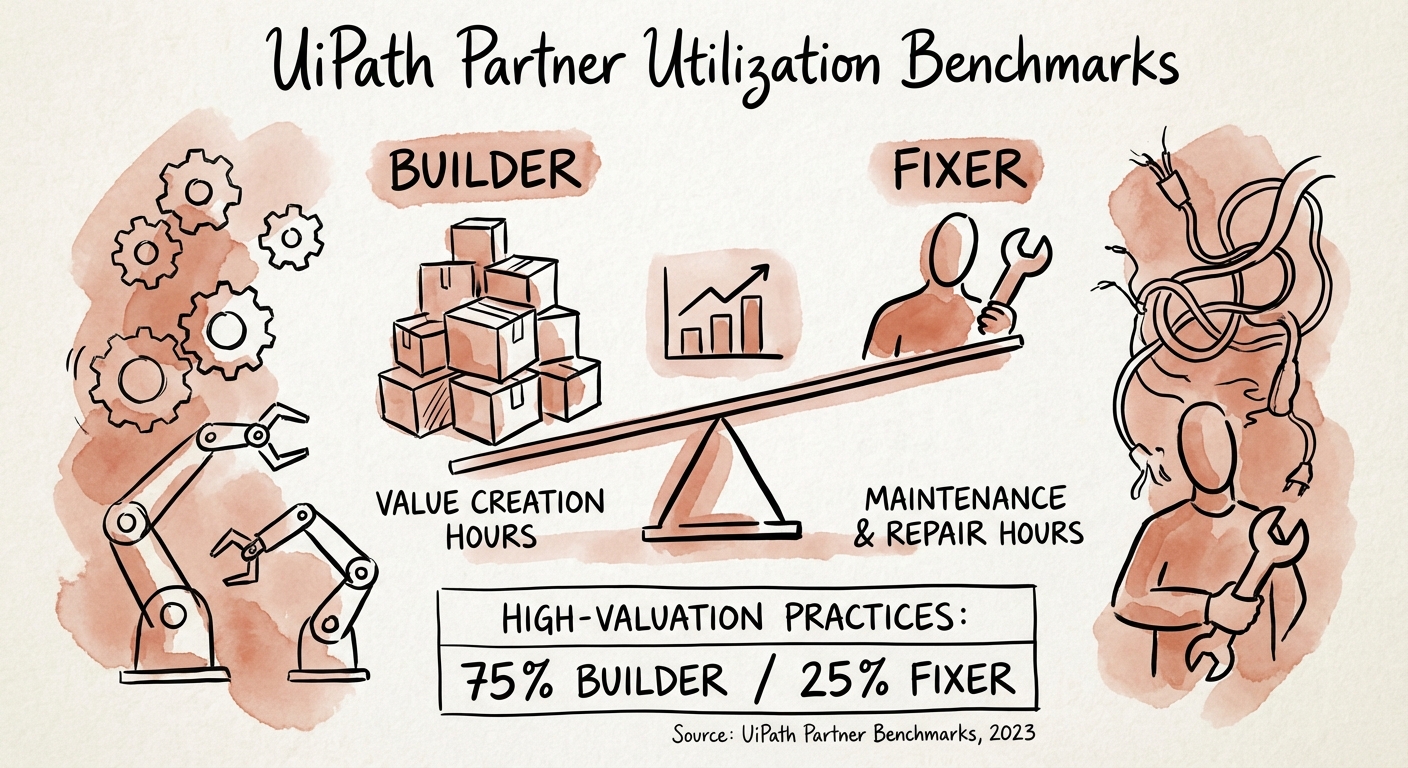
To evaluate the health of a UiPath practice, you must bifurcate utilization metrics. You aren't just measuring "time working"; you are measuring the quality of that work. We categorize utilization into two buckets: Builder Hours (New IP, Architecture, Agentic Deployments) and Fixer Hours (Maintenance, Ticket Resolution, Patching).
The 70/30 Rule for Valuation
A healthy, scalable UiPath practice should aim for a 70% Builder / 30% Fixer split. This ratio suggests that the firm is deploying resilient, "self-healing" automations using properly configured Orchestrator queues and REFramework standards. Conversely, a 30/70 split indicates a "Body Shop" model where margins are eroded by constant firefighting. This is the Hidden Margin in Your Delivery Model that kills exits.
Utilization Benchmarks by Role (2026)
- RPA Architect: 65% Billable. The remaining 35% must be allocated to pre-sales solutioning and reusable component asset harvesting.
- Senior Developer: 75% Billable. This is the sweet spot. Higher than this, and code quality degrades, leading to higher "Fixer" hours later.
- Maintenance Engineer: 85% Billable. High utilization is acceptable here only if it is covered by high-margin Managed Services contracts (ARR), not T&M firefighting.
If your Architects are billing 90%, you are not building a practice; you are renting out bodies. This prevents the development of proprietary IP—like industry-specific solution accelerators—that drives 12x multiples.
The Agentic AI Pivot: Why "Slack" is Strategic
The strategic imperative for 2026 is the shift from "Task Automation" (RPA) to "Agentic Process Automation" (AI Agents). This transition is not just a marketing slogan; it is a fundamental retooling of the workforce. Partners who run their teams at 90% utilization have zero capacity to pivot. They are maximizing short-term cash flow at the expense of long-term relevance.
The Utilization Rate Calculator clearly shows that the "Opportunity Cost" of a missed AI pivot exceeds the marginal revenue of that extra 10% utilization. USN partners are currently investing 12-15% of total capacity into GenAI and Specialized AI training.
Red Flags in Due Diligence
When evaluating a UiPath partner for acquisition or investment, look for these warning signs in the data room:
- Utilization >85% with < 10% Net Margins: Indicates low rates and high overhead (the "busy fool" syndrome).
- Zero "Innovation" Time Codes: If non-billable time is purely "Bench" or "Admin" rather than "R&D" or "Training," the asset is depreciating.
- High Utilization + High Churn: The classic burnout loop. The firm is burning through talent to hit revenue targets.
The Bottom Line: Stop chasing 85%. In the era of Agentic AI, the most valuable UiPath partners are those with the slack to innovate, the discipline to document, and the foresight to build IP. Aim for 72% utilization across the blended team, and scrutinize every hour above that.