
The practical answer
- Short answer
- Why Workday Adaptive Planning specialists command a 4x EBITDA premium over generalist HCM firms. A guide for PE investors on valuing 'Office of the CFO' assets.
- Best fit
- Industry: Technology Services. Function: M&A
- Operating path
- Exit Readiness → Operational Excellence → Transaction Advisory Services
- Key metric
- 13.6x Average EBITDA multiple for 'Office of the CFO' specialized implementation firms in 2025 vs 9.2x for generalist HCM shops.
The Shift: Why the CFO is the New Power Center for Services Spend
For the last decade, the Workday ecosystem was defined by Human Capital Management (HCM). If you were a PE Operating Partner looking at a services asset in 2018, you bought capacity: armies of certified consultants migrating legacy PeopleSoft to the cloud. It was a volume game, and valuations reflected that—trading at solid, but capped, multiples of 8x-10x EBITDA.
That era is over. In 2026, the alpha in the ecosystem has shifted violently to the Office of the CFO.
Private Equity firms are no longer just buying "digital transformation" for their portfolios; they are buying financial agility. In a high-interest, volatile market, the CFO needs continuous planning, scenario modeling, and real-time actuals vs. budget variance. They don't need a static ERP; they need Workday Adaptive Planning.
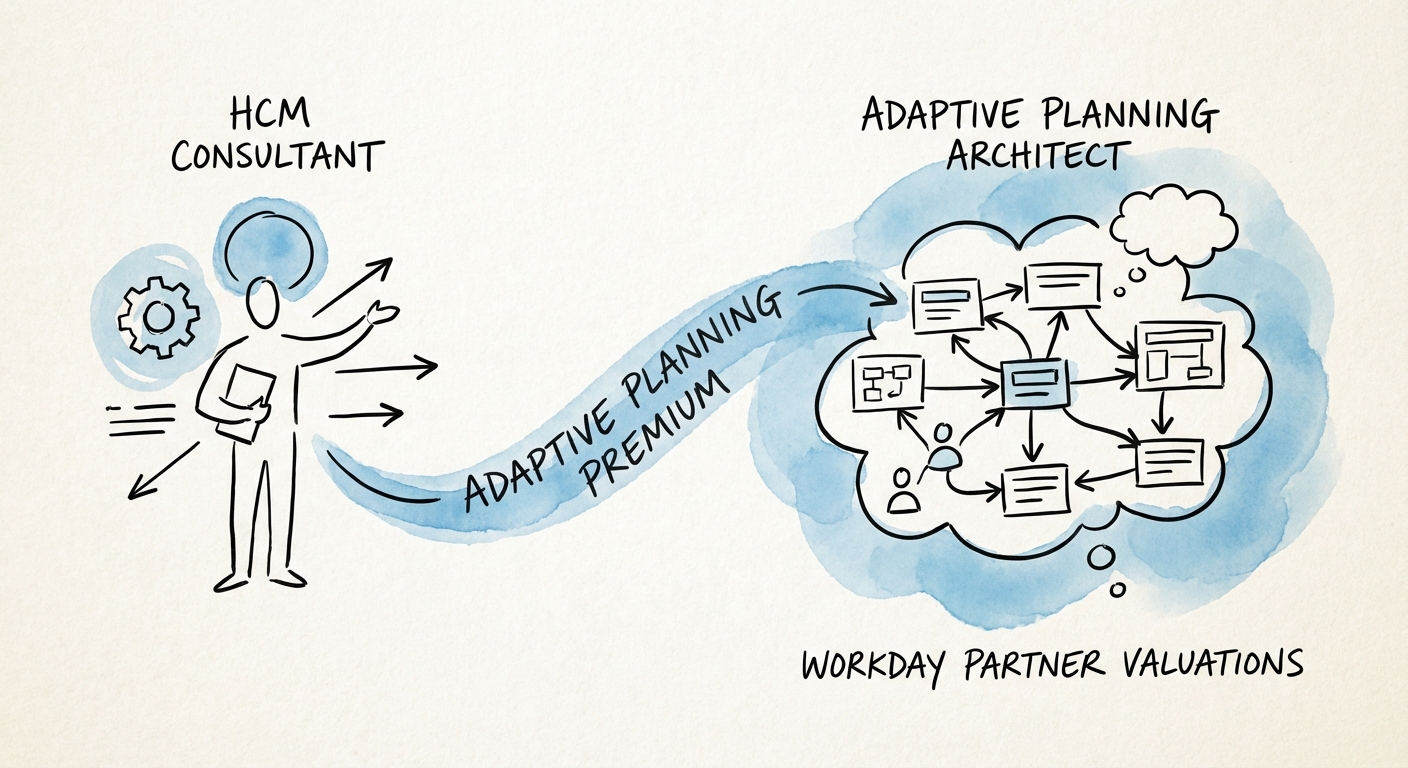
This demand shift has bifurcated the partner market. On one side, you have the "Generalist HCM" shops, now fighting a price war on rate cards as implementation becomes commoditized. On the other, you have the Adaptive Planning Specialists—firms that aren't just installing software but are fundamentally re-architecting how a company predicts its future. These firms aren't changing hands at 8x. They are commanding 12x-14x EBITDA multiples, driven by higher bill rates ($350+ vs. $225), stickier "Business Process as a Service" (BPaaS) revenues, and direct access to the check-writer that matters most: the CFO.
You cannot take a consultant used to configuring 'Time Off' policies and expect them to build a complex multi-currency consolidation model. The talent profile is not adjacent; it is distinct.
The 'Bolt-On' Fallacy: Why You Can't Just Cross-Train Your Way to a Premium
The most common mistake I see PE sponsors make is the "Bolt-On" strategy: acquiring a generalist HCM firm and assuming they can "add on" an Adaptive Planning practice to capture the valuation arbitrage. This fails 80% of the time. Here is why.
The Talent Profile is Fundamentally Different
An HCM implementer is typically an HR professional who learned configuration. An Adaptive Planning consultant is an accountant who learned to code. They speak fluent FP&A, understand the nuances of ASC 606 revenue recognition, and can debate the merits of zero-based budgeting with a client CFO. You cannot take a consultant used to configuring "Time Off" policies and expect them to build a complex multi-currency consolidation model for a $2B manufacturing firm.
The Sales Motion is Different
Selling HCM is a compliance and efficiency sale to the CHRO. Selling Adaptive is a strategic value sale to the CFO. The former is about "going live"; the latter is about "staying alive" in a downturn. Firms that try to cross-sell Adaptive using their existing HCM sales teams consistently miss quota because they lack the financial fluency to challenge the CFO's current Excel-based processes.
When we evaluate these assets for due diligence, we look for the "FP&A DNA" marker: What percentage of the delivery team has a CPA or CFA designation? In premium assets, this number is >40%. In generalist shops pretending to be specialists, it's <5%.
Valuation Drivers: The 14x EBITDA Scorecard
If you are looking to acquire an Adaptive Planning partner, or position one for exit, you need to understand the specific metrics that drive the premium. It is not just about revenue growth; it is about Revenue Quality.
1. The "Model Maintenance" Recurring Revenue Stream
Unlike HCM implementations which often have a distinct "end date," Adaptive Planning models are living organisms. They break when the business changes (M&A, new product lines, org restructure). Premium partners capture this through high-margin "Model Maintenance" retainers. We look for a 30%+ attach rate of managed services to implementation revenue. Generalists typically have <10%.
2. Industry-Specific IP (The "Accelerator" Premium)
A generic Adaptive implementation is worth 10x. An implementation using pre-built proprietary models for SaaS Revenue Forecasting or Healthcare Labor Planning is worth 14x. This Intellectual Property reduces delivery cost (higher gross margin) and increases win rates. If the target firm starts every project from a blank sheet of paper, walk away or discount the multiple.
3. The "Data Integration" Moat
The hardest part of FP&A isn't the planning; it's the data ingestion. Partners that have mastered the integration layer—pulling data not just from Workday, but from Salesforce, NetSuite, and Snowflake—create a technical moat that makes them irreplaceable. This "Data Gravity" reduces churn to nearly zero. In your technical due diligence, assess their library of pre-built connectors. If they are relying solely on manual flat-file uploads, you are buying a low-value service bureau, not a tech-enabled consultancy.