The practical answer
- Short answer
- A PE-portfolio SaaS company spent $220K on ABM and closed nothing. The failure wasn't the software — it was sales coverage. Here's the diagnostic.
- Best fit
- Industry: B2B Technology & Software. Function: Revenue Operations & Marketing
- Operating path
- GTM Execution → Commercial Performance → Performance Improvement
- Key metric
- 70% of Account-Based Marketing programs fail to generate a positive ROI within the first twelve months due to a lack of operational alignment.
The line item that closed nothing
The first thing I pulled in the audit was a single number: $220,000 a year, allocated to a $50M SaaS portfolio company's account-based marketing stack — platform license, intent data subscription, a boutique agency on retainer, and a quarter of a marketer's time. The second number was closed-won revenue attributable to the program over the prior twelve months. That one was zero. Not "early pipeline." Not "influenced." Zero signed contracts that the team could trace back to an ABM-sourced account.
What made it uncomfortable was the dashboard everyone had been reporting up to the board. Display ad click-through was up. Account "engagement" was up. Email opens on the target list looked healthy. Meanwhile the enterprise sellers — the people whose number this was supposed to move — described the leads as cold, mistargeted, and largely unworkable. Two teams looking at the same program, one celebrating and one frustrated, is the clearest signal you have that the program is measuring activity instead of revenue. You aren't alone in this: Gartner's research on ABM measurement finds that 42% of B2B organizations still can't reliably evaluate whether their ABM spend is financially effective at all.
The deeper problem is structural, and it's specific to how middle-market companies buy this category. ABM gets purchased like an ERP module — license the $30K to $50K platform, switch it on, expect enterprise accounts to start converting. But the software doesn't sell anything. It surfaces signal. If no human picks up that signal and runs a coordinated play against a named account, you've bought a very sophisticated way to spend money. And most companies never check whether it worked: ITSMA's ABM ROI benchmark study found that 48% of companies don't formally measure ABM ROI in the first place. You can't pause a leak you've never instrumented.
If your sellers can't name the next three accounts they're working from the marketing list, you don't have an account-based program. You have expensive advertising with a target-account label on the invoice.
The two lists that never matched
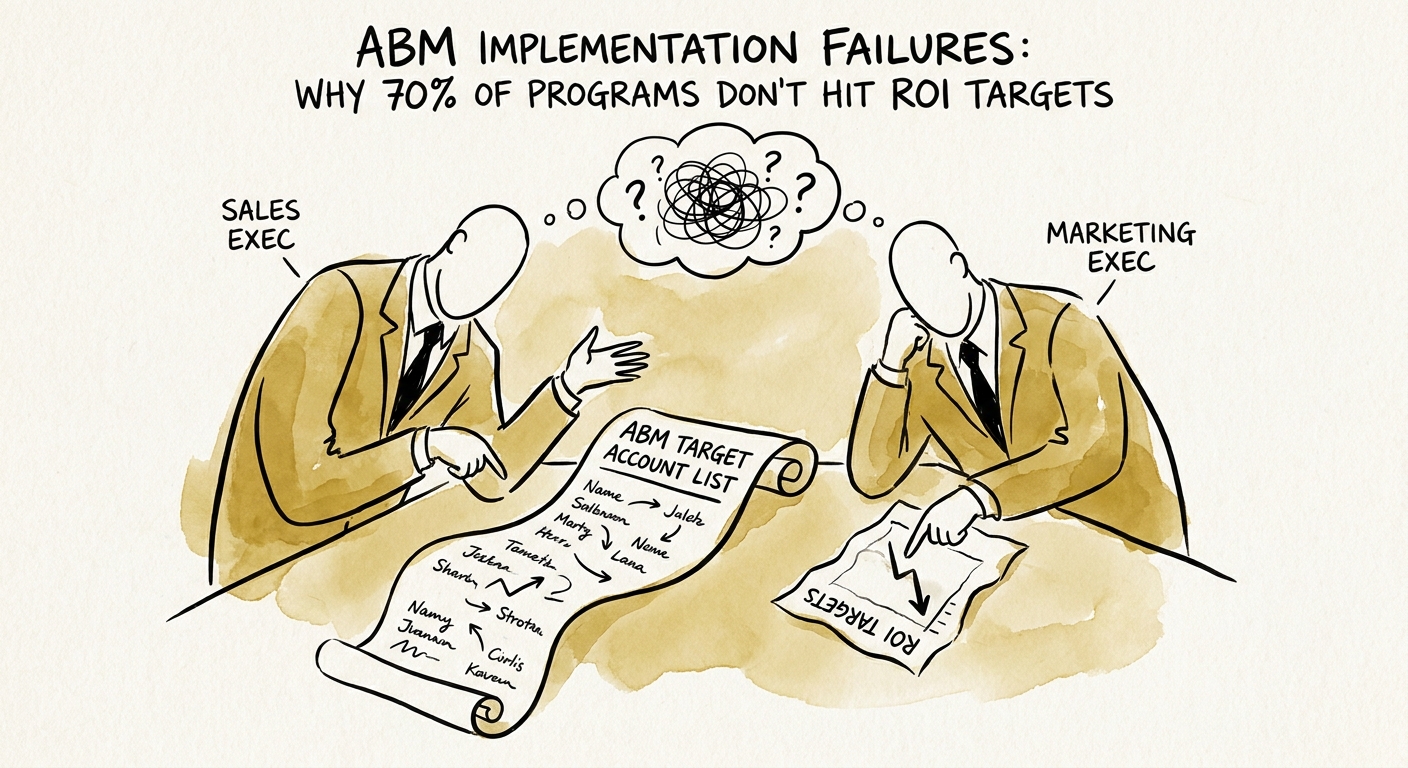
Here is the moment in the audit where the failure became obvious. I asked marketing for the target account list the program was running against. Then I asked the head of enterprise sales which accounts his reps were actively working that quarter. I put both lists in two columns of a spreadsheet. The overlap was about a third.
So marketing was sending personalized direct mail and high-touch gifts to a set of Tier 1 logos, while the sellers were heads-down on a different set — many of them inbound mid-market opportunities that had nothing to do with the ABM strategy. The "account-based" program was, in practice, two teams pointed at two different markets, each measured on its own scorecard. That isn't a tooling gap. It's a coverage gap, and it's the rule rather than the exception: Forrester's work on sales and marketing alignment in ABM reports that only 36% of companies running ABM consider the two functions tightly aligned. The other 64% are funding parallel motions and calling it one program.
I tell operating partners and founder-CEOs the same thing before they renew any ABM contract: fix the handshake before you touch the software. The reason this is worth the organizational fight is that the upside only shows up when the motion is actually unified. The whole point of account-based selling isn't winning more logos — it's changing the unit economics of the deals you do win by landing larger, more strategic accounts. Demandbase's analysis of ABM deal-size impact puts the effect at a 171% increase in average deal size when it's executed properly. But "properly" is doing enormous work in that sentence. The 171% belongs to the companies whose marketers and sellers are running the same play against the same named accounts, with one shared definition of progress. A misaligned program doesn't capture a fraction of that lift. It captures the agency invoice.
What I'd have you do Monday
I've rebuilt this motion three times inside portfolio companies, and the fix has never once been a better platform. Start with the spreadsheet I described above. Put the marketing target list and the active sales coverage list side by side, and measure the overlap honestly. If it's under 80%, you don't have a measurement problem yet — you have a coverage problem, and no dashboard will fix it. Lock a single tiered account list in a room with both leaders present, and tie the tiers to your own historical win/loss data, not to a vendor's firmographic model.
Then retire the generic MQL as your unit of progress. A click from one junior contact tells you nothing about whether a buying group is forming. Move to account-level engagement scoring that reflects multiple stakeholders activating across the same logo, and make that score the shared currency both teams report on. This is a revenue-operations rebuild more than a marketing one — the data architecture behind it is what most teams skip, and it's worth reading our guide to building that RevOps foundation before you commit budget.
Last, audit the pipeline the program generates as ruthlessly as you'd audit a forecast. The most dangerous artifact in a failing ABM program is the "influenced pipeline" number — deals the program touched but never actually advanced. It looks like traction and forecasts like air; the discipline for separating real opportunities from dashboard inflation is in our sales forecasting accuracy audit. And if your messaging simply isn't landing with the accounts you've targeted, that's a positioning problem the software will never solve — work the playbook for rebuilding win rates instead. The pattern that keeps these programs stuck is treating ABM as a pilot that never becomes how the company actually goes to market; ITSMA's research on ABM maturity finds fewer than 20% of companies have it fully embedded. Treat it as a capital-intensive coverage strategy, embed it, and hold it to a revenue number. If you won't align the organization around it, don't renew the license at all.