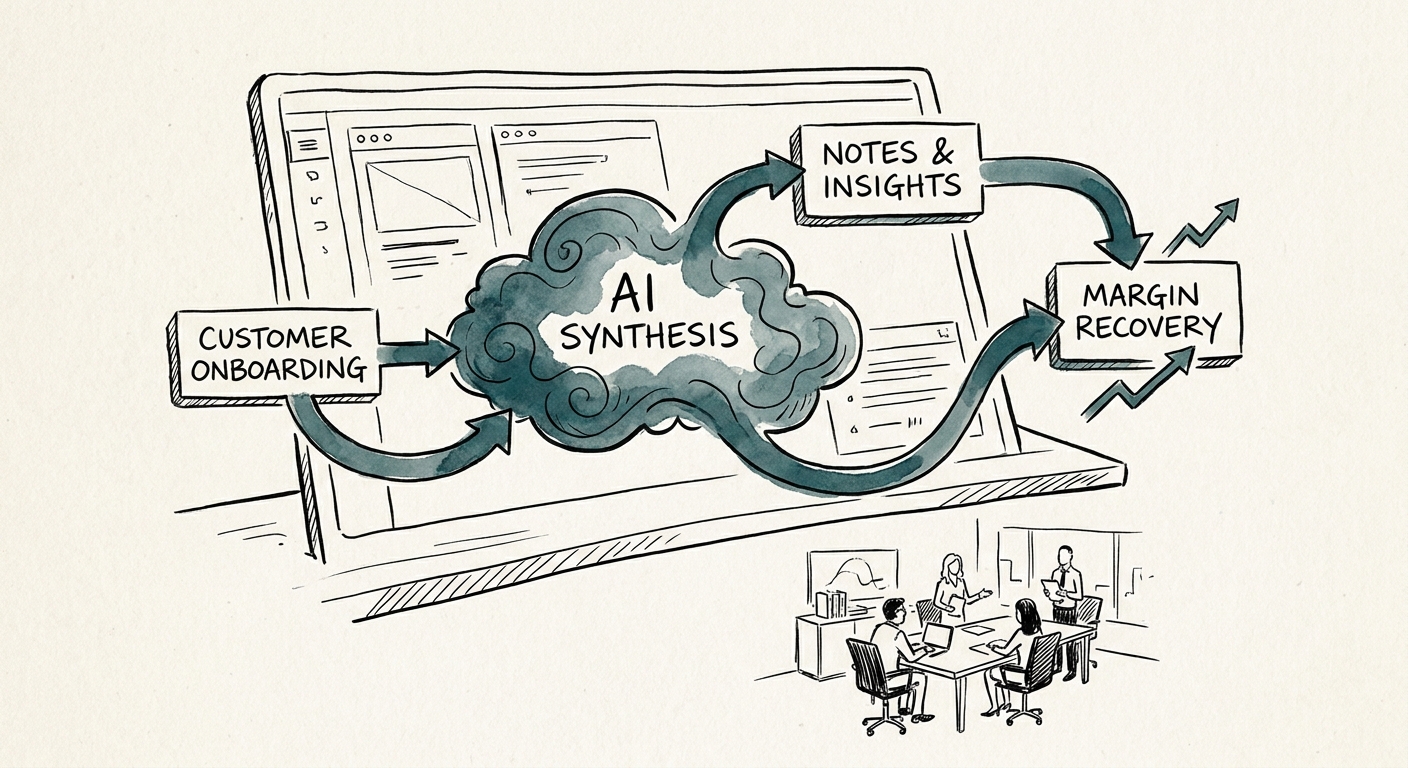
The handoff is where the money leaks
Picture a 60-person consultancy. A senior closes a six-figure implementation, runs a great kickoff, and fills two pages of notes: scope, the client's "must-haves," a few assumptions made on the call, and an open question about who owns data migration. Three weeks later that senior is on a different engagement, and a delivery lead is rebuilding the entire context from a Slack thread, a recording nobody re-watched, and a memory of what the client "probably meant." That gap, between what was promised at kickoff and what gets built, is where margin quietly disappears in professional services.
So the instinct is reasonable: point an AI at the onboarding notes and let delivery ask it questions. The instinct is also where most firms go wrong. A kickoff note is not a clean record. It's a layered document where a client commitment ("we need SSO live by launch"), an internal assumption ("they're probably fine with the standard auth provider"), and an unresolved risk ("migration owner unassigned") sit in adjacent sentences with no labels. Retrieval that treats all three as equally true will confidently hand a delivery lead an assumption dressed as a client requirement. That is worse than no answer, because it carries the manager's trust with it.
The adoption pressure is real. The U.S. Census Bureau's AI use data shows larger firms moving fastest, and OECD research on SME AI adoption shows smaller shops chasing the same gains with thinner guardrails. But Deloitte's 2026 State of AI report keeps landing on the same point: value comes from a workflow you can measure and correct after the demo, not from the demo itself. For onboarding notes specifically, that means the system's first job is not "answer questions about the project." It's "tell the reader which sentences are client fact and which are our assumption."
Build the layer to label, not just to summarize
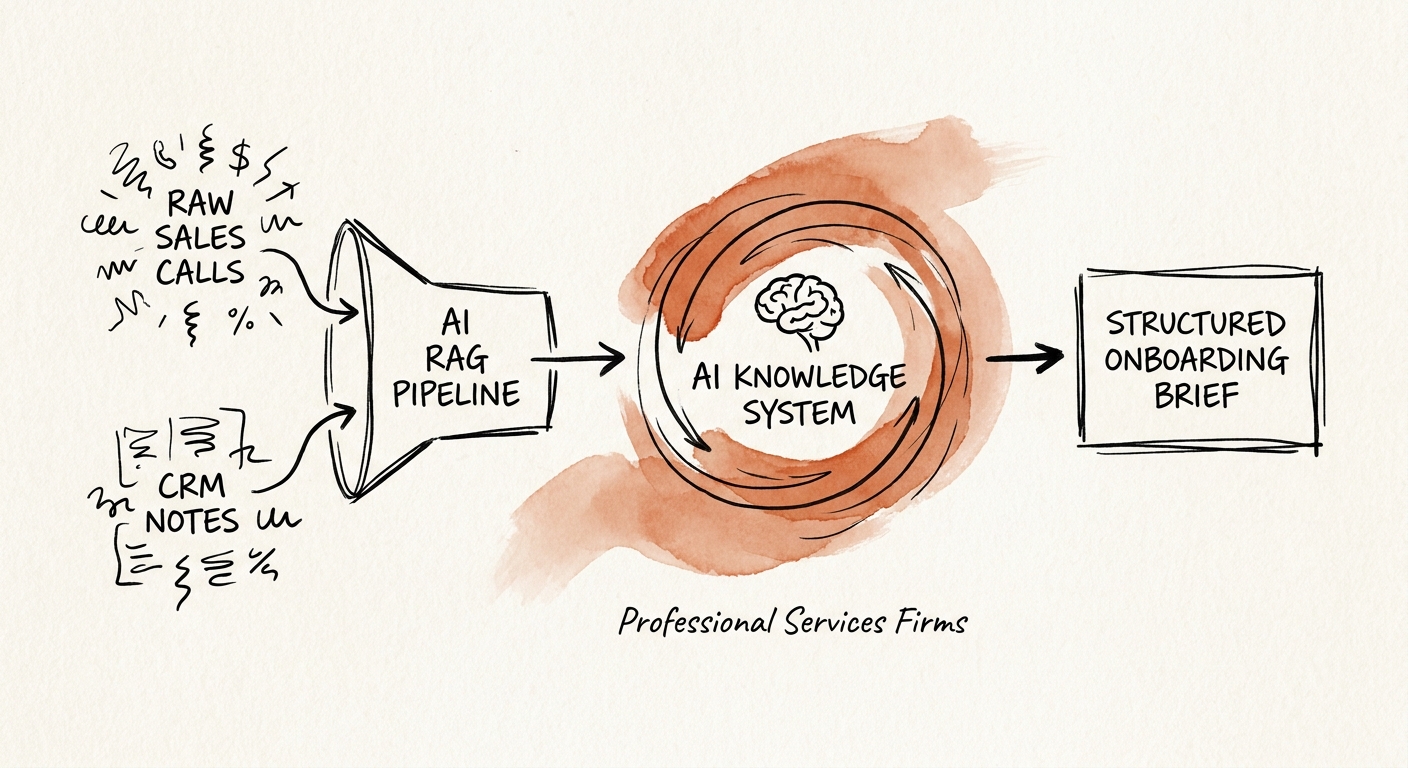
Here is the design decision that separates a useful onboarding-notes system from a fancy search box. When the delivery lead asks "what auth method did the client commit to?", the answer should not be a paragraph. It should be a small record: the retrieved sentence, where it came from (the kickoff doc, line and date), a tag of client-stated versus team-assumed versus open question, and the name of the person who can confirm it. If the auth method was never confirmed, the right output is "no client commitment on record, flagged as assumption by [senior] on [date], confirm before building," not a clean-sounding guess.
That structure is the control. NIST's AI Risk Management Framework frames risk as contextual, and onboarding notes are a textbook case: a phrase that's harmless in a sales recap becomes a missed deliverable the moment it drives a build decision. Because these notes carry client names, contract scope, and sometimes their systems data, the permission boundary, retention window, and access log for the notes corpus deserve the same treatment CISA's data-security guidance applies to any training and operating data, and you should know what your model vendor's enterprise privacy terms actually commit to before client engagement data flows through it. Set those boundaries before the first query, not after a client asks why their kickoff notes are searchable by the whole firm.
Then measure things a delivery org actually feels. Not "queries answered." Track: how often a handoff happens without the delivery lead pinging the original seller; how many assumptions get caught and confirmed before they become rework; and the manager acceptance rate on the AI's labeled records. If a delivery lead still has to re-read the raw kickoff doc to trust the answer, the system failed, and the fix is almost never a better model. It's cleaner labeling at the source, a narrower set of approved documents, or a seller who tags assumptions as assumptions while the call is still warm.
A 90-day test you can actually fail
Run it on one service line, not the whole firm. Days 1 to 30: take the last 20 closed engagements, and for each, have the seller and the delivery lead jointly mark every kickoff note as client-stated, team-assumed, or open. You will be surprised how much was "assumed." That labeled set is your gold standard and your reality check in one pass. Days 31 to 60: turn on retrieval for new kickoffs and, for each handoff, compare the AI's labeled answer to what the delivery lead would have concluded reading the raw notes. Days 61 to 90: count the assumptions that got confirmed before build instead of after, and decide.
A good result is boring. Delivery leads stop scheduling "re-kickoff" calls because the original context survived the handoff. Open questions get answered before someone builds against a guess. A bad result looks polished in a demo but leaves managers quietly re-reading the source doc anyway, because they learned the labels can't be trusted. For a mid-market services firm, that distinction is the whole game: you cannot justify a system that adds a review queue on top of the rework it was supposed to kill. If the labels aren't trusted, kill it and fix the note-taking habit first.
Monday, you can start without any software: ask one seller to tag assumptions inside their next kickoff note. If that single discipline reduces handoff friction, you have proof the AI layer is worth building. When onboarding notes are competing with other first AI use cases for attention, run the AI Opportunity Score to rank them, and reach for the AI ROI Calculator only once the review path has produced real time-saved evidence. We sequence that work inside the AI Transformation Blueprint so a firm can move from clean handoffs to the next workflow without losing control of who owns the source.