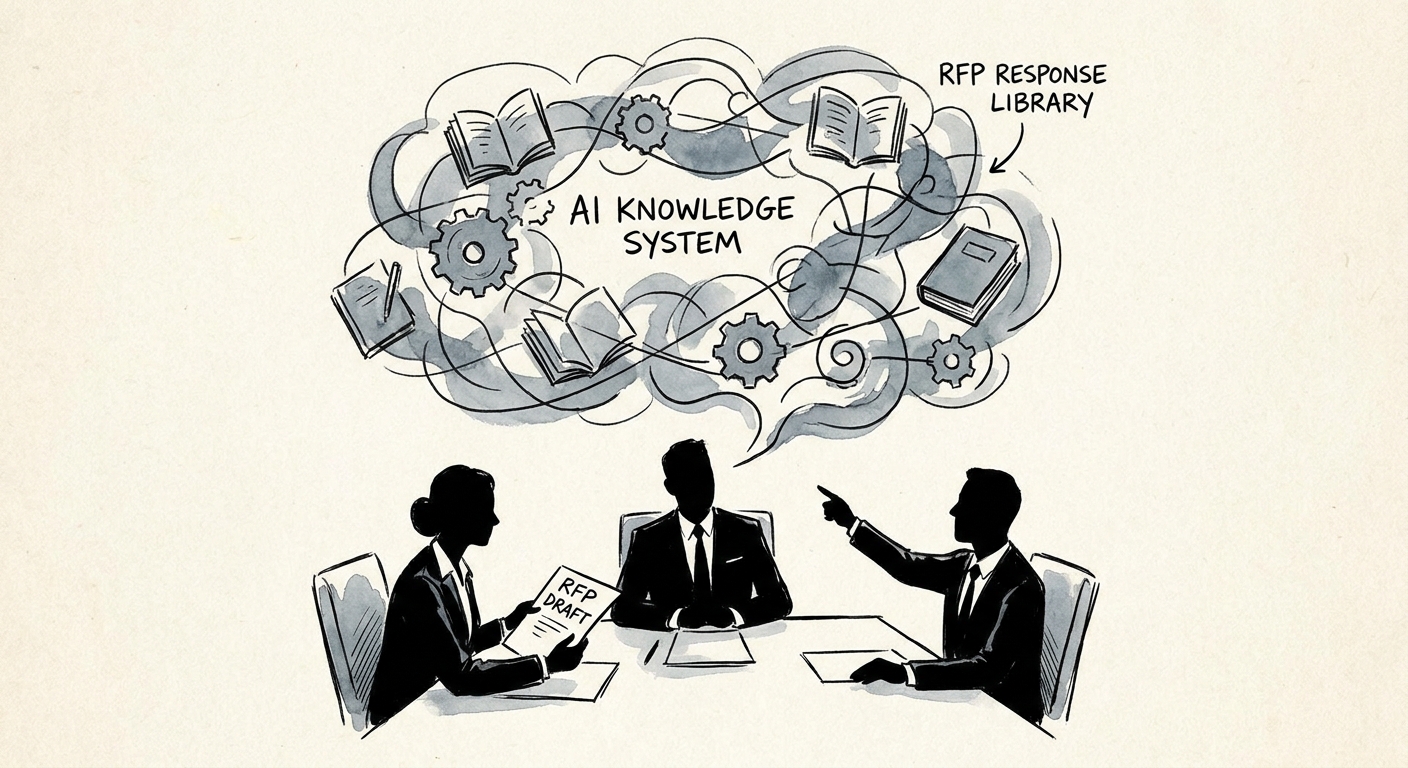
The 4 p.m. paste is where it breaks
Here is the moment that actually decides whether an AI RFP library helps or hurts. It is 4 p.m., the proposal is due at 5, and someone on your professional services team is searching the shared drive for the SOC 2 paragraph, the "describe your data retention policy" answer, and the three reference engagements that match this prospect's industry. They find a version. They paste it. Nobody can say for certain whether it is the version from the audit that closed last quarter or the one written eighteen months ago, before you changed sub-processors.
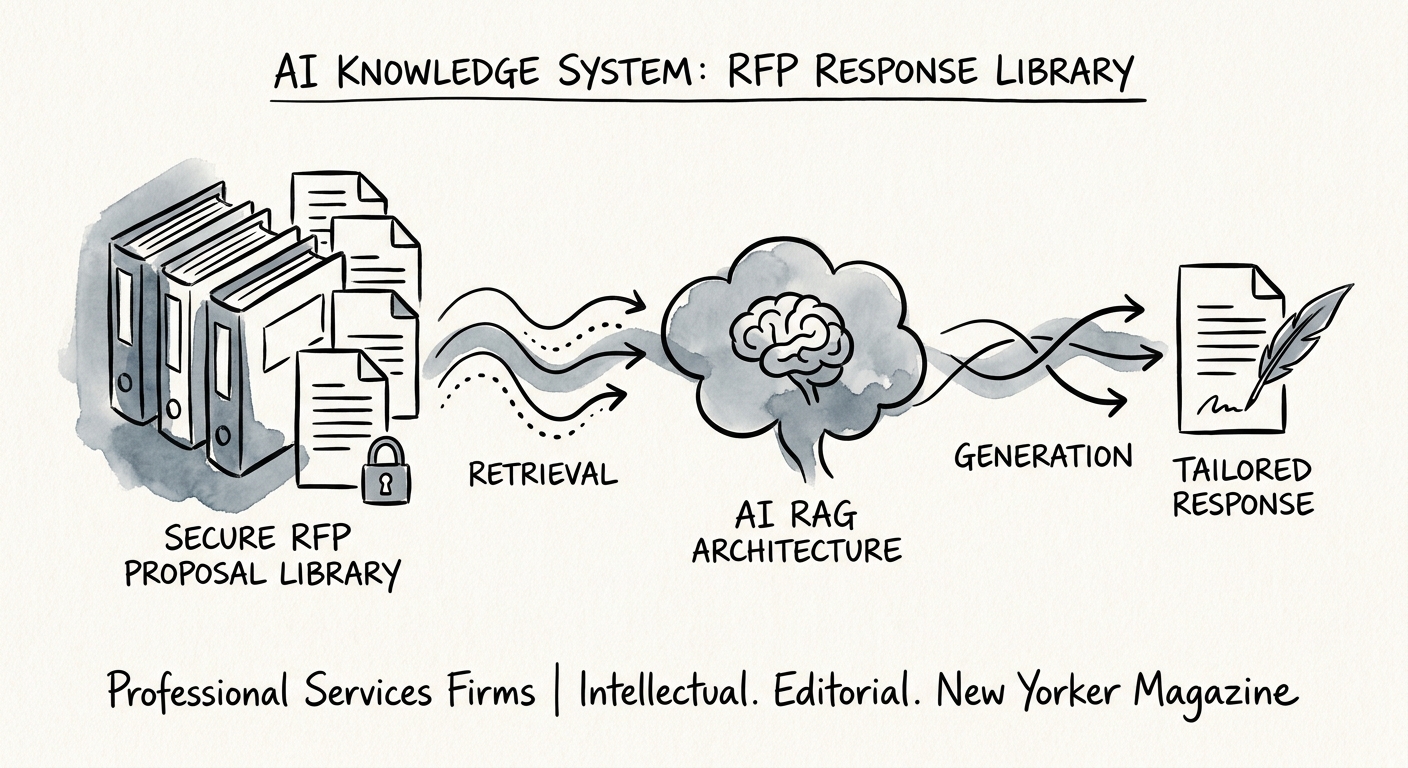
That is the workflow an AI knowledge system should attack first — not "answer any question about the firm," but the specific retrieval scramble across approved RFP answers, current proof points, security questionnaire responses, pricing caveats, SME annotations, and what you actually submitted last time to this buyer's category. The trap is treating this as a software rollout. It is an operating discipline. The U.S. Census Bureau's data on AI use at U.S. businesses and the OECD's research on AI adoption by SMEs both describe firms feeling pressure to adopt; neither says retrieval over an unmaintained library produces a winning proposal. Deloitte's State of AI in the Enterprise 2026 makes the same point in the language of production: value comes from a process you can measure and correct, not from the demo where the assistant retrieves a clean-looking answer.
So scope the first pilot to one thing: the security-and-proof section of inbound RFPs, the section that sinks deals when it's wrong and that nobody enjoys maintaining. Name one accountable owner for that library. Name what the AI is forbidden to settle on its own — pricing exceptions, contractual terms, security representations, and any named-client reference — because those four are exactly the fields that, when stale, turn a submission into a problem you cannot retract.
Make every answer carry a date and an owner
The difference between an RFP library that's safe to automate and one that isn't comes down to a field most firms never add: the proof date. A reference engagement you can describe is an asset. A reference engagement you described in 2024, retrieved confidently by an assistant in 2026, and submitted to a procurement officer who then asks for a current contact — that is a credibility loss you authored yourself. Before any AI sits on top of this library, every answer needs three attributes attached: when its proof was last verified, who owns its accuracy, and whether the cited client agreed to be named.
Then the review artifact does the work. For each AI-proposed answer, the reviewer should see the source record it pulled from, the verification date on that source, the specific RFP question it's answering, and the SME who can defend it. That is a packet a proposal manager can accept, edit, or reject in seconds — not a chat transcript they have to re-litigate. The NIST AI Risk Management Framework is useful here precisely because RFP risk is contextual: a capability sentence that's fine as internal marketing becomes a binding representation the moment it enters a response to a government or enterprise buyer. CISA's guidance on securing the data used to operate AI systems should set the permission and logging boundary for the security-questionnaire content specifically, since that material describes your own controls. And if you're using a hosted model, confirm the retention and training terms in writing — vendors like OpenAI publish enterprise privacy commitments for exactly this reason.
Measure five things in the first release: how many retrieved answers carry expired proof, the SME correction rate per submission, response-cycle time on the security section, the count of unsupported capability claims caught before submission, and the reuse rate of recently-verified proof. If those numbers don't move, the fix is not a smarter model. The fix is a cleaner library with owned, dated sources.
The 90-day test, and the win-loss link most firms skip
Days 1 to 30: trace one real RFP from "received" to "submitted" and flag every source the library owner would not personally defend in front of the buyer. Delete or quarantine those. You will likely find the bulk of your "AI accuracy problem" is actually a maintenance problem hiding in the source data. Days 31 to 60: run the assistant in parallel with your proposal manager and compare each retrieved answer against what an experienced manager would have approved — log the gaps, not just the hits. By day 90, decide: scale, narrow, or pause until the underlying library is repaired.
Here is the link almost every firm leaves on the table. Tie the AI library back to win-loss notes. When you lose, capture whether a security answer, a proof point, or a pricing caveat contributed — then feed that correction into the library so the next retrieval is sharper. A good outcome looks boring: fewer last-minute SME fire drills, fewer reviewer rewrites, faster turnaround on the section that used to eat a full afternoon. A bad outcome looks polished but still leaves your proposal manager re-checking every reference and security paragraph by hand, which means you've added a review queue instead of removing one — and a mid-market firm cannot carry that.
If RFP support is competing with other first uses for AI, run the AI Opportunity Score to rank it honestly. Once the review path has produced real time-saved and quality evidence — not before — pressure-test the case with the AI ROI Calculator. Human Renaissance sequences that work inside the AI Transformation Blueprint, so the firm moves from a governed RFP library to the next workflow without ever losing control of the source.
