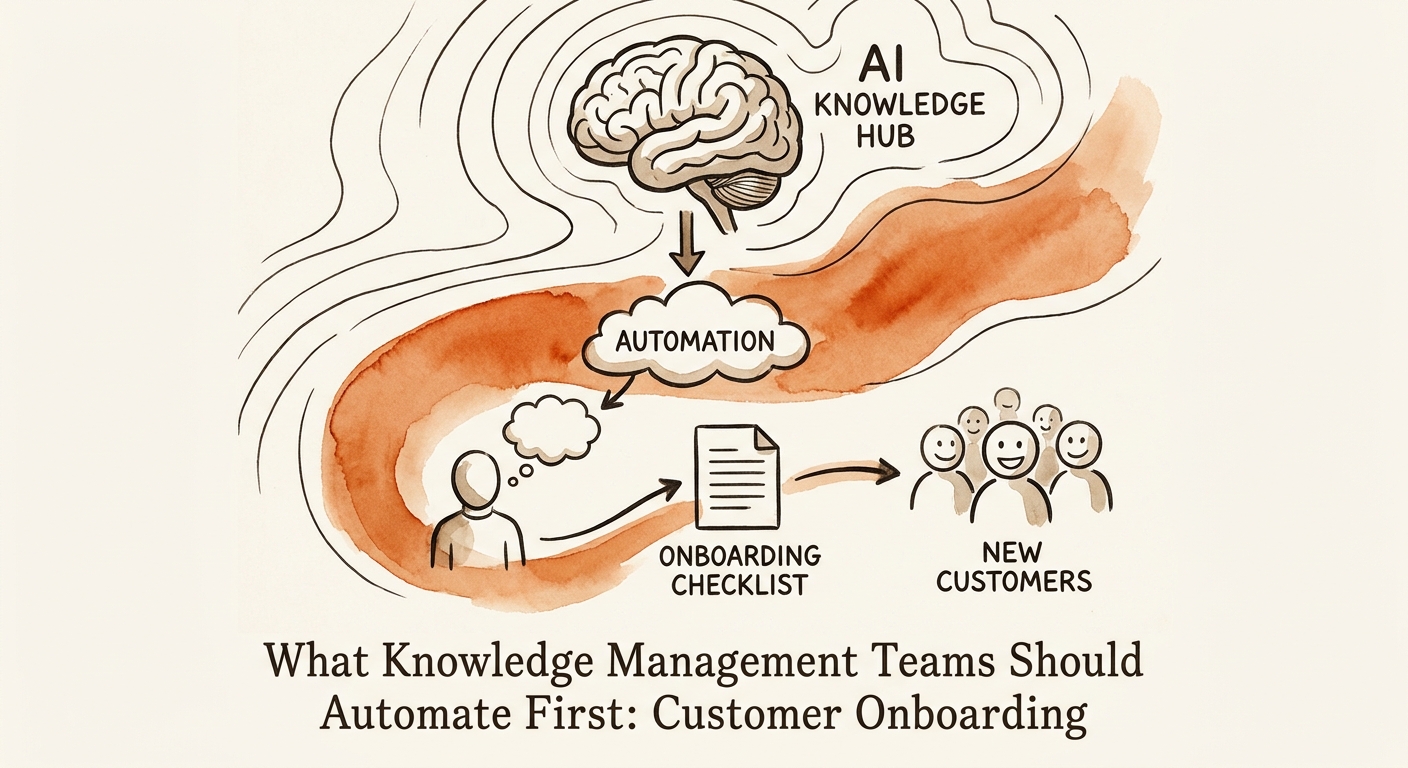
The new customer asks a normal question, and your IM goes hunting
Picture a 40-person SaaS company. A new mid-market account is in week two of onboarding. The customer asks something completely routine: "Does your SSO support our SCIM provisioning, and what scopes do we need to grant?" The implementation manager doesn't know offhand. So she does what implementation managers do everywhere: she pings the solutions engineer, who pings a backend dev, who half-remembers the answer was documented somewhere in a Notion page that got renamed in March. Three days and eleven Slack messages later, the customer has an answer. Multiply that by every SSO, every webhook config, every data-residency question, every "can we turn off this default" — across every account in flight — and you have your real onboarding bottleneck. It isn't relationship management. It's retrieval failure.
Customer onboarding in software is a compressed knowledge-transfer problem wearing a relationship-management costume. The customer needs provisioning steps, integration prerequisites, permission scopes, a sandbox-to-production path, and a credible answer to "what breaks if we do it this way." The IM has to surface all of that without becoming a tax on engineering's sprint. That's exactly the shape of work where a governed retrieval system earns its keep — and exactly where a generic chatbot makes things worse, because a public-facing bot that improvises an SSO answer doesn't save a week, it manufactures a support ticket and a trust problem.
The RSM middle-market AI survey shows adoption is already widespread among companies this size; the gap isn't whether to use AI, it's picking a workflow narrow enough to govern. The San Francisco Fed small-business AI analysis notes the same rising interest among smaller firms. Channel that interest into one diagnostic question: which onboarding answers are slow not because they're hard, but because they're scattered across stale docs nobody trusts?
Scope the corpus to what's actually true on the day of implementation
The interface is the easy part. The corpus is where projects live or die. For SaaS onboarding, build the truth set from the documents an IM reaches for during a real implementation: the integration prerequisites matrix, the SSO/SCIM provisioning runbook, the permission-scope reference, the sandbox-to-production cutover checklist, the API rate-limit and webhook config guide, the support-handoff criteria, and the approved language for known limitations ("here's the documented behavior, here's the workaround"). Then do the unglamorous work nobody likes: pull out the customer-specific exceptions that should never become a default answer, the deprecated v1 integration docs, and the engineering scratch notes that were never meant for an IM's eyes.
The OECD SME AI adoption report draws a sharp line between simply using AI and running an AI-enabled business activity. In onboarding that distinction is everything. An IM pasting a question into a model is "using AI." A controlled onboarding knowledge system has a named source owner, a refresh cadence tied to each product release, access boundaries, and a citation requirement on every answer. That's the difference between a clever shortcut and a system you'd trust during a six-figure implementation.
Set the behavior rule before you set the prompt: the assistant retrieves source-backed answers and shows the IM exactly which document and section it came from. When two sources conflict — say the rate-limit doc and the integration guide disagree — it flags the conflict instead of averaging them into a plausible lie. And when it can't find a reliable source, it does not write a confident paragraph. It hands back an escalation path and drops a missing-document item into the backlog. That last behavior is the feature, not the failure mode: every "I don't have a source for this" is a map of where your onboarding docs are quietly rotting. This is why AI Knowledge Systems and RAG is the right lane — retrieval-augmented generation is only as good as the retrieval layer, and if your integration docs contradict each other, your first project is source cleanup and ownership, not prompt tuning.
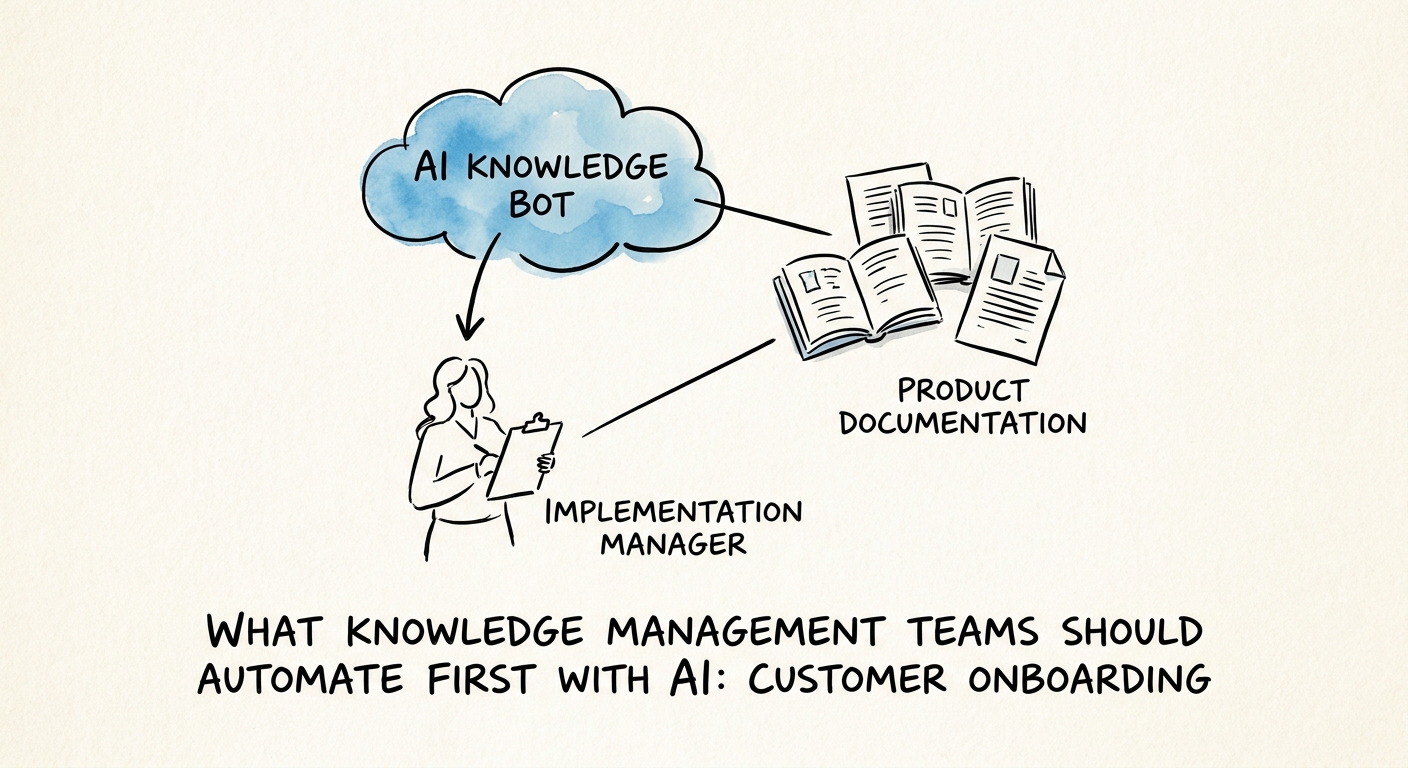
Measure time-to-value, and never let it promise a roadmap date
Track the business case in operating terms an IM and a CS lead already care about: median time to resolve a routine setup question, internal escalations per onboarding, answer consistency across IMs (do two managers give the same SSO guidance?), clean handoffs to support, and customer-facing corrections after go-live. The Deloitte State of AI report keeps returning to one lesson: value comes from changing the process, not bolting a tool beside it. If the assistant doesn't actually shorten the SSO-question loop, you've added software, not capability.
The risk boundary is unusually concrete in onboarding, because the assistant is one keystroke away from making promises the company will be held to. It must never commit to a feature, a roadmap date, a custom integration build, or a contract term that hasn't been approved — the moment it says "yes, that ships next quarter," you have a renewal conversation built on a hallucination. The Gartner agentic AI project forecast is the warning shot here: this is a human-reviewed knowledge assistant for your IMs, not an autonomous agent fielding customer questions unsupervised.
If you're deciding where to start, do this on Monday: pull the last twenty onboarding email threads, list every question that appears in at least half of them, and check each one against your approved docs. The questions that recur AND have a clean, owned source are your launch set. Use the AI Opportunity Score to sanity-check whether onboarding really has cleaner data and clearer ownership than, say, your support or sales-enablement content. Then ship deliberately small: one onboarding domain — say, integrations and provisioning — one source owner, one standing weekly review where you read the escalation log and the missing-doc list. Within ninety days that log tells you which answers landed, which questions exposed a gap, and which docs had to change. That's how onboarding stops being a weekly search exercise and becomes a knowledge product that gets sharper every release.