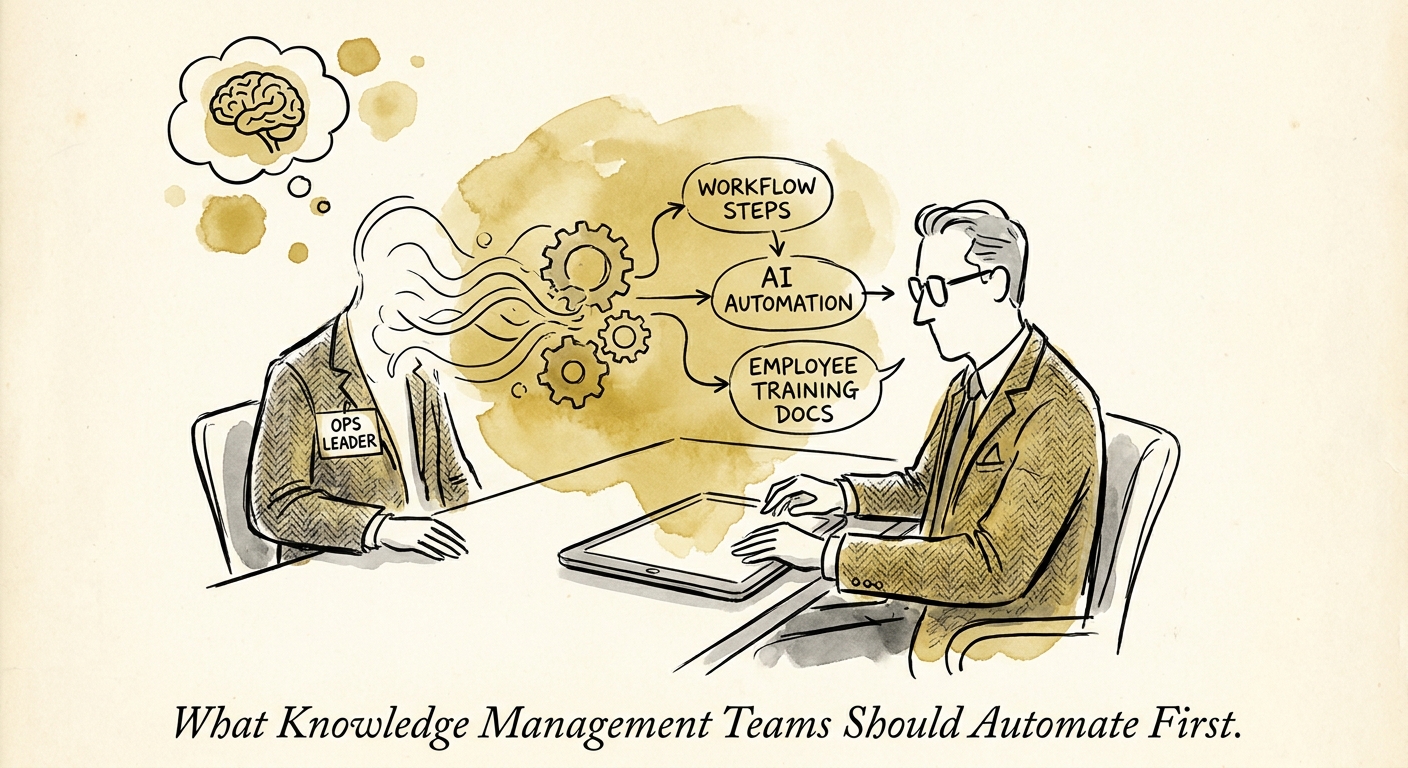
The handbook says one thing. The person training you says another.
Here is the scene that exposes the problem. A new hire at a 60-person B2B services firm is three weeks in. They open the onboarding guide, follow the documented process for setting up a client account, and get it wrong — because the real process changed two quarters ago and the change only lives in a Slack thread and in the head of whoever's been here longest. So they stop reading the guide and start tapping the senior person on the shoulder. Every. Single. Time.
That is what training documentation debt actually costs you: it doesn't show up as a missing document, it shows up as a tax on your most experienced people, who are now part-time onboarding infrastructure. The RSM middle-market AI survey shows wide AI adoption across firms your size — but pointing a chatbot at the existing handbook just makes the wrong answer faster to find. You've automated the lie.
The San Francisco Fed small-business AI analysis notes rising interest among smaller companies, and that interest tends to start broad and vague — "an AI for our docs." Resist that. The only question worth asking first is narrower: which one recurring onboarding question, asked by every new hire, currently has no trustworthy written answer? That is your first workflow. Not the handbook. One question that a senior person answers from memory more than twice a week.
Capture how the work is actually done — then let AI repeat it, not invent it
Most training-doc projects start with a blank page and a promise to "write the SOP." Skip that. Start by recording the senior person doing the thing — the client onboarding, the billing setup, whatever your high-frequency question maps to. Capture the screen, the decision points, the "if the client is on the legacy plan, do this instead" forks, and the moment where they say "honestly, at this point I just ask the account lead." That last sentence is gold: it marks where judgment beats procedure, and an AI assistant must hand the question off there instead of guessing.
That distinction is the whole game. The OECD SME AI adoption report separates AI experimentation from AI embedded in core work — and training crosses into core work the moment a new hire learns the job from the assistant instead of from interrupting a colleague. To get there, every workflow you capture needs five things nailed down before launch: a named owner, one approved source document, a review interval, a version rule, and an escalation path for the judgment calls. If the assistant isn't sure, it says so and drops the question into your documentation backlog — it never improvises a procedure.
This is the same discipline behind building an internal AI knowledge assistant: the assistant is the delivery layer, not the program. The program is the captured workflow, the approved source, and the feedback loop. Bolt an assistant onto undocumented tribal knowledge and you don't get training — you get a confident-sounding tool that's wrong in exactly the ways your handbook already was.
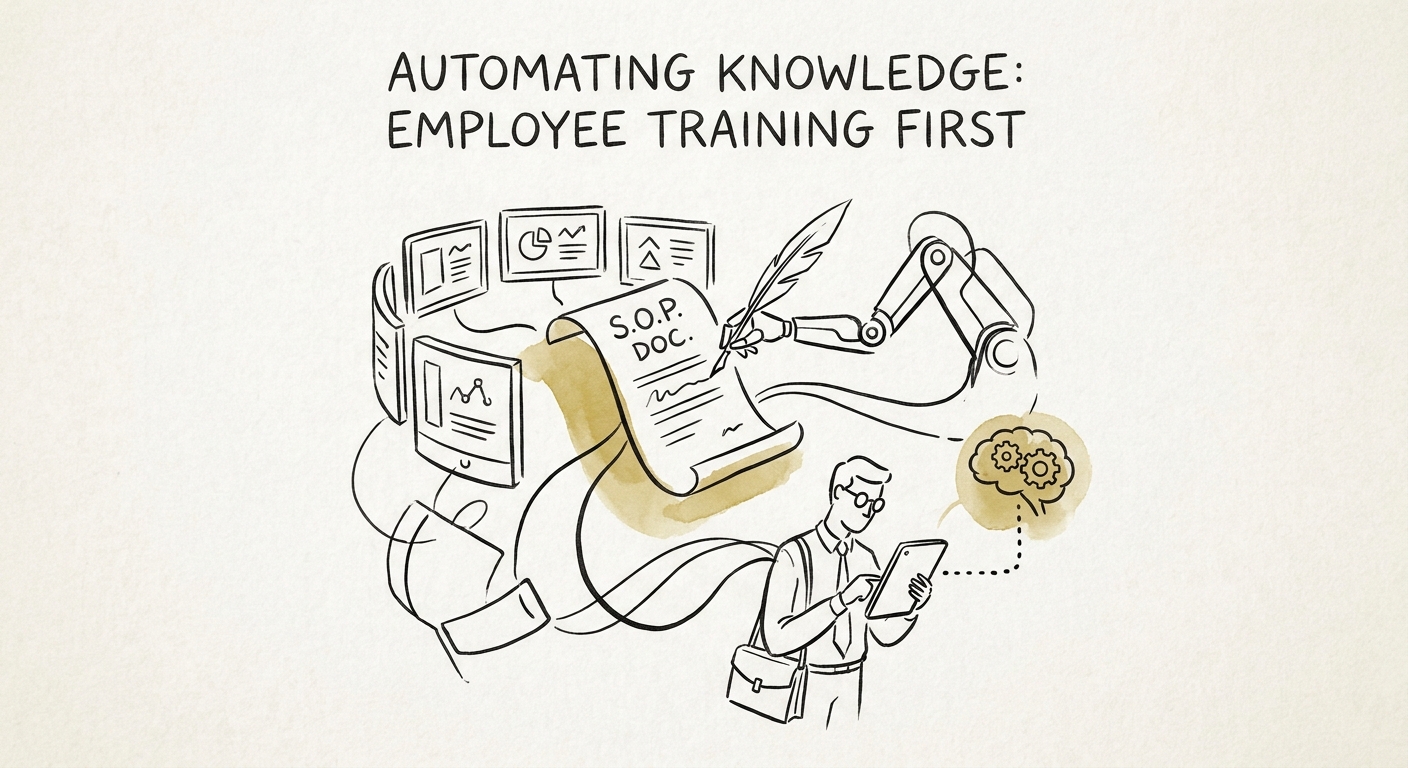
Measure time-to-competency, not "docs created"
You'll know it worked by watching one number: how long until a new hire can complete the captured workflow correctly without tapping a senior person. Track time-to-competency on that specific task, plus the count of repeat interruptions to your experienced staff. The Deloitte State of AI report is blunt that AI value comes from process change, not tool deployment — and training is the cleanest place to see it, because the outcome is binary. The new hire either got the account set up right on their own, or they came asking. Count the asks.
Mind the governance line. In a services firm, training content isn't uniform: "how to provision a client workspace" is procedural and safe to surface freely; "what we can and can't commit to in an SOW" carries contractual and financial weight and needs review attached to every answer. The Gartner agentic AI project forecast is a useful scare — projects die when teams automate past their controls. Your assistant should cite its source on every answer, flag the high-stakes topics for human review, and surface exceptions rather than smoothing them over.
So, Monday: pick the single onboarding question your senior people answer most, and time how long it takes a recent hire to do that task unaided today — that's your baseline. If you want to pressure-test whether training docs is even the right first workflow versus other candidates, run the AI Opportunity Score to compare them on value, source readiness, and risk. Once you've got one workflow captured and an approved source behind it, AI Knowledge Systems and RAG is how you turn that training library into something an assistant can actually be trusted to read aloud.