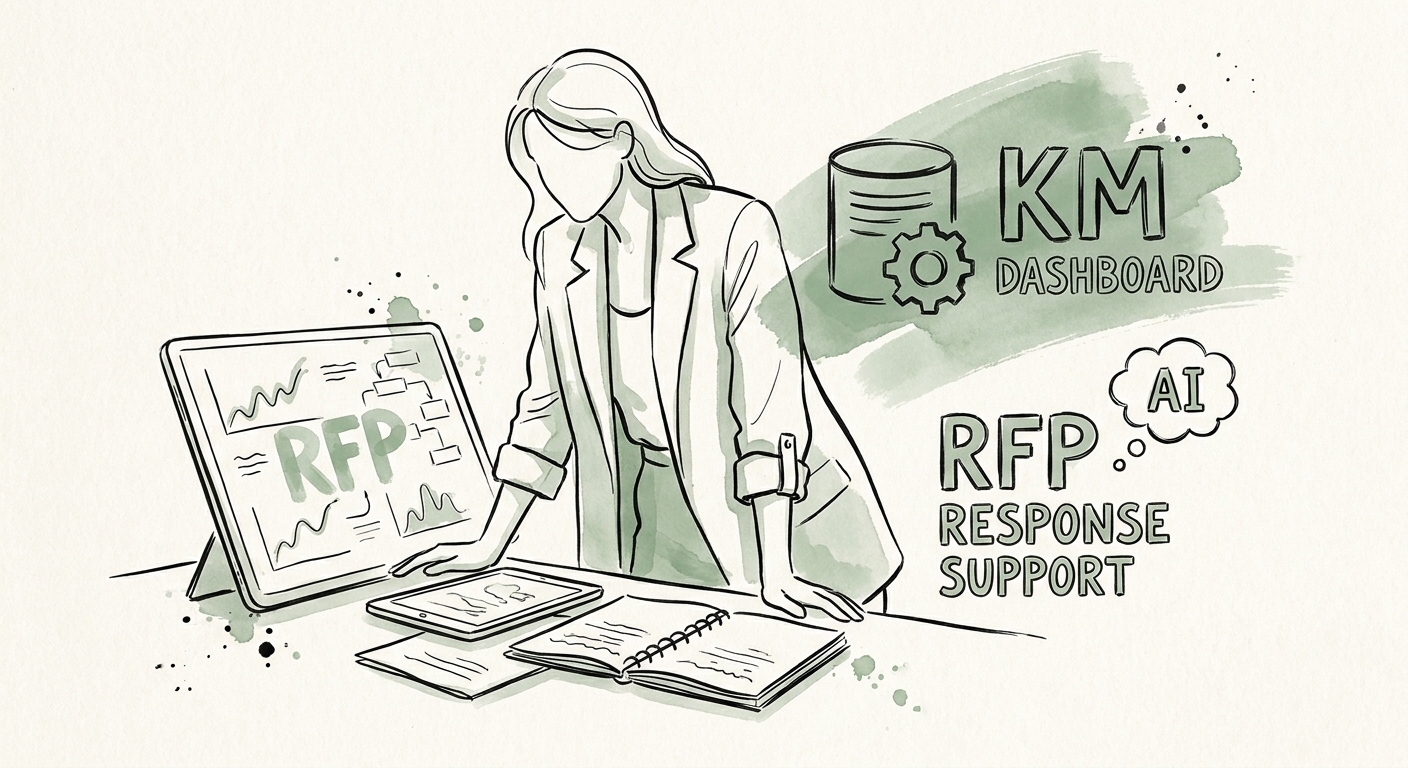
The Real Problem Isn't Speed. It's the Answer That Was Right Last Quarter.
Picture the Thursday-afternoon RFP. A 120-question security questionnaire lands with a Tuesday deadline, and the proposal lead does what every proposal lead does: searches the shared drive for the last response that looked close, copies the answers, and ships. Three of those answers are now wrong. Your SOC 2 scope changed in March. Your data-residency answer still says "US-only" after you spun up an EU region. The case study you cited belongs to a client who asked you to stop naming them. Nobody catches it, because catching it was nobody's job.
That is the workflow to automate first — not because AI writes prose faster, but because the cost of a stale answer in a binding procurement document is asymmetric. A clumsy sentence loses a few style points. A wrong security representation can lose the deal in legal review, or worse, survive into a signed contract. So the first question for a knowledge team isn't "can AI draft answers?" It's "can AI tell us which of our existing answers we're no longer allowed to send?"
The adoption pressure is real and rising — the U.S. Census Bureau's data on AI use at U.S. businesses shows steady uptake, and the OECD's research on AI adoption by SMEs confirms smaller firms are moving too. But Deloitte's 2026 State of AI is blunt about where value actually shows up: in workflows you can measure and govern, not in a chatbot pointed at every file you own. Pilot one queue — inbound RFPs and security questionnaires — over one answer library, with one owner who is allowed to retire an answer.
What AI Drafts, and the Four Answers It Is Never Allowed to Finalize
Here's the line that keeps this safe. AI retrieves and proposes; a human commits anything binding. Draw it explicitly, because RFP responses are full of sentences that look like prose but function like contract terms. Four categories never leave the building on AI's signature alone: security and compliance representations (encryption, certifications, breach history, subprocessors), pricing and commercial terms, named-client references and logos that require permission, and the final submission itself. Everything else — boilerplate company descriptions, methodology answers, standard feature explanations — is fair game for an AI first draft pulled from your approved library.
For each proposed answer, the reviewer should see one compact card: the source answer it pulled from, the date that answer was last verified, who owns it, and a freshness flag if it's aged past its review window. That's the difference between governance and a chat transcript. The NIST AI Risk Management Framework makes the point that risk is contextual — a sentence harmless in a brainstorm becomes material the moment it enters a procurement document — so your controls live at the answer level, not the model level. And because security questionnaires force you to describe exactly how you handle customer data, the CISA AI data-security guidance should shape what the tool is allowed to ingest, retain, and log in the first place. Don't let the system that writes your security answers become a security finding itself.
Then instrument the things RFP teams actually lose deals over: percentage of answers sent within their verified-fresh window, how many stale answers the tool flagged and suppressed before they shipped, source-citation coverage on submitted responses, and the SME rework rate — how often a subject expert had to rewrite an AI draft from scratch. If the SME rework rate isn't falling, the fix is not a smarter model. It's a cleaner library and an owner empowered to delete the answers nobody will stand behind.
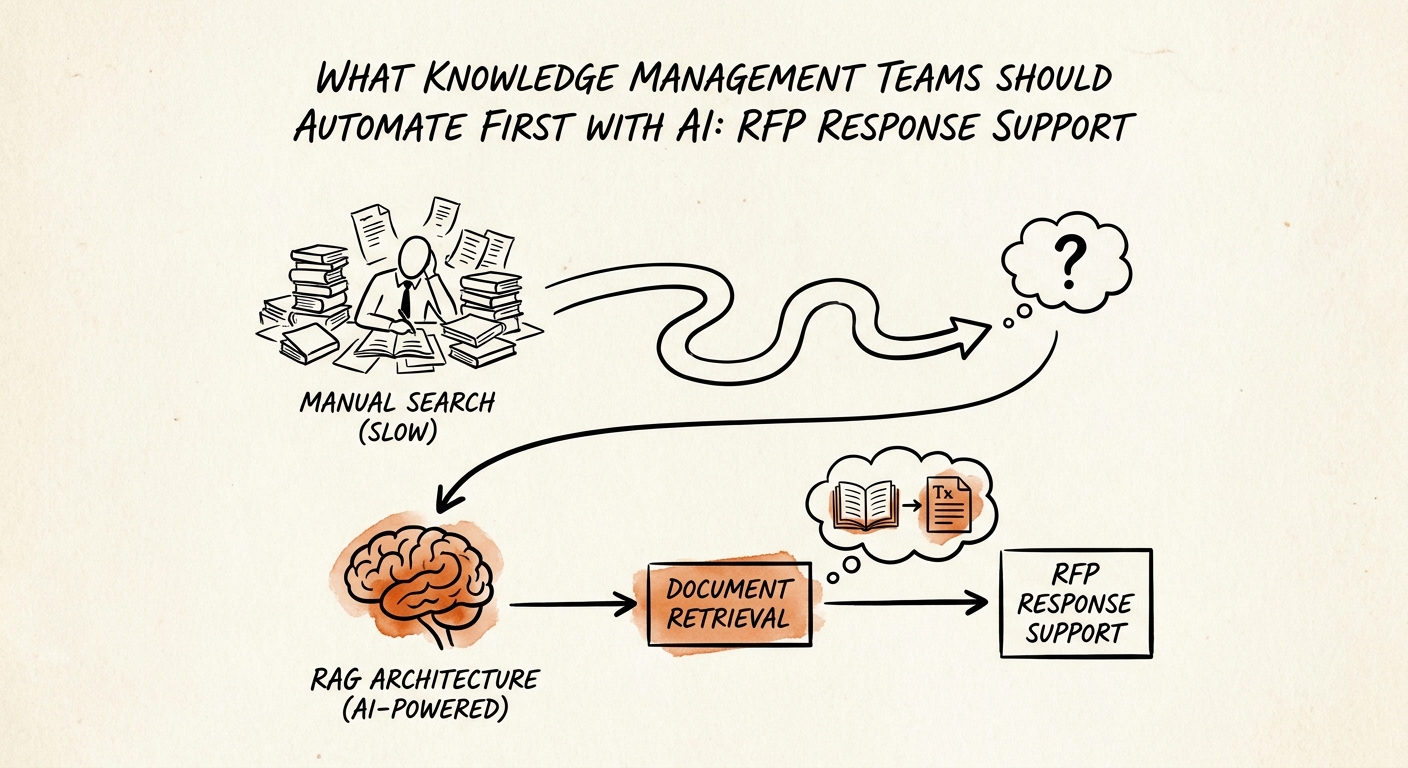
The 30-60-90 That Tells You Whether to Scale or Stop
Days 1–30: don't touch the AI yet. Map every inbound RFP from arrival to submission, and run a brutal triage of the answer library. Any answer no SME will personally defend gets retired or flagged "needs verification." A library you wouldn't trust without AI does not become trustworthy because AI now reads it faster — it becomes wrong at scale. Days 31–60: turn on AI drafting against the cleaned library and compare each suggestion to what a seasoned proposal lead would have approved by hand. You're checking judgment, not throughput. Days 61–90: decide.
A good scale decision is quiet. The proposal lead opens an RFP, AI pre-fills the boilerplate from current answers, the security and pricing sections route automatically to the people who own them, and the stale-answer flags mean nobody ships last quarter's SOC 2 scope by accident. A bad one is loud and polished: faster drafts, more total RFPs in flight, and a new review queue that the knowledge team now babysits manually — checking freshness by hand on top of the tool instead of because of it. A mid-market team can't carry that second outcome. If you've created a second job, you've automated the wrong thing.
If RFP support is competing with other candidates for your first AI project, score it honestly with the AI Opportunity Score before you commit a budget to it. Reach for the AI ROI Calculator only after the 60-day review has produced real numbers — recovered hours, fewer stale answers caught in legal — not projected ones. When you're ready to sequence this into the next governed workflow without losing control of the library, that's what the AI Transformation Blueprint is built to map.