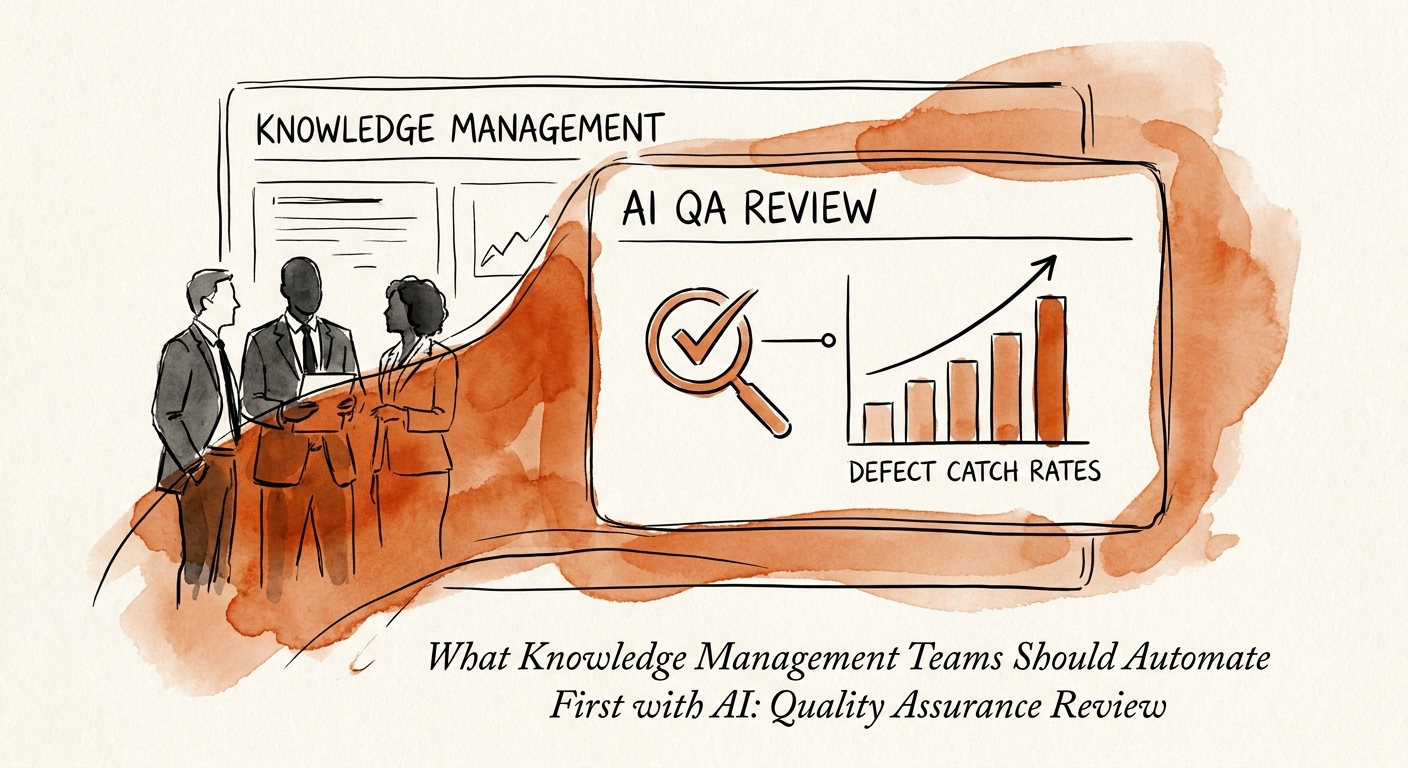
The article that quietly broke 200 tickets
Here is the failure mode nobody puts in the pilot deck. An AI tool drafts a refresh of your "How to process a refund" help article. It reads clean. A reviewer skims it, approves it, it goes live. Three weeks later a support lead notices that a chunk of recent refund tickets quoted the same wrong window — 14 days instead of 30 — because the agents pulled the language straight from that article, and the AI had silently merged it with an old promo policy. The error didn't cost you one bad answer. It cost you every answer that referenced it.
That is what makes a knowledge base different from almost any other place you'd point AI first. A bad reply in a live chat is one customer. A bad sentence in a published article is a template that frontline teams copy on purpose. So the question for quality-assurance review isn't "can AI write a decent draft" — it obviously can. It's "can we catch the wrong sentence before it becomes the canonical answer." That is an editorial control problem, not a model problem.
The adoption pressure is real and worth naming. Census Bureau data on AI use at U.S. businesses and OECD work on AI adoption by SMEs both show smaller teams moving fast and underbuilding the review layer. Deloitte's 2026 State of AI reinforces the part everyone skips: only a minority of companies report AI actually transforming the work, and the gap is almost always the process around the model, not the model. For a knowledge base, that process is your review gate.
Three checks that catch the wrong sentence
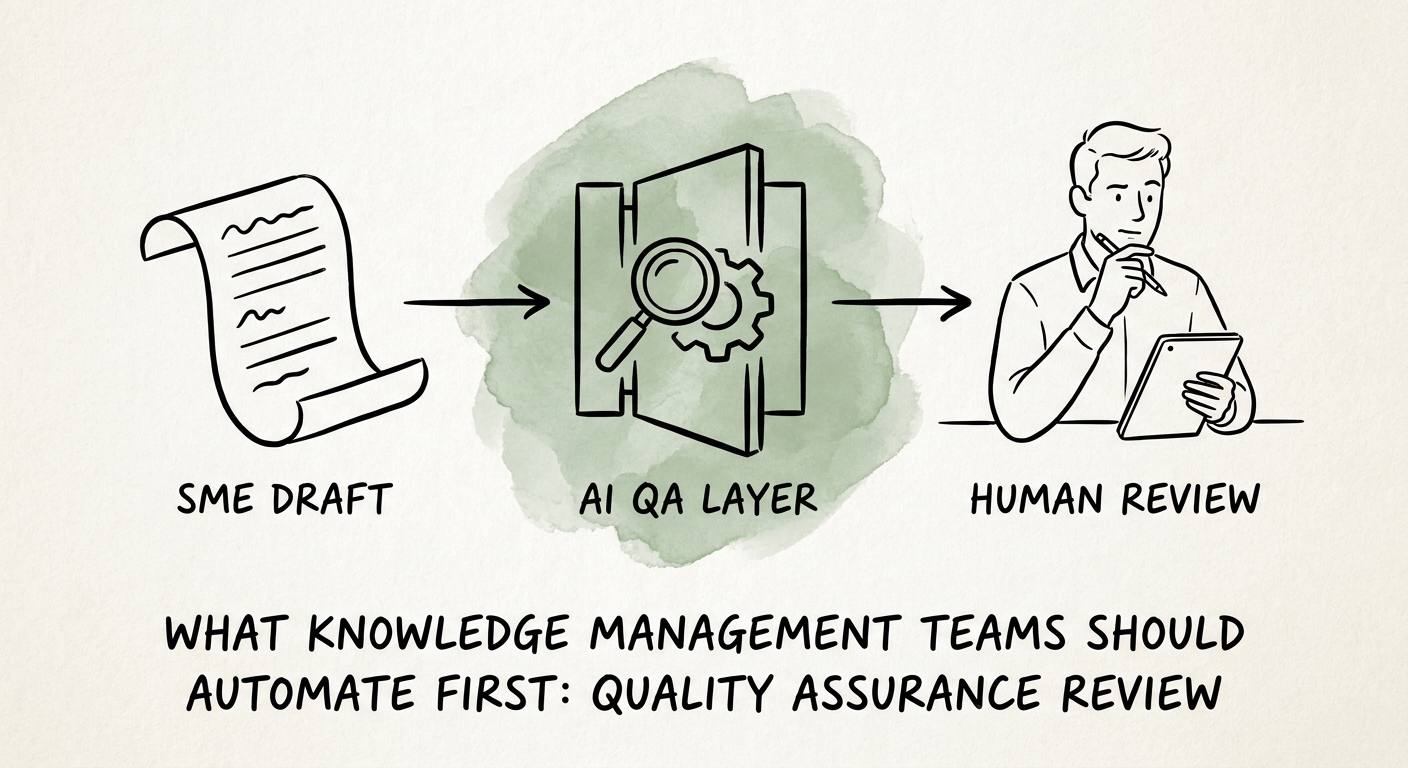
Start narrow. Pick one document type — say, the 40 most-viewed support articles, not the whole wiki — and put every AI-drafted change through a packet a reviewer can actually decide on. A usable packet shows four things side by side: the current published article, the AI's proposed version, the source record the AI claims to have used, and a redline of what changed. Most "review" failures happen because someone is reading a polished new draft with no way to see what moved. Show the diff and the source, and a 40-person team's lead editor can clear ten articles in the time it used to take to nervously reread one.
Within that packet, three checks catch the dangerous edits. Provenance: every factual claim — a number, a window, a price, a policy step — must point to a source record the knowledge owner will defend. If the AI can't show where "30 days" came from, that line gets held, not published. Contradiction: does this draft now disagree with another live article? The refund window broke precisely because two articles said two different things and no one cross-checked. Drift: did the AI "improve" a sentence that was load-bearing legal or policy language? Tone edits to a compliance line are how meaning leaks out. NIST's AI Risk Management Framework frames this well — the same sentence is harmless in a scratch draft and material the moment it becomes the answer agents cite.
Then decide upfront what AI is never allowed to touch without a human signing it: final publication, anything quoting policy or pricing, and any macro that goes customer-facing. CISA's AI data security guidance should set which source records the tool can even read and what it logs. Track four numbers, not a dashboard: how often a held draft turns out to have been right (over-blocking), how often a published change had to be rolled back (the expensive miss), reviewer time per article, and repeat defects. A defect that recurs is an editorial-rule problem — fix the rule, don't retune the model.
The 90-day test: does the library stay quotable?
Days 1–30: instrument the rollback. Tag every AI-drafted article and watch what gets reused downstream — which articles agents quote in tickets, which sentences show up in customer replies. You can't protect a knowledge base you can't trace. Pull any source the knowledge owner won't personally stand behind out of the AI's reach entirely.
Days 31–60: run the head-to-head. For each AI draft, compare it to what your best editor would have shipped. You're not grading prose — you're counting the held drafts that were correctly held and the rollbacks that slipped through. If the AI is producing clean copy but your rollback count isn't dropping, the win is fake. By day 90, the honest signal is boring: fewer contradictory articles, fewer reviewer rewrites, and a faster clock from "this is wrong" to "this is corrected and the dependent articles are updated too." If editors are still re-reading everything by hand to feel safe, you've added a queue, not removed one — and a mid-market team can't carry a tool whose only output is more reviewing.
If you're weighing this against other first AI projects, run the AI Opportunity Score before committing the editorial time. Once the review path has produced real evidence — rollbacks down, correction time down — reach for the AI ROI Calculator to size it, not before. We package that sequence inside the AI Transformation Blueprint so a knowledge team can move to the next workflow without ever losing the thread back to a source record.