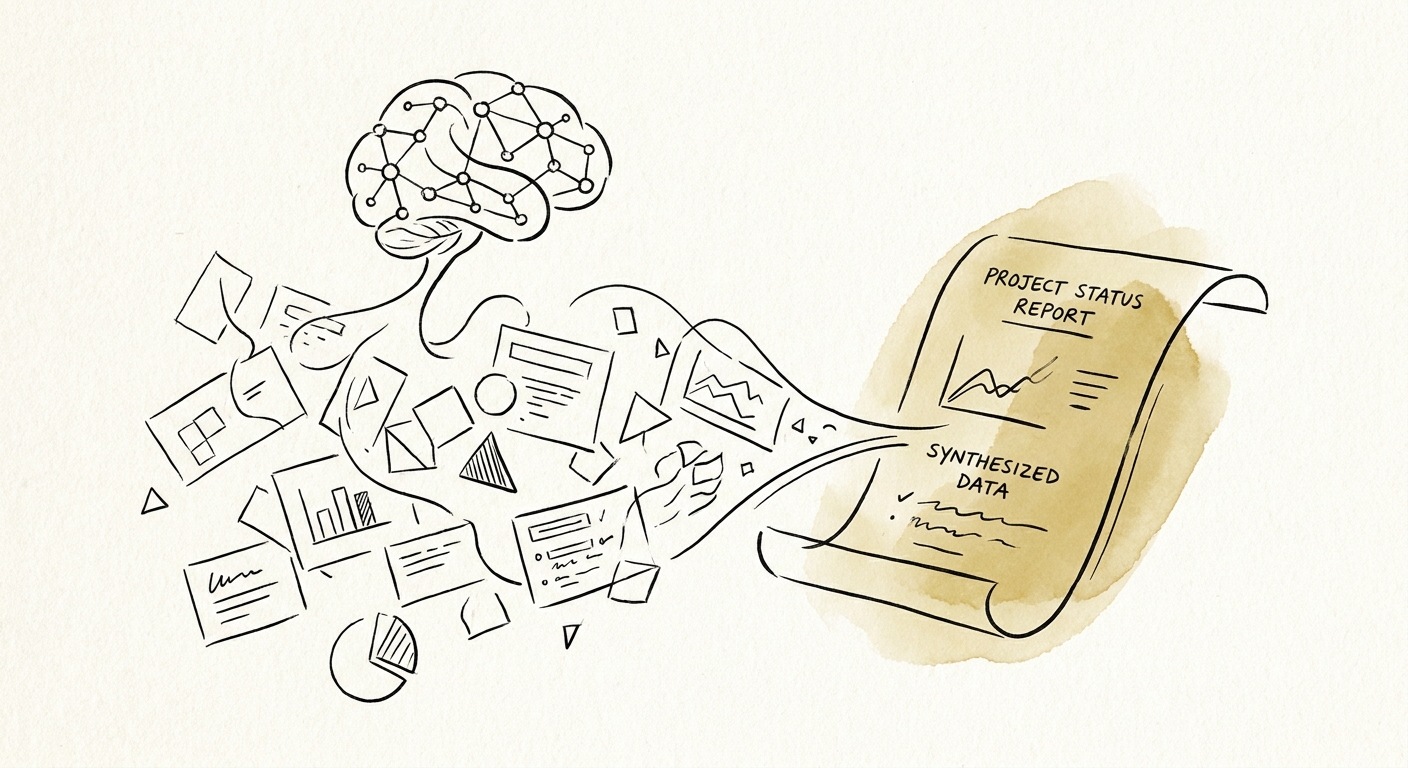
The Thursday-night status scramble
Picture a 60-person professional-services shop running eleven active client engagements. Every Friday, the delivery lead opens four tabs to write status: the ticket board, the project plan, last week's meeting notes, and a risk log nobody has touched since the kickoff. By the time the report goes out, half of it is reconstructed from memory and the other half is optimistic rounding. Three engagements say "on track" mostly because the people who'd say otherwise didn't update anything.
This is exactly the kind of work AI is built to compress: it repeats on a fixed cadence, and the answer already exists scattered across systems that don't talk to each other. The RSM middle-market AI survey shows adoption expanding across exactly these repetitive knowledge tasks, and the OECD report on AI adoption by small and medium-sized enterprises is blunt about why it sticks or fails: the data underneath has to be trustworthy, and someone has to own the process.
So aim the tool narrowly. Let it pull from the ticket system, the plan, the notes, the risk and decision logs, and the milestone tracker, then assemble a draft. What it must never do is manufacture confidence. The owner still writes the words "at risk," sets the dates, and makes any commitment that lands in a client's inbox. Before you wire it up, run AI workflow discovery on where status handoffs already cause rework — usually it's the gap between "the ticket says done" and "the client agrees it's done."
Teach it to flag silence, not fill it
The failure mode of an automated status report isn't a bad sentence. It's a confident sentence built on stale data. A ticket last touched nine days ago, a milestone whose owner is on PTO, a risk that was "monitoring" three weeks running — these are the things a human reader would catch and a naive summarizer will smooth over. So the first useful workflow does the opposite of writing prose: it audits freshness. It lists every input older than its expected update window, names the open decisions waiting on someone, and drafts the escalation questions the lead would otherwise forget to ask.
The NIST AI Risk Management Framework gives you the spine for this — govern, map, measure, manage — which in practice means writing down four things before launch: which sources are approved, how fresh each one must be, who reviews the draft, and the bright line between what AI may summarize and what a person must judge. A risk-status change crosses that line. A bulleted recap of closed tickets does not.
Then prove it's working with disciplined AI ROI measurement, and pick signals that resist gaming. "Time to write the report" is a weak one — you can hit it by lowering quality. Better: how many engagements went a full week with no input update before the tool flagged it, how many risks got escalated while they were still cheap to fix, and how often the lead had to send a correction after the report went out. If silent engagements drop and corrections drop together, the workflow is earning its place.
The report is the symptom; the cadence is the cure
Here's the part most teams skip: a faster-written status report changes almost nothing. If the underlying inputs are still updated whenever people get around to it, you've just automated a prettier guess. The Deloitte State of AI report keeps landing on this gap — the value shows up when the surrounding process tightens, not when the draft gets quicker. For status reporting that means a real loop: inputs are due by a deadline, AI assembles the draft against fresh data, the owner reviews and judges, escalations route to someone accountable, and follow-through gets checked the next cycle. The AI is one link in that chain, not the chain.
And resist the temptation to skip ahead. The obvious next idea is an agent that reads status, decides an engagement is slipping, and reschedules or pings the client itself. The Gartner agentic AI project forecast is a useful cold shower here: a large share of agentic projects get killed precisely because teams hand over decisions before the controls underneath are trustworthy. Earn the draft-and-flag workflow for a couple of months before you let anything act across systems on its own.
Monday move: pick your three messiest engagements, list every source a status report draws from, and mark which ones have a named owner and a freshness expectation. The ones with neither are why your "green" reports keep surprising you. From there, a 90-day implementation plan sequences source access, review cadence, escalation rules, and the value checks above into something you can actually run.
