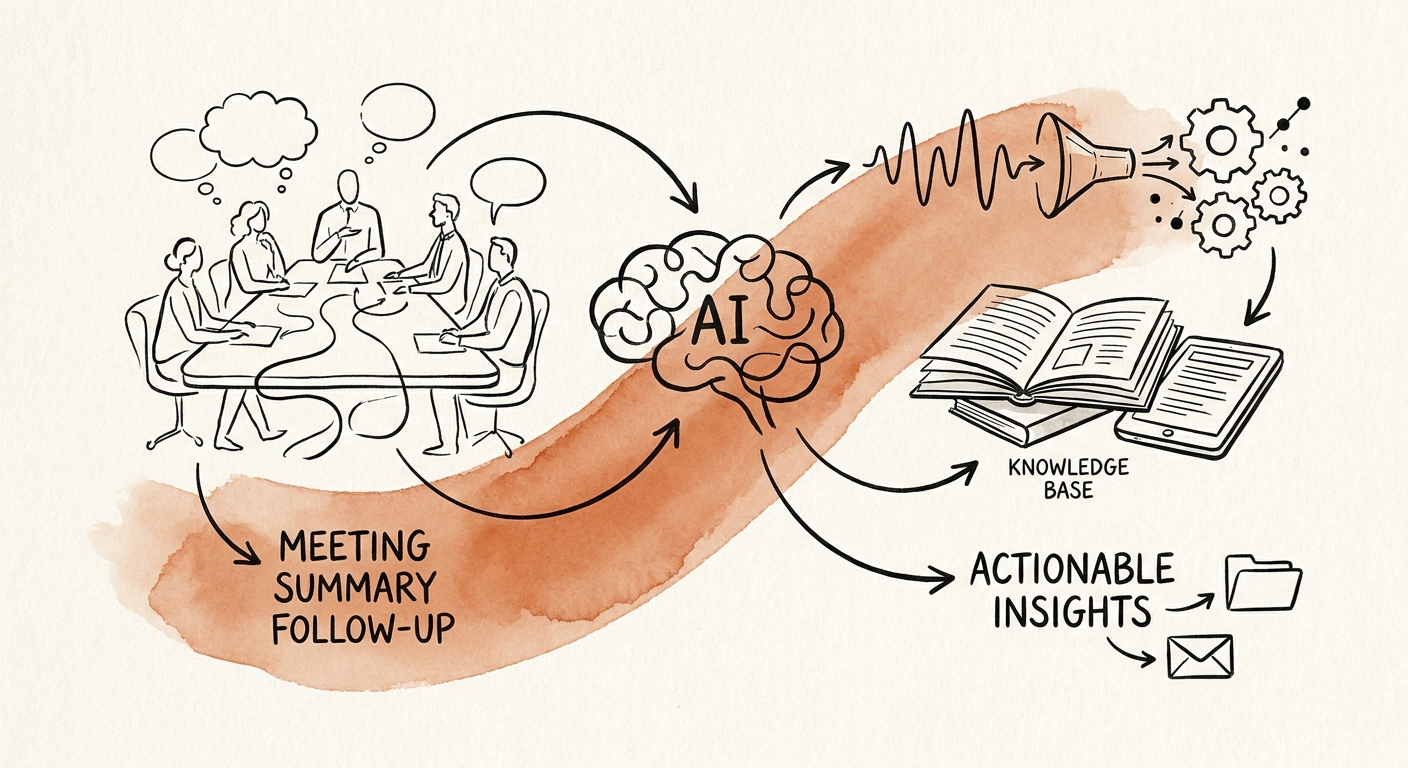
The Tuesday standup that vanished into a transcript
Picture a 60-person professional services firm. A recurring client-strategy meeting runs every Tuesday. The note-taking tool already produces a tidy AI summary — three paragraphs, a few bullet action items, nobody disputes it's accurate. And three weeks later someone reopens last month's account, asks "did we ever decide on the renewal terms?", and burns forty minutes scrolling transcripts to find out. The decision was made. It was even summarized. It just never became something the team could find again.
That is the gap a knowledge management team should automate first, and it is not the transcript. The transcript is a solved problem. The unsolved problem is the follow-up: turning the discussion into a decision with a named owner, a due date, and a link back to the moment in the meeting where it was agreed — landing in the wiki or project tool where the next person will actually look. Deloitte's State of AI in the Enterprise 2026 and the OECD's SME AI adoption report both describe adoption pressure pushing into mid-market teams trying to make knowledge reusable — but neither makes the workflow choice for you. For a KM team, the highest-leverage first loop is meeting-to-knowledge follow-up, scoped to exactly one recurring meeting type.
Here is what most teams get wrong: they grade the pilot on whether the summary reads well. A polished summary that nobody reuses is a more eloquent version of forgetting. Worse, an over-eager summarizer that pushes confidential client context into a wiki page the whole company can see is a polished way to create an incident.
Pick one meeting type, and count reuse — not word count
Resist the urge to point AI at every meeting in the calendar. Choose one recurring meeting where stale knowledge actually hurts — the weekly client-strategy review, the engineering decision sync, the deal-pipeline call. One type. The reason is diagnostic: a single meeting cadence gives you a clean week-over-week baseline you can read in an afternoon, and a narrow blast radius if the AI mishandles something sensitive.
Before you turn anything on, write down the honest "before" state for that one meeting: decisions made with no owner attached, wiki pages that still say something the team has since reversed, the same question re-asked in three consecutive sessions because last week's answer was never written down anywhere findable. Those are your baselines. Now run the loop for a few weeks and inspect entirely different numbers. Not whether the summary read well — instead: how many follow-up records did another team member actually open and act on? How often did the source link survive so someone could trace a decision back to who said it and when? How many times did a reviewer have to catch the AI promoting confidential content into the wrong audience? A summary that's beautifully written and never reopened scored a zero on the only metric that matters.
The value case for a KM team is concrete and unglamorous: fewer repeated questions after recurring meetings, and decisions that survive in a form the next person trusts. Once a named owner is accountable for those reuse numbers — not before — the AI Opportunity Score or the AI ROI Calculator can help you size where this loop goes next.
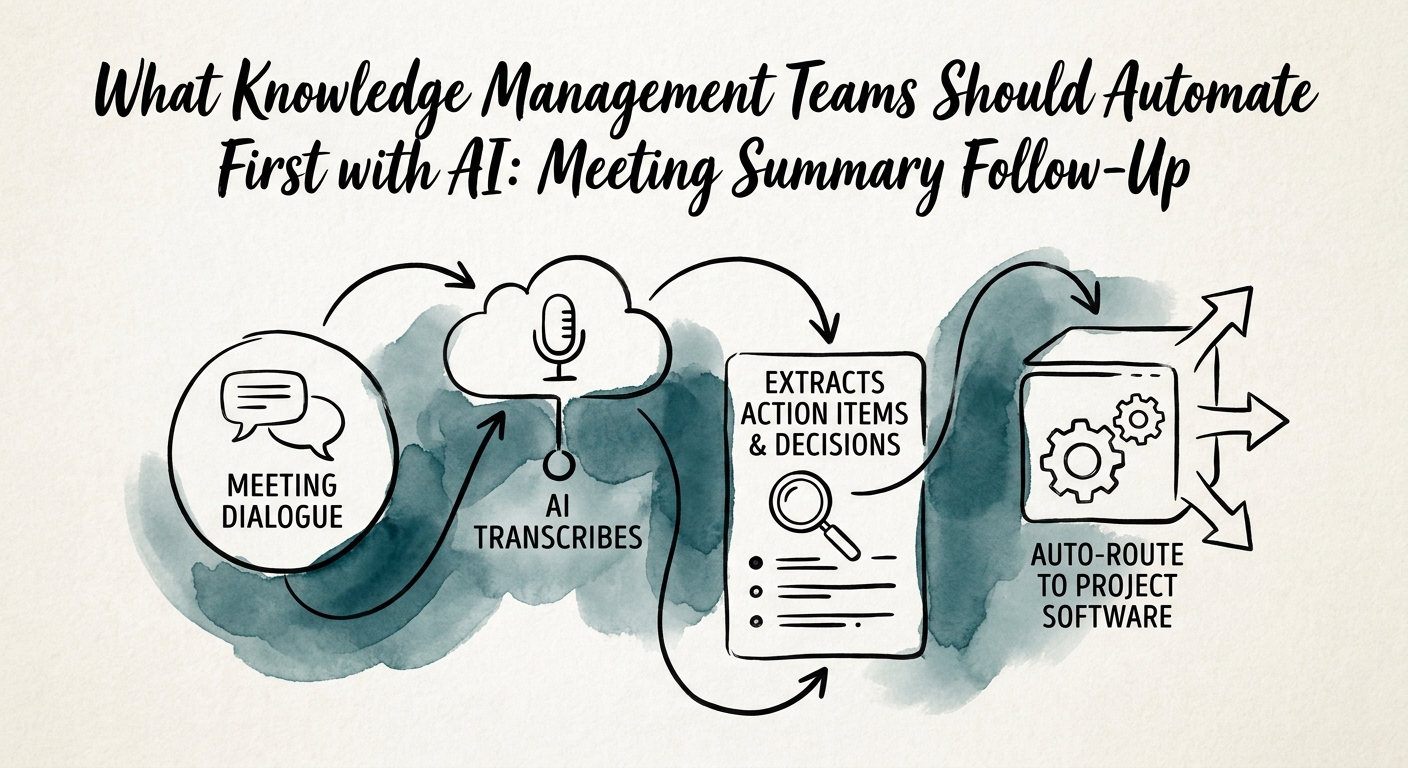
The two failure modes a reviewer has to catch
Meeting follow-up is unusually sensitive for a KM team because the raw material — transcripts — often contains the exact things you do not want auto-published: a client's confidential numbers, a candidate's name in a hiring debrief, a half-formed idea someone explicitly said "don't write this down yet." The CISA AI data-security best practices are the right lens for deciding what the AI is allowed to ingest, who can see each resulting record, and how long transcripts are retained. The NIST AI Risk Management Framework gives you the structure to write down intended use, the risks, how you'll measure them, and who is accountable when a summary goes wrong.
In practice that means two non-negotiable rails. First, assign a human reviewer per meeting type — the person who runs that meeting is usually right — and require that every published record links back to the source moment, so a wrong summary is traceable, not anonymous. Second, hold any summary the model flags as low-confidence, or that touches confidential content, before it ever updates shared knowledge. A held draft is a five-minute review; a leaked client figure in a company-wide wiki is a phone call you don't want to make.
What you can do Monday: name the one recurring meeting, write its three "before" numbers on a whiteboard, and assign its reviewer. Run that single loop for three weeks. Only when accuracy, permissioning, and real reuse all hold should you add a second meeting type. Prove the loop on one before you trust it with the calendar — and if you want help mapping where it leads, build the AI roadmap.