The same complaint, in eleven different places
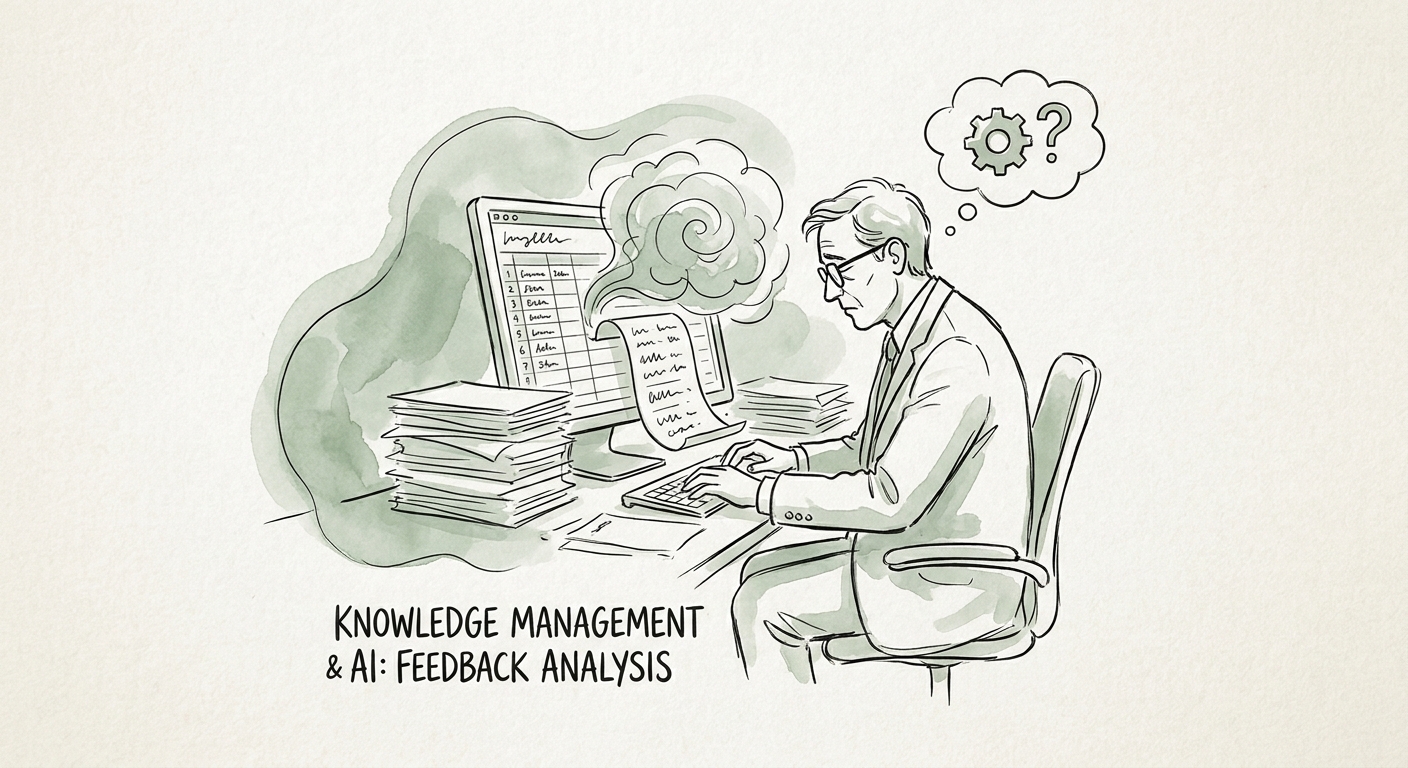
A customer of yours has been frustrated about the same thing for six months. They mentioned it in a support ticket in December. They brought it up on a QBR call in February. Their champion flagged it in a renewal survey in March, and a sales engineer noted it in the CRM during an expansion conversation in April. Four signals, four systems, four different people who each saw one piece. Nobody connected them. Then the account churned, and in the post-mortem someone pulled all four together in an afternoon and asked the obvious question: how did we miss this?
That is the real problem with customer feedback at a B2B technology company. It is not that you collect too little. It is that the signal is smeared across support tickets, onboarding notes, call summaries, NPS verbatims, product requests, and renewal objections — most of it unstructured text that no single person reads end to end. Forrester calls unstructured data the rocket fuel for generative AI, and customer feedback is exactly that: high-volume, text-heavy, and tied directly to revenue you can lose.
This is why feedback analysis is the right first AI workflow for a knowledge management team specifically. It is bounded enough to test, the source material is sitting in systems you already own, and the payoff lands on operating decisions you make every month. You are not trying to replace your CS team's judgment. You are trying to stop asking smart people to re-read and re-tag the same patterns by hand, every cycle, forever — and to stop letting the December ticket and the March survey live in separate worlds.
A dashboard tells you it happened. A loop tells someone to fix it.
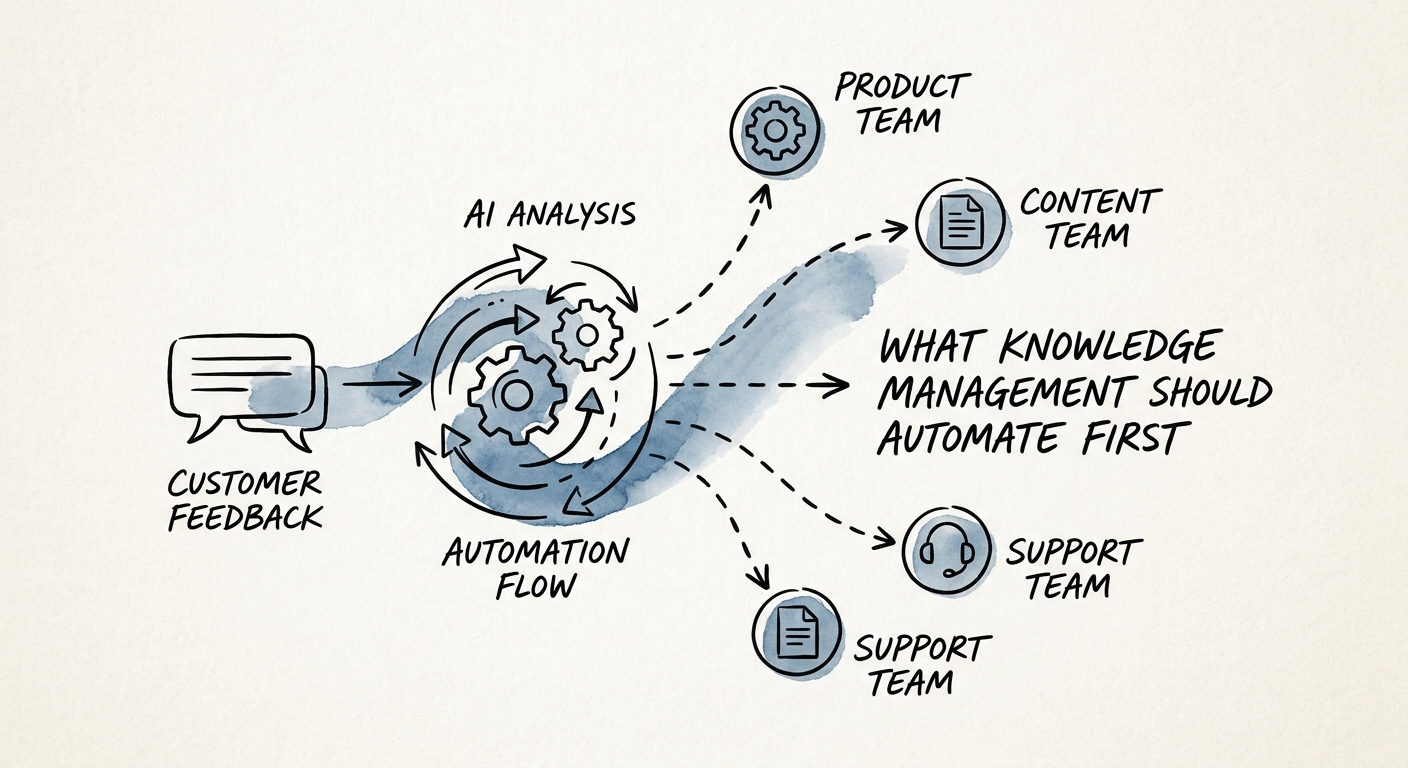
Most "feedback AI" projects stall at the dashboard — a tidy bar chart of theme counts that leadership glances at and forgets. Bain's point about closing the feedback loop is the one most teams skip: the value isn't in seeing the pattern, it's in the pattern reaching a person with the authority to act, fast enough to matter. A theme that surfaces on a dashboard a month after the renewal is a report. A theme that pings the account owner the same week is a save.
So design the workflow around routing, not reporting. Take one stream first — say, last quarter's support tickets and renewal-call notes for a single product line. AI drafts the categorization: this comment is an onboarding friction theme, that one is a missing-integration request, this one reads like contractual frustration. A human approves the taxonomy and spot-checks the edge cases, because the model will confidently mislabel the ambiguous ones, and the ambiguous ones are usually the expensive ones. Then you wire the rules. Churn-risk language and implementation failures route to the named account owner with the original customer quote attached — not buried in an aggregate where the specific account vanishes. Product requests batch to the backlog. Everything keeps the raw verbatim, because the customer's own words carry context no summary preserves.
One sequencing note. This same work is what makes a broader knowledge system worth building later. A retrieval assistant is only as good as the material under it, and feedback analysis is how you learn which themes are real and which records are clean before you ever point a bot at them. If a knowledge bot is on your roadmap, when a knowledge bot is worth building covers why feedback comes first.
Measure the loop, not the model's accuracy
Resist the urge to grade this project on classification accuracy alone. A model that tags themes at 95% accuracy while no routed issue ever gets a response has produced nothing. Forrester frames generative AI here as an evolution of feedback management, not a revolution — and that framing is exactly right, because the win is operational, not technical. Track five things: how fast feedback gets categorized, how many themes actually reach a named owner, how often a routed issue gets a response, how much manual tagging time you removed, and whether recurring problems now surface sooner than they used to. If those five move, the workflow is working — regardless of what the model's F1 score says.
You can prove this in 30 days without buying anything new. Pick one source. Define the taxonomy with your CS lead. Run last quarter's feedback through the workflow and lay the AI classification next to a human's. Where they agree, you've found your automation. Where they disagree, you've found the edge cases worth a review step. Then decide which themes deserve a real-time alert, which belong in the monthly operating review, and which go straight to the product backlog. McKinsey's work on AI-powered customer interaction describes the destination; this is the unglamorous first mile that gets you there.
If you want to weigh feedback analysis against other candidate workflows before committing, run the AI Opportunity Score. And if customer knowledge is already scattered across support, sales, delivery, and product — which, if you're reading this, it probably is — AI Knowledge Systems and RAG is the fuller service lane to grow into.
