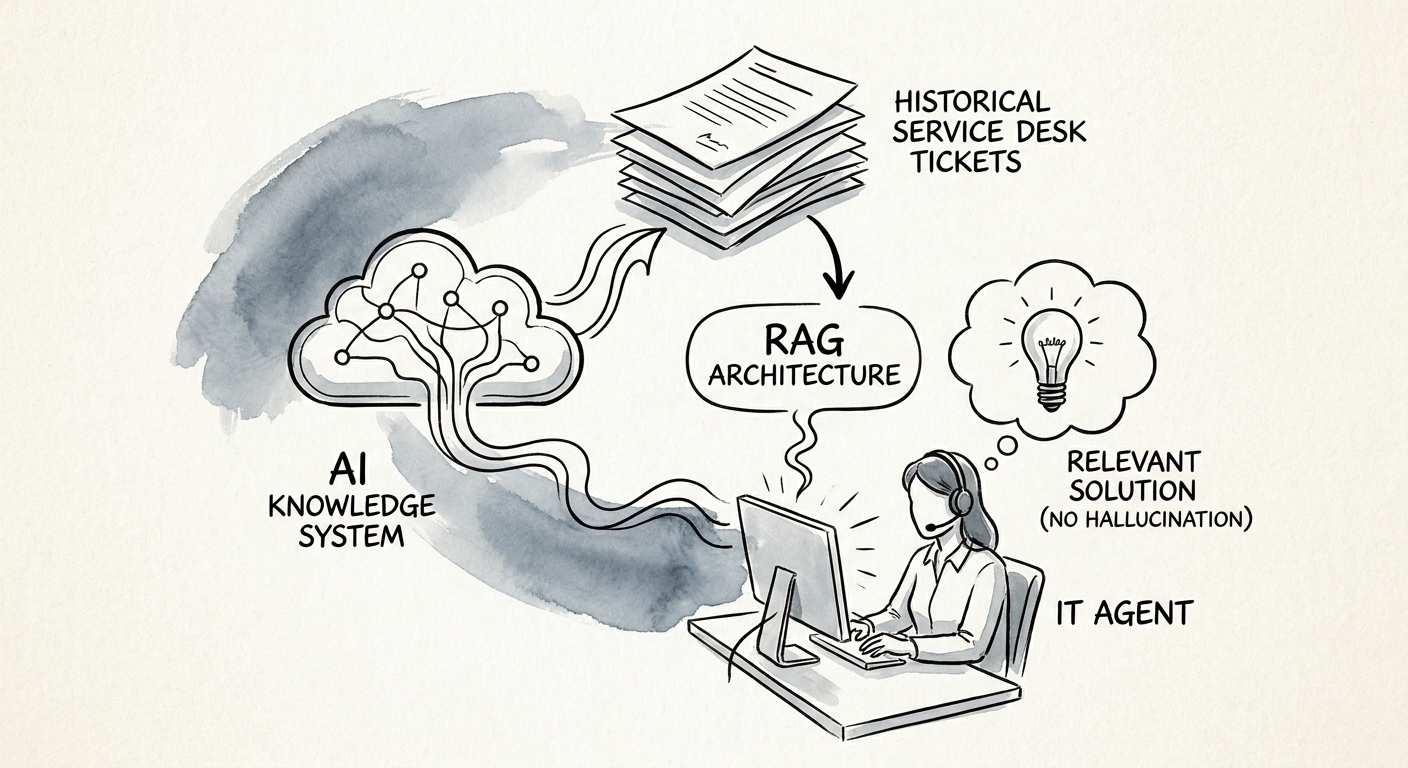
The fix exists. It's buried in a closed ticket from eight months ago.
Picture a 35-person IT consulting firm. A client's VPN appliance starts dropping sessions at 4 p.m. every Thursday. The junior engineer assigned to it spends six billable-but-not-billable hours rediscovering a root cause your senior engineer already nailed for a different client last spring — wrote it up, closed the ticket, moved on. The answer is sitting in your service desk history. Nobody can find it, because "finding it" means knowing which of 9,000 resolved tickets to search and what words the original engineer happened to type.
That's the actual problem an AI knowledge system solves for a consulting firm. Not "deflect tickets with a chatbot" — you're the people clients call when the chatbot fails. The job is recovering the resolution patterns your team already paid to learn. Service desk history is unusually good raw material for this: unlike the wiki nobody updates, resolved tickets are written under pressure by people who had to actually make the thing work. They're honest. The constraint, confirmed across the RSM middle-market AI survey, the San Francisco Fed analysis of AI and small businesses, and the OECD report on AI adoption by small and medium-sized enterprises, is the same: a firm your size wins by aiming AI at one painful workflow, not by indexing everything and hoping.
Here's the part most firms skip: your tickets are full of other people's secrets
A consulting firm's service desk is not your data. It's Client A's network diagram, Client B's admin credentials pasted into a comment box, Client C's incident timeline that's covered by an NDA. The moment you point a retrieval system at the full ticket archive, you've built a machine that can answer one client's engineer using another client's confidential environment. That's not a privacy footnote — for an MSP it's the kind of thing that ends a master services agreement.
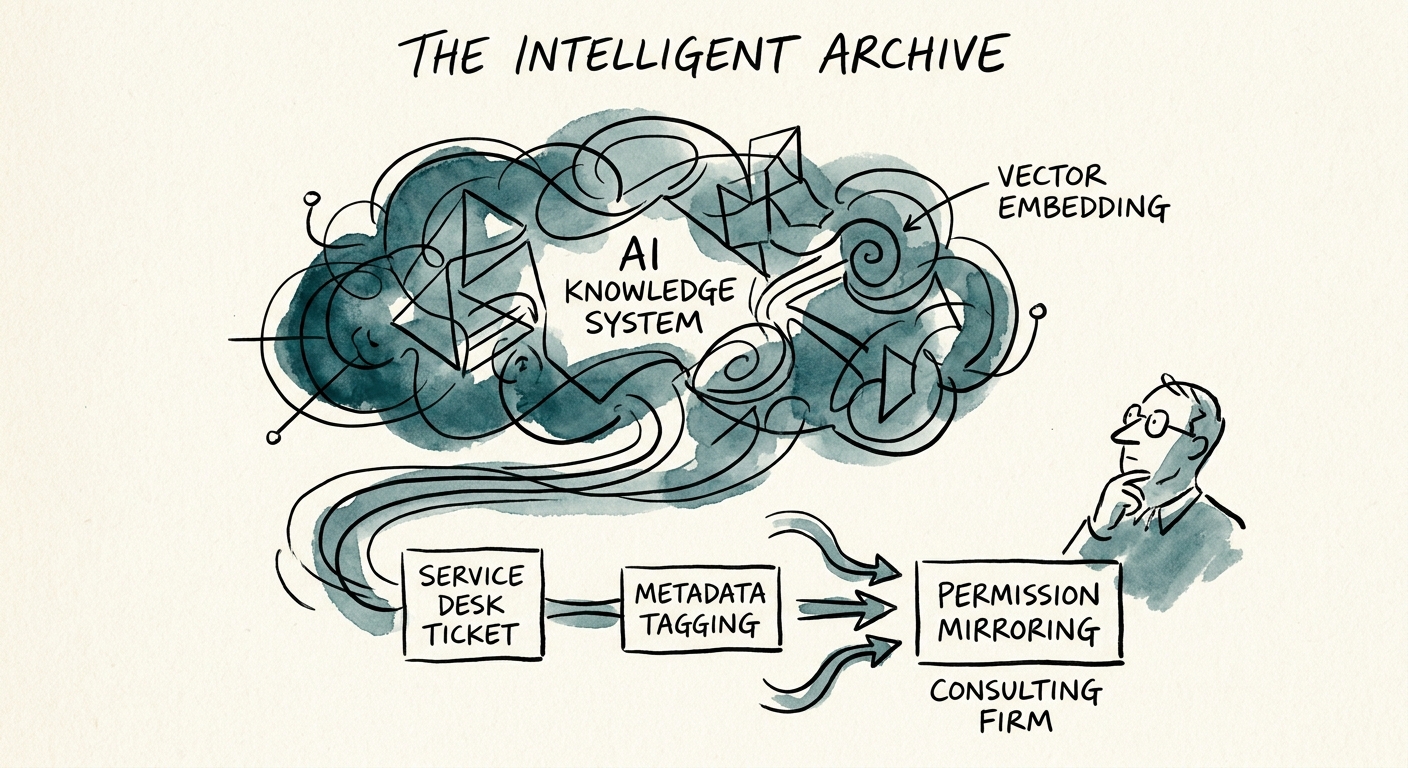
So the sequence matters. Before retrieval, classify the source library by client and sensitivity, strip the credentials and PII that engineers inevitably dump into ticket notes, and set hard permission boundaries — Client A's resolutions should never surface in a workspace serving Client B unless the pattern has been genuinely de-identified. The NIST AI Risk Management Framework gives leadership the language to map that risk, and CISA AI Data Security Best Practices speaks directly to a system touching client, vendor, and security data. If you're running this through an enterprise assistant, hold the configuration against Microsoft 365 Copilot privacy and data controls and OpenAI enterprise privacy commitments. One test settles it: can you prove which tickets fed an answer, that no cross-client data leaked, and that confidential material never left the approved environment? If you can't, you don't have a knowledge system — you have a liability with a search bar.
Ship the boring version: one ticket type, cited answers, a named reviewer
Don't index 9,000 tickets on day one. Pick a single recurring category — say, the firewall and VPN escalations that eat your bench every week — and connect only the resolved tickets in that lane. Require every AI-drafted answer to cite the specific ticket numbers it drew from, so the engineer reading it can judge whether the old fix applies to this client's environment. Route anything the system can't ground in an approved ticket to a named senior reviewer instead of letting it guess. That's the whole production system: narrow, sourced, reviewed.
Then watch five numbers. Resolution-reuse rate (how often a drafted answer actually closed the new ticket), reviewer edit volume, hours saved per recurring issue, questions the system couldn't answer, and — most valuable — the documentation gaps it exposes, the runbooks your team has been carrying in their heads. That last metric is the quiet payoff: the system tells you which expertise lives in exactly one person before that person resigns. To draw your source boundaries, use the internal AI knowledge assistant guide; to confirm your firm actually has the ownership, permissions, and review capacity to run it, work through the SMB readiness assessment before you connect a single ticket.