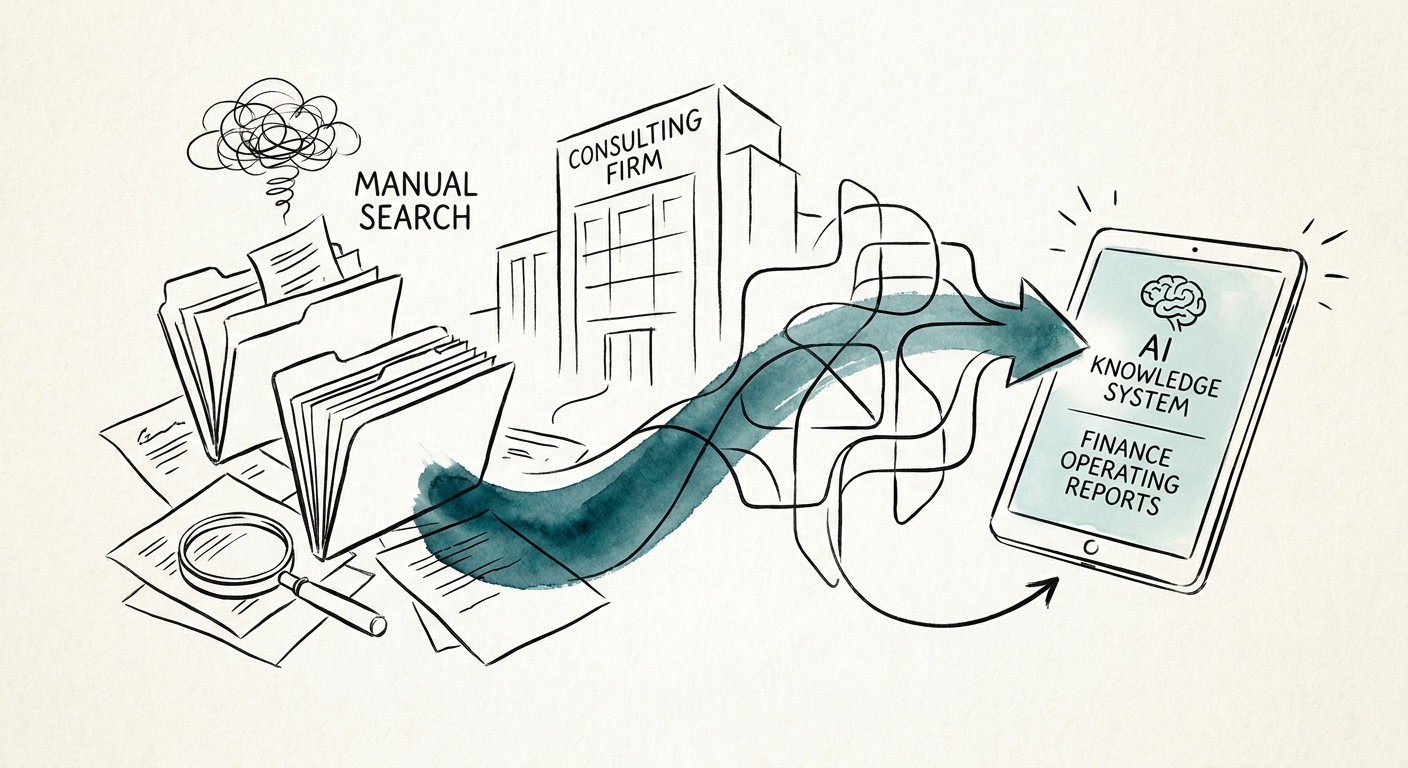
The expensive version of "I'll get back to you"
Picture a Thursday at a 120-person consulting firm. A partner is on with a client and gets asked a simple question: what's our realization rate on the program this quarter, and how does utilization compare to the plan? The answer lives in a finance operating report. But there are four of them in the shared drive, two in someone's inbox, and a "FINAL_v3_revised" that nobody trusts. The partner either says "let me confirm and circle back," which costs credibility, or quotes a number from memory, which is worse. The risk in a consulting firm is rarely a missing answer. It is a confident, stale one delivered in front of the client who is paying for your judgment.
Firms this size are squarely in the zone where this bites. The Census Bureau reported in May 2026 that AI adoption climbs sharply with headcount, reaching 32% of firms with 100 to 249 employees and 37% of firms with at least 250 employees. That is the mid-market squeeze in one sentence: you are big enough to have finance operating knowledge scattered across partners, project leads, and finance, but not so big that anyone has been assigned to keep it canonical. An AI knowledge system here is not a chatbot bolted onto the drive. It is a governed retrieval layer over one domain that matters: the operating reports that drive billing, staffing, and what you tell clients about their own programs.
Tag the report before you index it
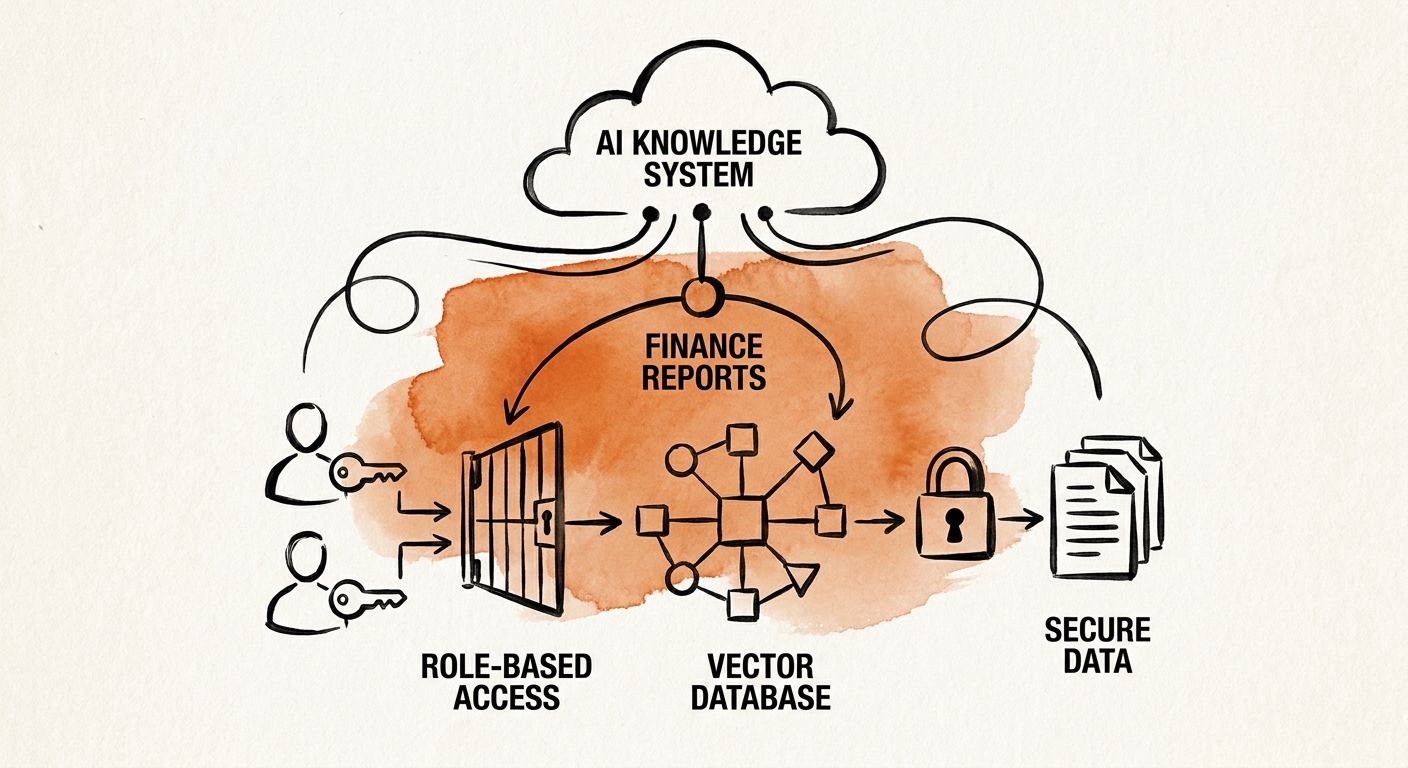
For consulting finance reports, the metadata is the whole game, because the failure mode is specifically about freshness and permission. Before anything gets indexed, each report should carry: the client or engagement it covers, the reporting period, the source system it was pulled from, who approved it, the permission group allowed to see it, and a confidence flag for draft versus signed-off. That last pair is what stops the system from cheerfully surfacing a draft margin figure to a junior who then repeats it to a client. CISA's guidance on securing the data used to train and operate AI systems lands hard in a consulting context: client-confidential financials cannot leak across engagement walls, so access control and source approval come before the assistant ever goes firm-wide.
Run it on the NIST AI Risk Management Framework shape: map the workflow, measure answer reliability, govern ownership, manage drift as new quarters close. Concretely, the assistant should answer only from approved, period-stamped reports, cite the exact source and date it pulled from, say "the latest signed-off figure I have is from Q1" when newer data isn't approved yet, and route anything ambiguous to a named finance owner instead of guessing. Build it as a real AI knowledge system with RAG, owned by someone, not as a side experiment a project lead spun up between deliverables.
Twenty questions, then a production owner
Skip the tooling debate at the start. Write down the twenty questions partners and project leads actually ask about finance operating reports, realization by engagement, utilization against plan, write-offs, margin by service line, and for each one name the single approved source. Then test whether the system retrieves that source, with the right date, without exposing a restricted client's numbers to the wrong team. That test set is your acceptance bar, and it is the difference between a demo and something a partner will lean on mid-call. Deloitte's 2026 enterprise research found only 25% of leaders moved 40% or more of their AI pilots into production, and the firms that stall usually had a demo sponsor instead of a production owner. Assign the owner first.
Once retrieval is stable, measure the things that move the P&L: hours senior people no longer lose answering "where's the latest report" questions, faster turnaround on client financial asks, and fewer stale-number corrections after the fact. Because client financials are involved, pin down vendor privacy, retention, and data-use terms before you sign. Verify those boundaries; don't assume them. The mechanics of standing this up are walked through in our internal knowledge assistant guide, and Human Renaissance uses the AI Transformation Blueprint to turn that first governed report library into a broader operating roadmap rather than a one-off win.