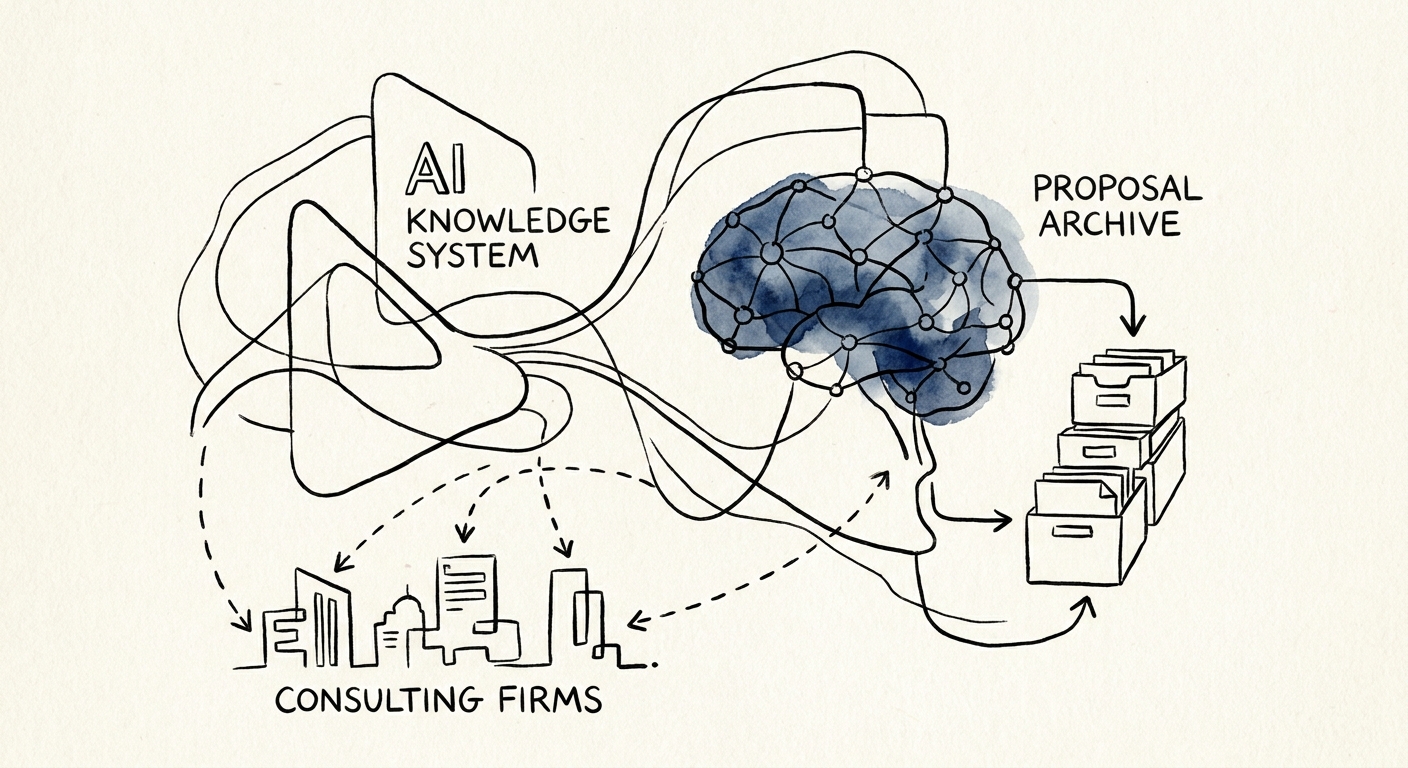
The Frankenproposal Problem
It's Thursday afternoon. A response is due Monday. A senior consultant pulls three old proposals into a blank doc — the one she half-remembers winning last year, one a colleague swears was "the good cybersecurity scope," and one she finds by searching the shared drive for the client's industry. She stitches them together, fixes the pricing she can spot, and ships it. Nobody is sure the methodology section reflects how the firm actually delivers anymore. Nobody checks whether the rate card is current. That's the real cost of a messy proposal archive: not that the knowledge is missing, but that the team can't tell the approved version from the abandoned draft fast enough to matter on a deadline.
Consulting firms don't have a document shortage. They have a retrieval-and-trust problem, and it gets worse precisely as the firm gets big enough to be worth the effort. The Census Bureau reported in May 2026 that AI adoption is already materially higher in larger firms — 32% of firms with 100 to 249 employees and 37% of firms with at least 250 employees. That's the mid-market shape of this: a firm with enough partners, practice areas, and years of past work to have genuinely scattered operating knowledge, but not so much governance that anyone can say with confidence which scope language is current. A useful AI knowledge system here is not a chatbot pointed at that shared drive. It's a governed retrieval layer over one domain — the proposal archive — that surfaces the approved answer faster than the consultant can rebuild it from memory.
Tag the Archive Like a Partner Would Judge It
The difference between a knowledge system that earns trust and one that quietly poisons every new proposal is the metadata you attach before anything gets indexed. A raw drive search treats a rejected 2023 draft and a $2M win identically. A governed system doesn't. For a proposal archive, every document should carry: client type and industry, the partner who owns it, the date and engagement outcome (won, lost, withdrawn), the source system it came from, the permission group allowed to see it, and a confidence level that says whether this is approved boilerplate or a one-off draft. Now when the assistant retrieves "our standard data-migration methodology," it can prefer the version from a won engagement, owned by an active partner, marked approved — and flag the rest.
That tagging discipline is also your security model. CISA's AI data security guidance stresses protecting the data used to operate AI systems — and in a 50-to-300-person firm, proposals are full of things that must not leak: confidential client pricing, deal terms, named references. Permission groups have to survive into the retrieval layer, so a junior consultant asking for pricing precedent never sees a deal they weren't staffed on. Run the build the way the NIST AI Risk Management Framework describes — map the workflow, measure answer reliability and data risk, govern ownership, manage change over time. The assistant answers only from approved materials, cites the document it pulled from, says plainly when it has no approved source, and routes the gap to a named owner. That's AI knowledge systems and RAG done as an owned capability, not an unowned side experiment.
Prove It on Twenty Real Questions Before You Pick a Tool
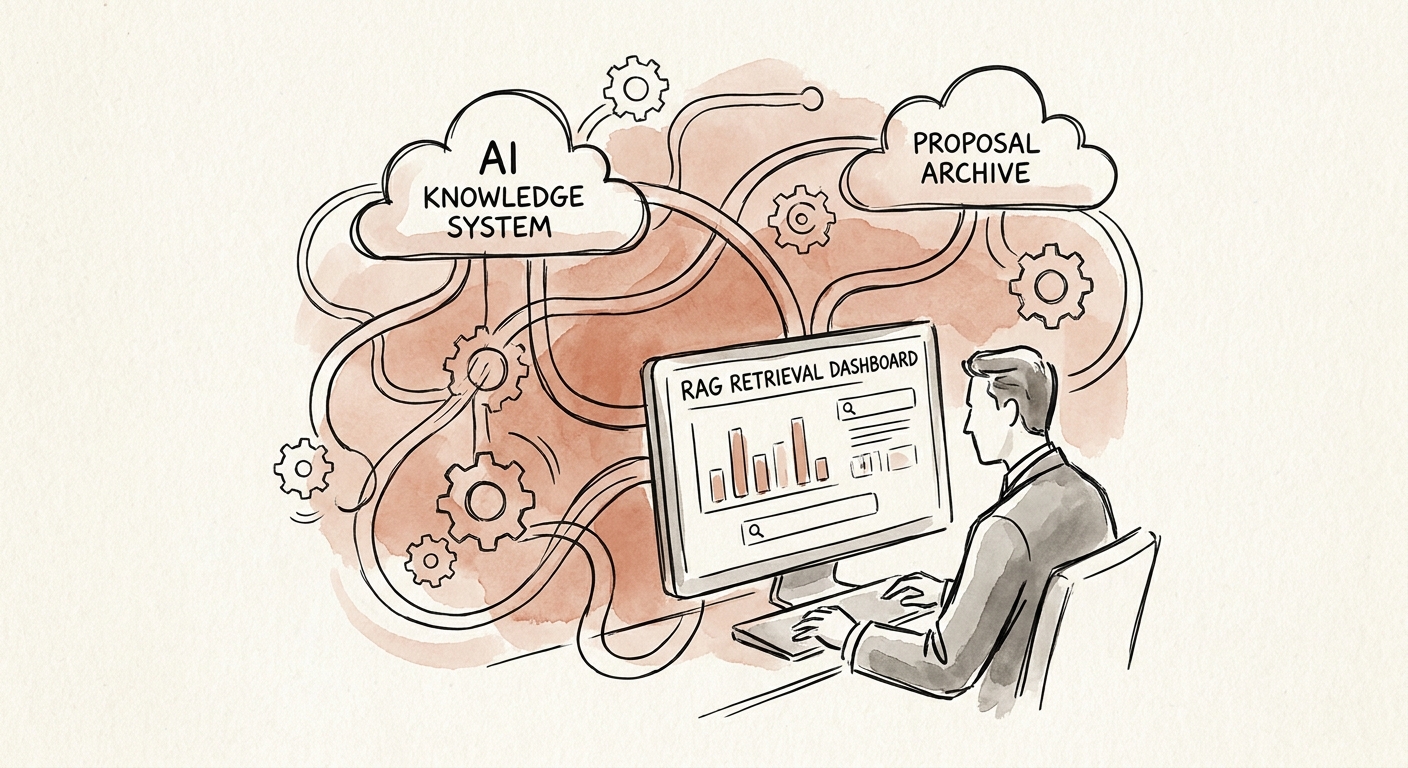
Don't start with a vendor demo. Start with a retrieval test set. Write down the twenty questions your consultants actually ask the archive: "What's our current scope language for a 12-week ERP assessment?" "Have we proposed to a PE-backed manufacturer before, and what did we charge?" "What's the approved bio for our cyber lead?" For each, name the single document that holds the right answer. Then score the system on whether it retrieves that source — and, just as important, whether it ever surfaces a restricted deal it shouldn't. A system that's 90% helpful and 10% leaky is not shippable.
This test-first discipline is why most knowledge systems stall. Deloitte's 2026 enterprise research found only 25% of leaders moved 40% or more of their AI pilots into production — the rest die as demos with a sponsor but no production owner. So before launch, assign one: a partner or knowledge lead who owns the answer library, approves new source documents, and resolves the questions the assistant couldn't answer. Once retrieval is stable, measure the four numbers that prove it's working: adoption, senior-interruptions avoided, answer quality on the test set, and proposal turnaround time. Vet vendors on privacy, retention, and data-use terms — verify your client data won't train someone else's model, don't assume it. The mechanics of the build are in the internal knowledge assistant guide, and the AI Transformation Blueprint is how the first governed archive becomes a roadmap for the rest of the firm.