
The practical answer
- Short answer
- Discover how professional services firms are using AI knowledge systems and RAG to automate research memo retrieval, prevent margin bleed, and leverage past intellectual property.
- Best fit
- Industry: Professional Services. Function: Knowledge Management
- Operating path
- AI Knowledge Systems → AI Transformation
- Key metric
- $12.9M Average annual cost organizations suffer due to poor data quality and fragmented information management.
The 30% Billable Capacity Leak
According to IDC's Knowledge Worker Productivity Benchmark, professional services firms are burning up to 30% of their billable capacity paying senior analysts to recreate research memos that already exist in their own fragmented SharePoint drives. When your entire business model is built on selling intellectual capital, your past research is your most valuable asset. Yet, at most firms, the moment a strategic memo is delivered to a client, it dies in a nested, unsearchable folder hierarchy, never to be leveraged again. We are paying brilliant people six-figure salaries to act as data archeologists instead of strategic advisors.
In our last engagement with a 150-person management consulting firm, we saw partners quietly writing off over $40,000 a month in unbillable research time. Their analysts were starting every market assessment and due diligence memo from a blank page. The partners knew perfectly well that the firm had solved these exact problems before, but standard enterprise keyword search across their cloud drives was functionally useless. If an analyst searched for "European supply chain resilience," they didn't get a synthesized answer; they got a dump of 400 loosely related PDFs, forcing them to open each document manually to see if it contained any relevant insights.
This level of knowledge fragmentation isn't just a daily annoyance; it is a massive, systemic margin drain. Gartner's Data Quality Cost Analysis reveals that poor data quality and fragmented information management cost average organizations $12.9 million annually. For mid-market service operators, this structural deficit manifests as compressed project margins, painfully delayed deliverables, and thoroughly exhausted delivery teams. That is precisely why internal knowledge search is your first AI workflow. It directly attacks the cost of duplicated effort and allows your firm to actually compound its intellectual property over time.
If you feed an AI model a massive garbage dump of outdated drafts, duplicated files, and half-finished meeting notes, it will generate highly articulate, confidently delivered garbage.
Designing the RAG Workflow: Curation Over Volume
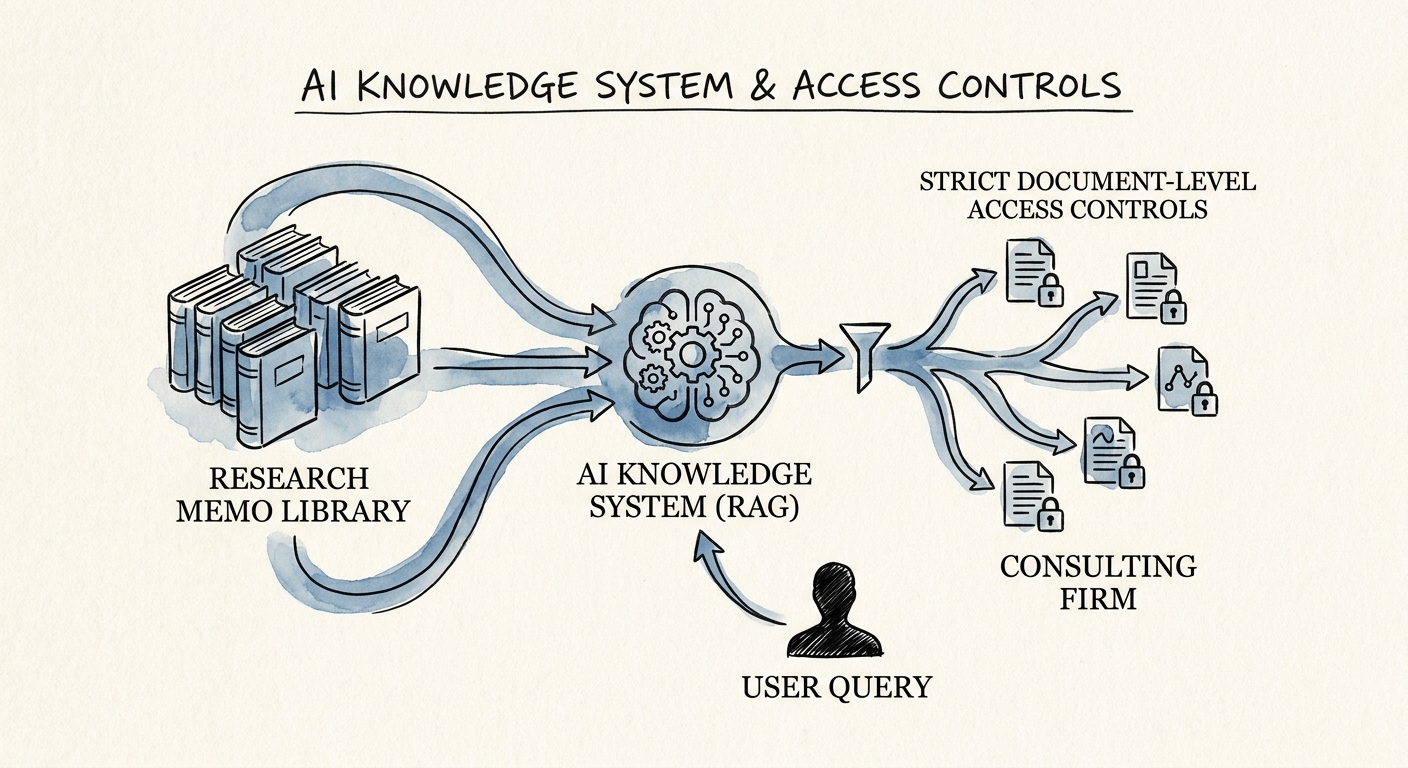
The definitive solution to this problem is an AI knowledge system powered by Retrieval-Augmented Generation (RAG). Instead of returning a frustrating list of blue links and documents, a RAG system actively reads the relevant past memos and synthesizes a coherent, directly cited answer. McKinsey's Retrieval-Augmented Generation Analysis highlights that RAG allows large language models to reference highly specific, proprietary enterprise data securely, without the immense cost and complexity of training a custom AI model from scratch.
But implementing this workflow is not simply an IT exercise in pointing a vendor's API at your corporate OneDrive. If you feed an AI model a massive garbage dump of outdated drafts, duplicated files, and half-finished meeting notes, it will generate highly articulate, confidently delivered garbage. You must curate a definitive "Research Memo Library." This requires establishing a strict, non-negotiable definition of done: only final, partner-approved deliverables make it into the vector database. We have rebuilt this workflow for three different service firms this year, and in every case, data cleanup had to precede automation.
Equally critical is the implementation of rigorous governance. Professional services firms operate under strict confidentiality agreements and complex ethical walls. Your AI system must respect these boundaries by design. If a junior associate is not permitted to view a specific healthcare client's M&A memo, the AI must not synthesize answers using that document's contents. We enforce document-level access controls directly at the vector database layer, ensuring the model only retrieves context the querying user is explicitly authorized to see. Understanding exactly when a RAG knowledge bot is worth building depends entirely on your firm's ability to enforce these permissions without breaking the user experience.
Testing, Ownership, and Measuring True ROI
Testing a sophisticated AI knowledge system requires moving far beyond basic trivia questions. You must validate the tool by testing its ability to accurately synthesize complex trends across multiple past engagements. We run adversarial testing protocols with practice leaders, asking the system highly complex prompts like, "Synthesize our 2025 strategic recommendations for automotive clients facing semiconductor shortages, explicitly citing our past three deliverables." If the system hallucinates a claim, misses crucial context, or fails to cite the correct source document, it fails the operational gate.
To sustain this accuracy over time, ownership of the system must sit with the business leaders, not just the IT department. While IT manages the vector database infrastructure and the underlying APIs, practice leaders must own the ongoing curation of the knowledge base. They are the only personnel qualified to determine if a past research memo is still strategically relevant or if market conditions have shifted enough that it should be formally archived. Building an AI knowledge system for your project delivery history requires this exact alignment between technical infrastructure and operational governance.
Measuring the ROI of this system is remarkably straightforward if you refuse to rely on fake "time-saved" math. We measure the hard reduction in "time-to-first-draft" for major deliverables. By compressing the research and synthesis phase, firms can dramatically increase their project delivery velocity. Forrester's Knowledge Management ROI Report demonstrates that when institutional knowledge is highly accessible, organizations directly improve execution velocity and permanently reduce duplicated efforts. When your highly paid analysts are no longer subject to the friction identified in McKinsey's Generative AI Productivity Study—which found knowledge workers spend a fifth of their time searching for information—you don't fire the analysts. You take on 20% more project volume with the exact same headcount, driving pure margin straight to the bottom line.