
The practical answer
- Short answer
- Learn why professional services firms are building AI knowledge systems and RAG architecture to automate quality assurance record retrieval and eliminate unbillable search time.
- Best fit
- Industry: Professional Services. Function: Quality Assurance
- Operating path
- AI Knowledge Systems → AI Transformation
- Key metric
- 47 Minutes wasted daily by knowledge workers simply searching for historical data and documents.
Professional services firms are burning an average of 18% of their senior delivery capacity digging through fragmented quality assurance records just to defend past decisions. When a client challenges a deliverable, or an external auditor requests the compliance trail for a project completed two years ago, operations leaders panic. They pull their most expensive billing resources off active projects to hunt for buried sign-offs, defect logs, and variance notes scattered across SharePoint, Jira, and buried email threads.
This is the unbillable tax of defensive delivery. According to Gartner's 2024 Digital Worker Experience Survey, digital employees spend up to 47 minutes every day simply searching for information. In professional services, that lost time is entirely unbillable. When applied to quality assurance and compliance, the financial bleed is even worse. Bain & Company's 2024 Tech Report indicates that poor data governance and fragmented knowledge cost firms up to 15% of their total revenue in unbillable rework and administrative delays.
In our last engagement with a 150-person engineering services firm, I watched their top QA directors function as human search engines. They spent their days cross-referencing PDFs against disparate ticketing systems just to verify that final implementation checks matched the initial client requirements. This is why building an internal AI knowledge search is no longer an innovation project; it is an absolute margin-defense imperative.
A robust AI knowledge system transforms your QA records from a dormant compliance liability into an active operational asset, ensuring your senior talent spends their time delivering value rather than digging through the past.
The Governance Trap: Why Basic Copilots Fail QA Workflows
Many operations leaders mistakenly believe they can solve this problem by purchasing an off-the-shelf AI assistant, pointing it at their company's cloud storage, and letting it index every QA document. This is a catastrophic approach. Quality assurance records are highly sensitive and context-dependent. A blanket search tool will confidently hallucinate a compliance sign-off because it read a draft document instead of the final, approved version.
This is precisely why Deloitte's 2024 Tech Trends report highlights that 60% of companies implementing enterprise AI fail their initial pilots due to poor data permissions and untagged documents. An AI knowledge system for QA requires strict Retrieval-Augmented Generation (RAG) architecture. It must respect document hierarchies, enforce Role-Based Access Control (RBAC), and prioritize verified final records over collaborative drafts. In professional services, client confidentiality is non-negotiable. If your QA retrieval system accidentally surfaces defect data from Client A when a project manager is querying data for Client B, you have a massive breach of trust. The system must explicitly inherit the permissions of the user querying it.
If your AI retrieves an outdated testing protocol and presents it as the current standard, the liability is entirely yours. As PwC's 27th Annual Global CEO Survey reveals, 41% of executives admit their companies suffer from inefficient administrative and compliance processes that AI could fix, but they hesitate due to risk. We routinely guide clients through the Microsoft Copilot vs. Custom AI workflow diagnostic for Quality Assurance to map exactly where generic tools fail. You cannot automate QA retrieval until your underlying metadata—project IDs, client names, date stamps, and approval statuses—is clean.
Architecting a Defensible QA Knowledge System
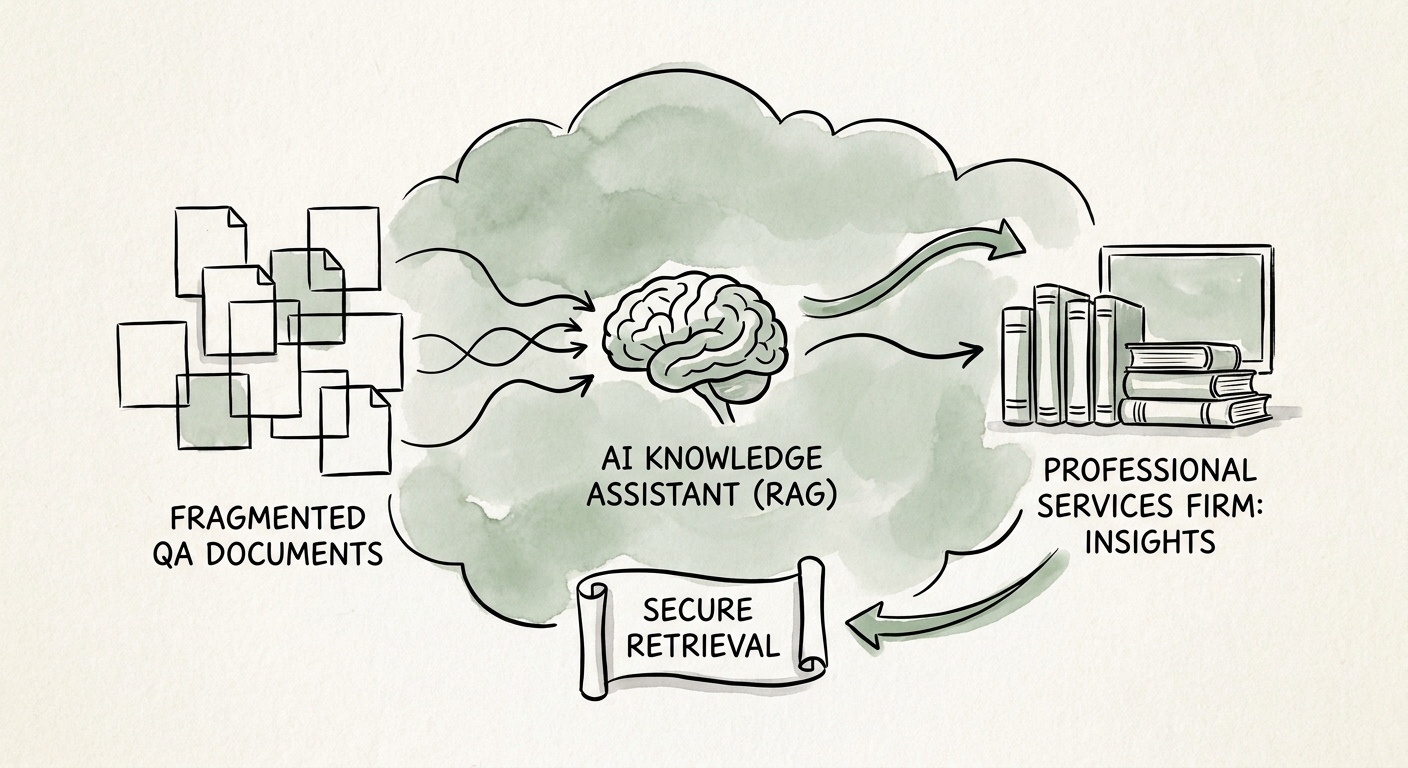
Building a secure AI knowledge system for QA records requires a structural shift in how your operations team handles data intake. You must move away from folder-based chaos and implement vector databases that chunk QA documents by specific intent. When a project manager asks the AI, "Show me the final defect resolution log for the Q3 migration and who signed off," the system must pull the exact paragraph from the verified audit log—complete with a hyperlink to the verifiable source file.
We saw this pattern at a mid-market software implementation partner. By structuring their historical QA checklists and linking them to a governed RAG system, we cut their audit response time from three days to under four minutes. The return on investment is immediate. McKinsey's State of AI in Early 2024 reports that high-performing organizations using generative AI for supply chain and quality control see efficiency gains of up to 30%. They are not achieving this by buying generic chatbots; they are building purpose-driven knowledge retrieval systems.
Retrieval testing is the most critical phase of deployment. You cannot launch a QA knowledge assistant without running rigorous evaluations against known ground-truth questions. We force the AI through hundreds of historical QA queries to measure precision and recall. Does it accurately identify a skipped compliance step? Does it refuse to answer when the documentation is missing, rather than inventing a plausible response?
Before you invest in an AI interface, you must audit your QA archives. Standardize your naming conventions, archive duplicate files, and clearly demarcate final audit reports from working drafts. It may also be time to reconsider automating your SOP documentation with AI to ensure your teams are operating from the same standardized baselines. A robust AI knowledge system transforms your QA records from a dormant compliance liability into an active operational asset, ensuring your senior talent spends their time delivering value rather than digging through the past.