The practical answer
- Short answer
- Learn how professional services firms can stop margin bleed by implementing a secure, RAG-based AI Knowledge System for their SOP library.
- Best fit
- Industry: Professional Services. Function: Knowledge Management
- Operating path
- AI Knowledge Systems → AI Transformation
- Key metric
- 68.9% Average billable utilization in 2024, dragged down heavily by unbillable administrative search time.
The Administrative Bleed and the Hallucination Trap
The average professional services firm bleeds nearly 20% of its weekly capacity just searching for the right Standard Operating Procedure (SOP) or past deliverable. In fact, McKinsey's report on information worker productivity reveals that employees spend 1.8 hours every day—9.3 hours per week—searching and gathering information. Your highly paid consultants, engineers, and account managers are stuck in SharePoint purgatory, wasting time trying to figure out "how we do this" rather than delivering billable work to clients. The knee-jerk reaction over the past year has been to buy an off-the-shelf "AI Copilot," point it at a disorganized Google Drive, and hope it magically organizes the chaos.
This "plug and play" delusion is exactly why Gartner's 2025 Generative AI Abandonment Prediction states that 30% of generative AI projects will be abandoned after proof of concept. You cannot automate your way out of a mess. If your foundational data is garbage, your AI will simply hallucinate at scale.
In our last engagement rebuilding an AI knowledge assistant for a 150-person consulting firm, we found that their initial "AI bot" was constantly hallucinating answers. The underlying issue wasn't the language model; the issue was that the bot was reading five different, conflicting versions of the same onboarding SOP from 2021, 2023, and 2025. This lack of governance contributes directly to the margin collapse we are seeing across the sector. SPI Research's 2025 Professional Services Benchmark reports that average billable utilization has dropped to an alarming 68.9%. Every unbillable hour spent hunting for process documentation instead of billing hours is raw profit evaporating from your P&L.
A mess is not something you can automate. If your foundational data is garbage, your AI will simply hallucinate at scale.
Building a RAG Architecture That Respects Permissions
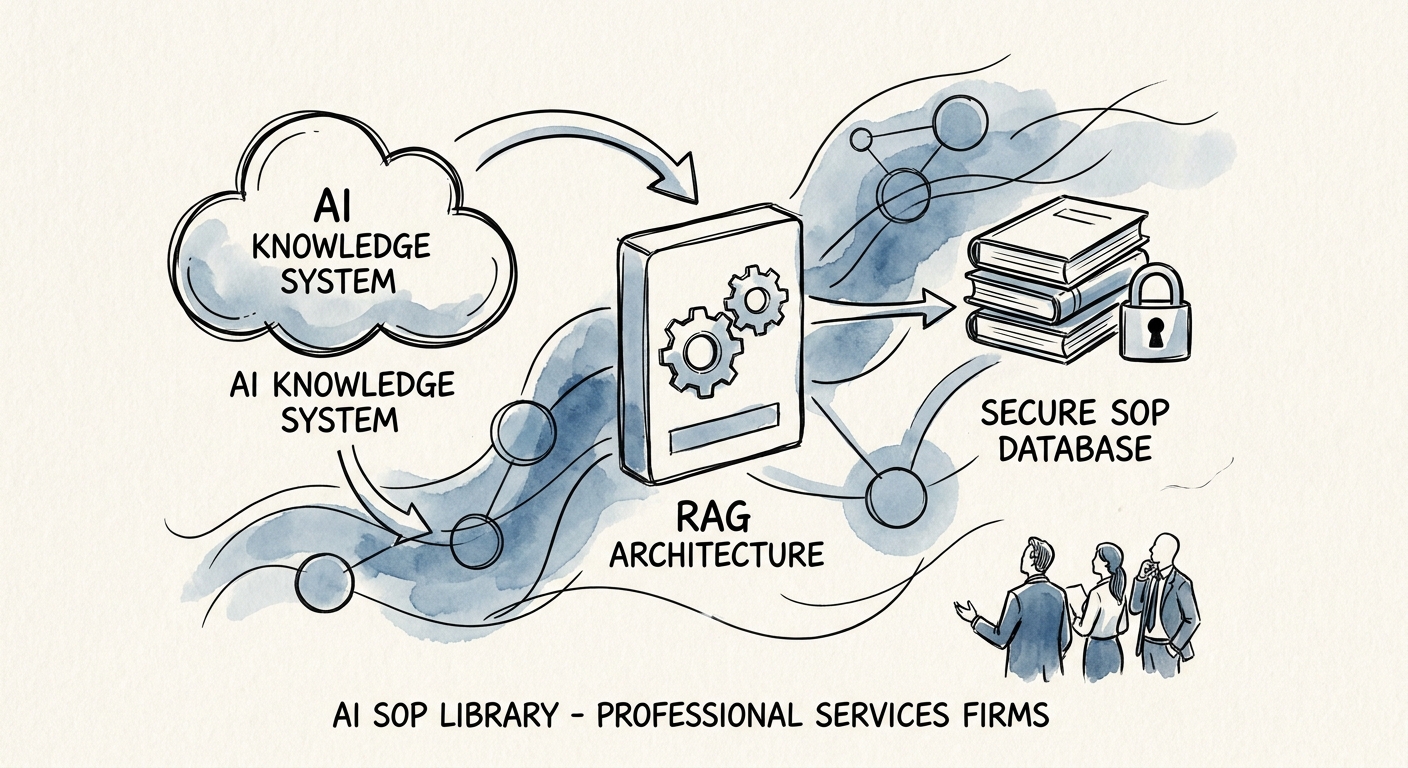
If you want an AI Knowledge System that actually works for a professional services firm, you must implement Retrieval-Augmented Generation (RAG). RAG forces the AI to ground its answers strictly in your verified SOPs, explicitly citing the exact document it used rather than letting the model guess based on its public training data. But RAG architecture is only as good as the repository it searches, and fragmentation is the enemy of retrieval. Harvard Business Review Analytic Services' 2025 Knowledge Management Survey notes that 73% of businesses cite fragmented, siloed knowledge sources as their primary challenge.
You must establish a "Golden Source" for your SOPs before you deploy AI. If an old PDF on a local server contradicts a newly updated Notion page, the AI will fail the end user. Before deploying any RAG system, operations leaders must ruthlessly consolidate, archive obsolete documentation, and tag authoritative sources. If you want a deeper look at establishing this foundation, read our guide on SOP Documentation: When Copilot Is Enough and When You Need a Custom AI Workflow.
Beyond data cleanliness, the greatest hidden risk in an AI knowledge system is access control. RAG systems bypass traditional folder navigation and search queries. If your AI does not respect Role-Based Access Control (RBAC), a junior analyst can simply ask, "What is the partner compensation structure?" or "What are our redundancy plans for Q3?" and the bot will happily summarize a restricted HR document. We mandate that any AI deployment maps its retrieval capabilities directly to your Active Directory or identity provider. The bot must only be allowed to "read" the documents that the specific user querying it has permission to view. Failing to lock down permissions turns your productivity tool into a massive internal security breach.
Retrieval Testing and the Shift in Unit Economics
Once your data is clean and your permissions are locked down, you must relentlessly test retrieval accuracy before the system ever faces a billable employee. I see mid-market operators deploy AI bots without defining what a "correct" answer actually looks like. You need a dedicated library of test queries—including edge cases, complex policy questions, and multi-step delivery processes—to grade the system. If the bot fails, you do not just tweak the prompt; you must adjust the vector search parameters, chunking strategies, and metadata tags. For a complete understanding of when this testing proves a system is unready, review When Not to Automate SOP Documentation with AI.
When you take ownership of this testing and governance, an AI knowledge system fundamentally shifts your unit economics. Instead of senior partners spending hours answering the same process questions from junior staff, the knowledge system handles the administrative burden instantly and accurately. Forrester's 2025 Agency Operations Report found that professional services firms automating internal workflows reclaim 8 to 14 billable hours per week per account manager. That is recovered capacity falling straight to your bottom line.
This margin expansion justifies the upfront build cost and proves exactly why RAG for SMBs: When a Knowledge Bot Is Worth Building is the most critical strategic conversation your operations team needs to have today. Stop treating your SOP library like a digital dumping ground where documents go to die. Treat it like a structured database, wrap it in a secure RAG architecture with strict identity controls, and give your operators their billable capacity back. Doing so will transform your firm from a chaotic, reactive body shop into a highly profitable, scalable enterprise.