
The practical answer
- Short answer
- Learn how consulting firms can stop bleeding unbillable time by building an AI knowledge system to index and retrieve project delivery history using RAG.
- Best fit
- Industry: Professional Services. Function: Knowledge Management
- Operating path
- AI Knowledge Systems → AI Transformation
- Key metric
- 31.1% Average unbillable capacity in professional services.
The SharePoint Wasteland Tax on Consulting Margins
According to the 2025 SPI Professional Services Benchmark on utilization, consulting billable utilization has dropped to an industry average of 68.9%. If you want to know where the remaining 31.1% of your capacity is bleeding out, start by looking at how your consultants research past projects. They are drowning in a SharePoint wasteland. I have seen this pattern at dozens of mid-market firms: a partner sells a "custom" engagement, and the delivery team spends the next two weeks recreating methodologies, interview guides, and maturity models that a different team already perfected nine months ago.
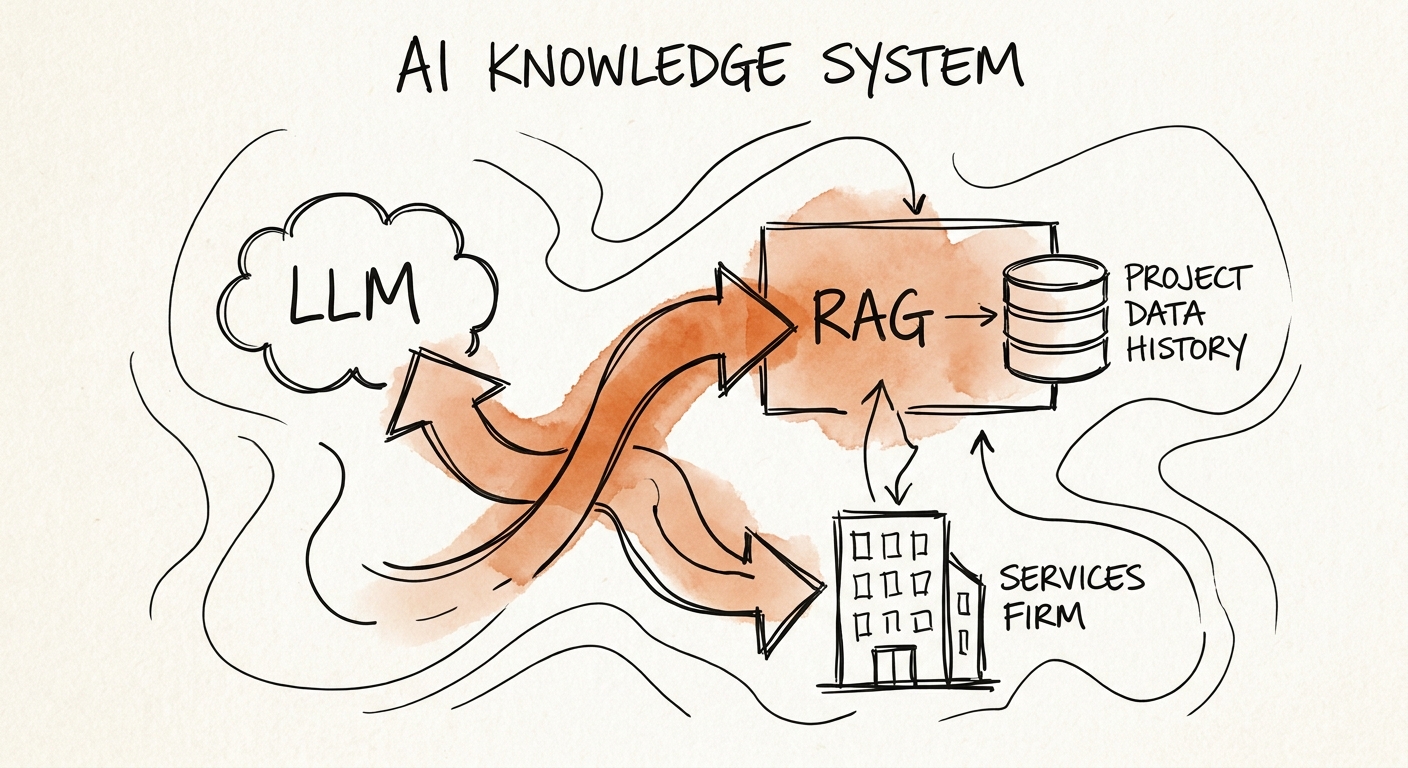
This isn't just an operational annoyance; it is a massive margin killer that directly throttles your firm's profitability. Glean's 2025 Enterprise Search Metrics reveal that knowledge workers spend up to 30% of their workday simply searching for information. In a professional services firm, that search time is entirely unbillable. You are paying six-figure salaries for highly educated professionals to play digital archaeologists, digging through nested folders trying to find a slide deck from 2023. When they inevitably fail to find the exact deliverable they need, they start from scratch. The solution to this systemic inefficiency is not another corporate mandate about folder naming conventions or tagging standards. The solution is an AI Knowledge System—specifically a Retrieval-Augmented Generation (RAG) architecture—designed exclusively to index, retrieve, and synthesize your project delivery history.
You cannot allow a consultant working on one account to prompt an AI and accidentally retrieve confidential data from a competitor's past engagement. Strict, document-level permissions are non-negotiable.
Building the RAG Knowledge System: From Search to Synthesis
Building an AI knowledge system for your project history requires fundamentally shifting your firm's mindset from "search" to "synthesis." You do not want a bot that just returns a list of 40 hyperlink results that a consultant still has to read. You want a system that can accurately answer: "What was our exact methodology for the post-merger integration for a regional manufacturing client, and extract the specific vendor consolidation risk matrix we delivered?" To get there, you must master the mechanics of Retrieval-Augmented Generation (RAG).
But here is the brutal reality check for operations leaders: your AI is only as smart as the garbage you feed it. As Foxit's 2026 State of Document Intelligence report found, fragmented document workflows cause businesses to lose over $14 million annually due to compliance violations and duplicated efforts. If you simply point an AI at raw, uncurated project folders in a vector database, your RAG system will confidently synthesize outdated draft proposals alongside final client deliverables. The result is a highly articulate hallucination.
The scale of this duplication is staggering. Across mid-market firms, a large share of employees routinely duplicate work done by other teams simply because they lack document visibility across the enterprise. In our last engagement with a 150-person IT services consultancy, I completely rebuilt their knowledge infrastructure after their first attempt at an internal AI assistant failed spectacularly. It was indexing documents labeled "v2_draft_FINAL.docx" alongside the actual final deliverables, feeding consultants contradictory frameworks. You must clean the underlying data first. Separate your final deliverables, sanitized research memos, and client read-outs from the noise of daily project management. If you are evaluating this technology build, you absolutely must prioritize data cleanup for your knowledge assistant before buying a single AI license.
Governance, Ownership, and Securing the ROI
The biggest roadblock to deploying AI knowledge systems in consulting is not the technology stack; it is information governance. You cannot allow a consultant working on one beverage client's account to prompt an AI and accidentally retrieve confidential supply chain data from a directly competing brand's past engagement. In professional services, strict, document-level permissions are non-negotiable. Your AI knowledge system must seamlessly inherit the access controls of your core document repository. If a user does not have permission to view the source file in SharePoint or Google Drive, the RAG model must not be able to use that file to generate an answer.
Failing to lock this down creates massive liability and destroys client trust. The ECM Consultant's analysis of digital workplace productivity notes that knowledge workers spend roughly 19% of their week just gathering information—but you cannot safely reclaim that time by compromising client confidentiality walls. I have audited too many implementations where IT deployed a tool without consulting operations, resulting in immediate data exposure.
To secure the ROI of your AI transformation, focus relentlessly on retrieval testing and attribution. Before rolling this system out to the broader firm, operations leaders must build a rigorous test suite of 50 common project queries and manually grade the AI's responses for both accuracy and source attribution. Every single claim the AI makes must include a citation link back to the specific source document it referenced, ensuring consultants can verify the data. We consistently advise our clients to rigorously evaluate ChatGPT Team versus custom AI workflows to ensure they completely control their infrastructure and data privacy. Stop paying your consultants to search for old collateral. Build an AI Knowledge System for your project delivery history that synthesizes your firm's intellectual property, protects your client data, and gets your team back to billing.