
The practical answer
- Short answer
- Learn how marketing operations leaders are using RAG AI knowledge systems to turn buried quality assurance records into queryable margin-saving assets.
- Best fit
- Industry: Marketing Agencies. Function: Quality Assurance
- Operating path
- AI Knowledge Systems → AI Transformation
- Key metric
- 35% Reduction in recurring QA failures with AI pattern recognition
A staggering 22% of agency project margins are quietly destroyed by preventable rework according to Forrester's 2024 Agency Margin and Performance Report, largely because past quality assurance records remain locked in fragmented silos. I see this specific margin leak constantly: an agency's QA team flags a critical brand compliance issue on a pharmaceutical banner ad, documents the fix in a Jira ticket, and moves on. Six months later, a different creative team commits the exact same violation on a related campaign because they had no frictionless way to query past defects. This is not a talent problem; it is a fundamental knowledge retrieval failure that systematically erodes agency profitability.
The Invisible Tax of Unsearchable Compliance Data
In our last engagement with a 150-person performance marketing agency, we uncovered a brutal reality: project managers and QA specialists were spending upwards of five hours a week simply hunting down past approval checklists, bug reports, Frame.io comments, and client-specific compliance mandates. They were functioning as highly paid human search engines. This manual tax drains capacity that should be spent on strategic client advisory and accelerated campaign execution. When QA data is buried in Asana task descriptions, Google Drive documents, and deep Slack threads, your agency essentially suffers from corporate amnesia every time a key employee leaves or transitions off a major account.
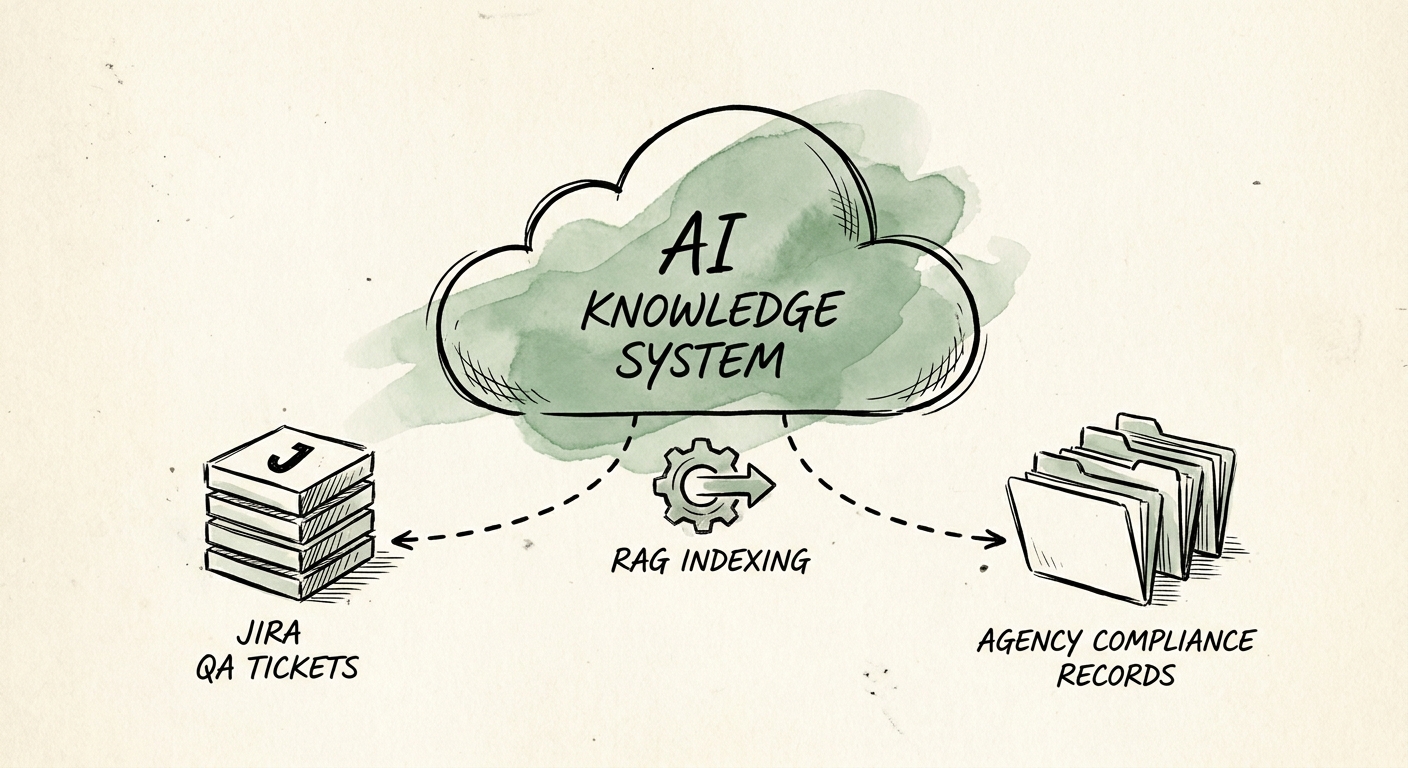
We have successfully implemented Retrieval-Augmented Generation (RAG) knowledge systems to solve this exact bottleneck and reclaim lost operational capacity. By indexing historical QA logs, compliance rejections, and post-mortem delivery notes into a secure, semantic search engine, agencies can surface highly contextual guidance before the next project begins. Instead of asking around a crowded Slack channel to find out why a client rejected the last video export, an account manager can query the AI and instantly retrieve the specific technical constraints documented during the previous quarter's QA review. But building this system requires moving beyond the hype of basic chatbots and addressing the structural reality of your operational data. For further context on how this approach applies to broader organizational process documentation, review our guide on The AI Knowledge System for Marketing Agency SOPs.
You cannot expect an AI to generate reliable compliance checklists if it is pulling from a swamp of outdated Slack threads and unresolved Jira tickets. Data taxonomy must precede AI automation.
The Danger of Unfiltered RAG in Agency Environments
The most dangerous mistake an agency operations leader can make is plugging a foundational model directly into their entire project management suite without explicit governance and data hygiene. RAG is incredibly powerful, but it is deeply vulnerable to data contamination. If you feed an AI knowledge system five years of unresolved bug tickets, outdated brand guidelines, and contradictory Slack debates, you will simply automate the distribution of terrible, outdated advice at scale. We know exactly how this plays out in the real world: Gartner's 2024 Generative AI in the Enterprise report explicitly warns that 30% of corporate GenAI projects will be abandoned post-pilot specifically due to inadequate data quality and missing risk controls.
Strict Permissions and Cross-Client Contamination
In the marketing agency context, this technical risk is exponentially compounded by client-specific compliance boundaries. You absolutely cannot allow a RAG system to hallucinate quality assurance criteria for a highly regulated financial services client based on the relaxed brand guidelines of an e-commerce client sitting in the same database. Strict permission mapping and metadata tagging are non-negotiable prerequisites. You must structure your vector database so that QA retrieval is strictly bounded by client ID, project type, and industry vertical. KPMG's 2024 Marketing Compliance and AI Study highlights this exact threat, revealing that 41% of marketing executives view cross-client data leakage as their most critical AI governance exposure.
Before we write a single line of code for an AI knowledge system, we force the agency to perform a QA data cleanup sprint. We identify the canonical sources of truth—typically finalized Jira resolution notes, approved client compliance matrices, and formal project post-mortem reports—and we strictly exclude the chaotic conversational data that clutters the retrieval process. You must designate clear ownership over the QA knowledge base. If no one is responsible for archiving outdated compliance rules, the AI will confidently instruct your team to execute against expired standards, turning a theoretical efficiency gain into a hard liability. This governance model mirrors the discipline required when Building an AI Knowledge System for Quality Assurance Records in other highly regulated professional services verticals.
Engineering a QA Knowledge Engine That Defends Margins
To build a QA knowledge system that actually defends your profit margins, you must prioritize rigorous retrieval testing over generic conversational abilities. An operator's goal is not to have a chatty assistant; the goal is to instantly extract the exact technical parameters, media specifications, or compliance mandates required to pass QA on the first attempt without human intervention. This means engineering the system to cite its sources directly. When a front-end developer queries the system about accessibility requirements for a specific healthcare client build, the AI must append a direct hyperlink to the original QA ticket or compliance document where that requirement was established. This builds operational trust and ensures an auditable paper trail.
The Financial Impact of Predictive QA Retrieval
The economic impact of deploying these systems correctly is profound and immediate. When your team stops repeating the same creative, technical, and regulatory mistakes, your effective hourly realization rate skyrockets because unbillable rework hours drop to near zero. McKinsey's Economic Potential of Generative AI research proves that well-architected knowledge retrieval systems cut enterprise search time by up to 20%, unlocking massive latent capacity across the organization. We see this translate directly to the bottom line: fewer internal review cycles, eliminated client revision rounds, and a dramatic reduction in project write-offs. Furthermore, Deloitte's Global Quality Management Benchmark demonstrates that organizations deploying AI-driven defect pattern recognition reduce their recurring QA failures by 35%.
Do not let your agency's hard-won operational intelligence rot in archived project management folders. The quality assurance friction you experience today is the exact training data you need to automate a smoother delivery process tomorrow. By treating QA records not as administrative exhaust, but as a structured, queryable asset, you transform your compliance and review protocols from a margin drain into a competitive moat. Start by auditing your current QA repositories, defining strict client-level access controls, and isolating your highest-quality resolution data. The agencies that master this retrieval capability will systematically out-execute those still relying on manual memory and endless Slack searches to ensure the quality of their work. For further context on turning historical data into a strategic advantage, explore The Agency Amnesia Tax: Building an AI Knowledge System for Project Delivery History.