
The practical answer
- Short answer
- Learn how consulting firms stop margin leaks by building AI knowledge systems (RAG) for Quality Assurance records. A guide to governance, testing, and ROI.
- Best fit
- Industry: Consulting. Function: Operations & Delivery
- Operating path
- AI Knowledge Systems → AI Transformation
- Key metric
- 60% of project margin erosion stems from repeating past QA failures
Unbillable rework silently drains up to 12% of project margins in mid-market consulting firms, entirely because delivery teams repeat the exact same quality assurance failures we already paid to fix once. When scoping a new engagement, partners rarely review the peer-review notes, defect logs, testing scripts, or client escalation emails from similar past projects. The data exists, but it is buried deep in scattered SharePoint folders, locked Jira tickets, and disconnected Teams threads. The result is a massive margin leak that most operations leaders simply accept as the inevitable cost of doing business. I refuse to accept it. Paying your most expensive senior talent to solve a QA problem your firm already solved two years ago is a massive operational failure.
The Margin Impact of Knowledge Retrieval
In our last engagement with a 200-person technology consultancy, we found that 60% of their project margin erosion stemmed from just three repeating QA issues across their cloud implementation practice. Finding these patterns manually across thousands of historical project files was impossible. This is why building an AI knowledge system via Retrieval-Augmented Generation (RAG) specifically for QA records is the most profitable automation a delivery team can deploy. By vectorizing past QA data, your project managers can simply ask, "What were our primary QA failures during the last three healthcare ERP implementations?" and get a sourced, highly accurate summary in seconds. The impact on billable capacity is immediate. In fact, McKinsey's Generative AI productivity analysis demonstrates that effective knowledge retrieval can reduce the time employees spend searching for internal information by up to 20 percent.
But building this system is not a simple plug-and-play exercise. You cannot simply point a generic AI bot at your entire Microsoft 365 tenant and hope for the best. Without deliberate scoping, you risk surfacing outdated QA frameworks or, worse, exposing sensitive client data across internal silos. According to SPI Research's 2024 Professional Services Maturity Benchmark, top-performing firms attribute their premium margins directly to structured knowledge management and repeatable delivery excellence. If you want those premium multiples, you have to treat your historical QA records like a structured corporate asset before you let an AI touch them.
Paying your most expensive senior talent to solve a QA problem your firm already solved two years ago is a massive operational failure.
The Governance Barrier: Permissions and Data Quality
I have rebuilt knowledge management architectures for services firms three times over the past decade, and the failure point is always exactly the same: garbage data. If your QA system ingests draft peer reviews, abandoned Jira tickets, unapproved change requests, and obsolete testing scripts, your AI will confidently give your delivery team the wrong answers. This is why data cleanup must precede your AI knowledge assistant. We mandate a hard cutoff rule in our implementations—only QA records that have been finalized, closed, and tagged by a QA lead are vectorized into the RAG database. Anything still marked "in progress" is excluded to prevent the AI from surfacing unverified hypotheses as factual delivery guidance.
Then comes the critical issue of permissions and access control. In professional services, client confidentiality is paramount. If a consultant querying the QA system asks about a failure pattern, the AI absolutely cannot leak proprietary code snippets, financial metrics, or PII from another client's protected project. Managing these access controls inside a RAG architecture requires strict document-level security trimmings. PwC's 2024 AI Business Survey found that managing data security and privacy remains a top barrier to AI scaling for over 40% of executives. You must build your knowledge system so that the LLM only retrieves chunks of data the querying user already has the active credential to see.
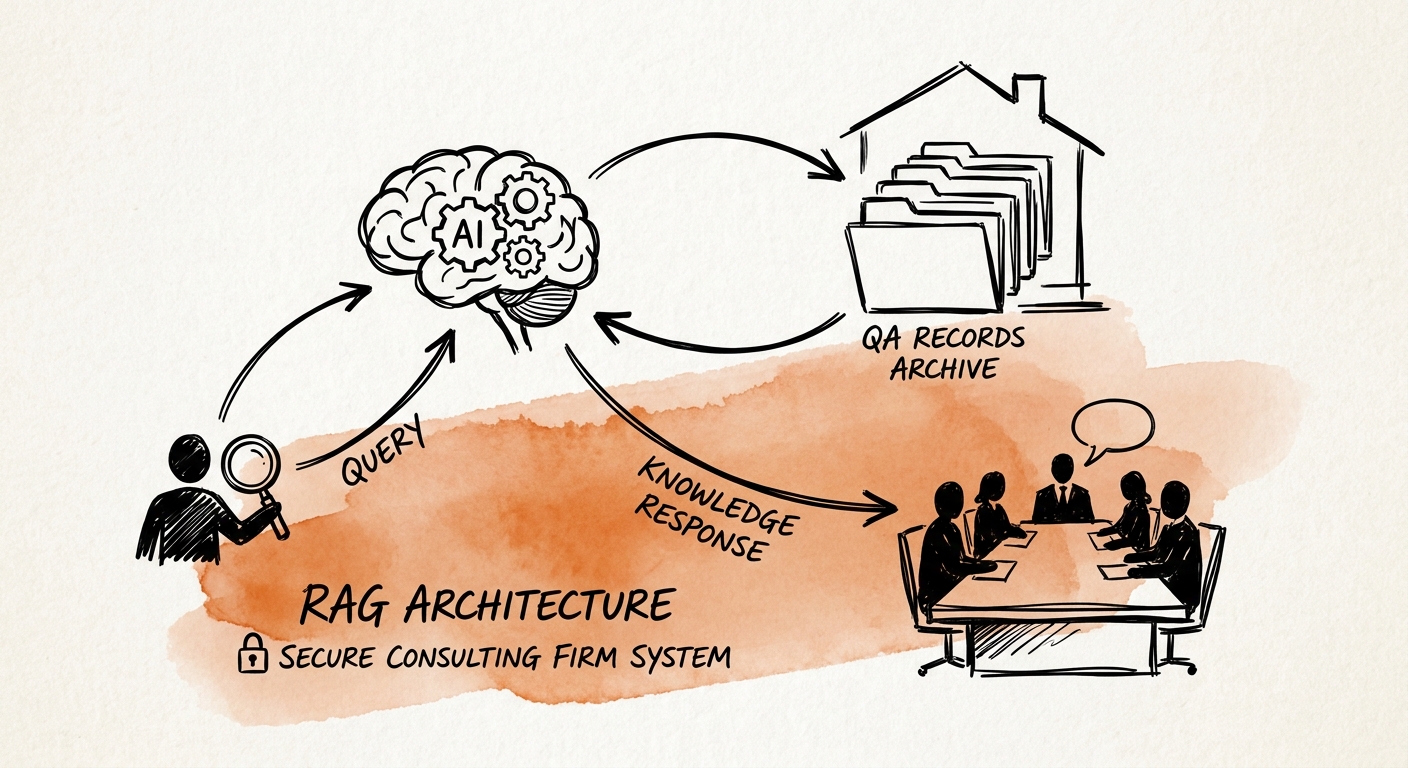
We solve this governance challenge by deliberately divorcing the LLM from the storage layer. The AI doesn't "know" anything; it merely synthesizes the specific QA records your enterprise search tool hands it. If the search tool respects your SharePoint and Jira permissions, the AI respects them too. If you are serious about deploying this, building an AI Knowledge System for Quality Assurance Records requires an operations leader to own the data tagging taxonomy, not just an IT director buying another software license.
Testing Retrieval and Defining System Ownership
Once the QA knowledge base is connected and permissions are mapped, you must rigorously test the retrieval accuracy before rolling it out to the floor. An AI that hallucinates a "passed" QA status for a known critical deployment bug is a massive operational liability that will destroy trust in the tool immediately. We implement a "ground truth" testing framework before any system goes live. We take 50 historical QA questions where we know the exact answer, run them through the RAG system, and manually score the output on relevance, accuracy, and safety. Despite the massive market hype, Bain's 2023 AI in Enterprise Technology Report reveals that while companies are rushing to adopt AI, integration and data quality remain massive hurdles, stalling many proofs of concept at the pilot stage. You bypass pilot purgatory entirely by treating retrieval testing as a pass/fail engineering requirement.
To cross the finish line and sustain value, someone must own the feedback loop. When a project manager receives a sub-par answer about past delivery defects, they need a one-click button to flag the response. The system owner—typically the Head of Delivery, Practice Lead, or QA Director—must review these flags weekly to adjust the chunking strategy or update the source data. As noted in Gartner's GenAI adoption forecast, 80% of enterprises will have deployed GenAI by 2026, meaning your most aggressive competitors are already building these margin-protecting capabilities. You cannot afford to delay your deployment while waiting for perfect data.
Ultimately, a RAG system for QA isn't an IT project; it is a margin protection strategy. It turns the painful, expensive lessons of past engagements into active, real-time guardrails for your current ones. For firms debating whether the upfront investment in data structuring is justified, review our operator's guide on when a knowledge bot is actually worth building. If you are tired of watching your gross margins evaporate to fix the exact same mistakes quarter after quarter, organizing your QA records for AI retrieval is your next mandatory operational upgrade.