
The practical answer
- Short answer
- Learn how consulting firms can reclaim unbillable hours by deploying governed AI knowledge systems for their Standard Operating Procedures.
- Best fit
- Industry: Consulting. Function: Operations
- Operating path
- AI Knowledge Systems → AI Transformation
- Key metric
- 1 Secure ethical walls by implementing granular access controls before indexing your SOPs.
Consulting firms are burning 9.3 hours per consultant every week just searching for and gathering internal information, effectively operating as the world's most expensive librarians. This McKinsey benchmark on knowledge worker productivity represents a massive unbillable tax on your margins. When an engagement manager cannot instantly locate the correct Standard Operating Procedure (SOP) for a specific compliance audit, they either recreate it from scratch or rely on outdated memory. When a junior analyst can't find the exact formatting rules for a due diligence report, they interrupt a senior partner on Slack, burning two people's time instead of one. Across a 100-person firm, this administrative friction silently erodes millions of dollars in billable capacity every year. This is the hidden cost of tribal knowledge, and it is destroying your realization rates.
To stop this margin bleed, operations leaders are rushing to deploy AI Knowledge Systems using Retrieval-Augmented Generation (RAG). The promise is intoxicatingly simple: point an AI at your massive, tangled web of SharePoint, Confluence, and Google Drive folders, and let consultants ask questions in plain English. However, this "Everything Bagel" approach to AI deployment almost always fails. According to MIT's 2024 AI Adoption Study, 73% of employees abandon enterprise AI tools simply because the systems provide unclear, irrelevant, or contradictory answers.
In our last engagement with a 250-person financial advisory firm, we saw this exact pattern firsthand. They had dumped thousands of unstructured, outdated files into a generic AI wrapper and wondered why the bot routinely hallucinated obsolete compliance standards. The AI didn't know which version of the client onboarding SOP was the current, legally binding one, so it just merged three different versions from 2019, 2022, and 2024 into one confidently incorrect answer. If you want an AI knowledge system to actually scale and drive ROI, you have to stop treating it like a magic search box and start treating it like a highly governed operational system.
In our last engagement with a 250-person financial advisory firm, we saw this exact pattern firsthand. They had dumped thousands of unstructured, outdated files into a generic AI wrapper and wondered why the bot routinely hallucinated obsolete compliance standards.
The Permission Risk of Ungoverned AI
In the consulting industry, information access is not just a logistical issue; it is a profound legal and ethical risk. Your SOP library sits adjacent to highly sensitive client data, engagement histories, and proprietary commercial methodologies. If you deploy an AI knowledge system without rigid, granular access controls, you are building an unauthorized, automated bridge across your ethical walls. Forrester projections on generative AI risks warn that ungoverned AI adoption will cost B2B companies over $10 billion in enterprise value by the end of 2026, largely driven by regulatory fines, breached NDAs, and loss of intellectual property.
Imagine a scenario where a consultant on a retail supply chain project queries the firm's AI for "best practices in vendor consolidation." Because the underlying data lake is poorly governed, the RAG system bypasses standard folder permissions, retrieves, and summarizes confidential vendor contracts from a healthcare M&A deal handled by an entirely different team. The consultant unknowingly pastes this privileged framework into their client deliverable. This is the exact reason why the IBM 2025 Cost of a Data Breach Report notes that organizations struggling with "shadow AI" and ungoverned models face breach costs averaging $670,000 higher than their more disciplined peers.
To mitigate this existential risk, you must adopt strict data governance before turning on the AI. Gartner's 2025 AI Data Readiness research predicts that through 2026, organizations will abandon 60% of their AI projects entirely because they are unsupported by AI-ready, governed data. You cannot automate a mess. For a deeper dive on getting your data house in order and securing your permissions, read our step-by-step guide on Why Data Cleanup Must Precede Your AI Knowledge Assistant.
Architecting a High-Fidelity SOP Knowledge System
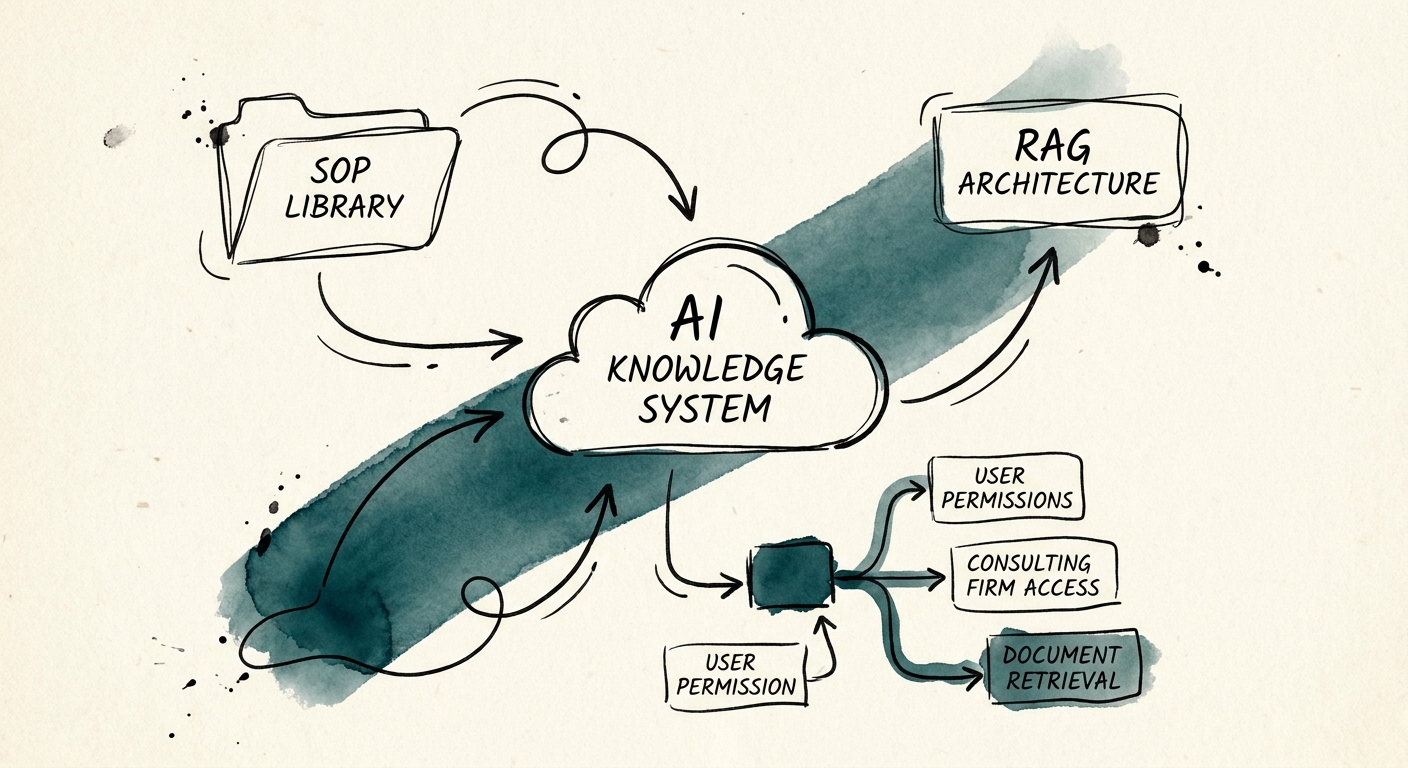
The secret to a successful AI knowledge system is ruthlessly narrowing its focus. Instead of indexing every document, email, and slack thread your firm has ever created, build a "Narrow RAG" architecture focused exclusively on vetted, approved Standard Operating Procedures. In this model, curation should represent 90% of your effort, with the actual technical pipeline implementation taking up the remaining 10%. By restricting the AI's retrieval corpus to a highly curated, strictly version-controlled repository, you drastically reduce the hallucination surface area. If the answer isn't explicitly detailed in the official SOP, the AI must be programmed to confidently state, "I do not have an approved procedure for this request," rather than guessing or interpolating from unrelated documents.
Next, operations teams must implement rigorous, ongoing retrieval testing. Most consulting firms make the amateur mistake of only evaluating the final text generation. However, if the underlying retrieval engine pulls the wrong source document, even the most advanced, expensive large language model will generate bad operational advice. Establish a strict evaluation framework that scores the system exclusively on whether it fetches the correct SOP document for specific, complex operational scenarios. If you are applying these systems to past client work, the exact same rules apply—see our detailed breakdown on Building an AI Knowledge System for Your Project Delivery History for the specific engineering mechanics.
Finally, assign a human owner to the system. An AI knowledge assistant is not a piece of software you buy and forget; it is a digital employee that requires onboarding, feedback, and ongoing management. The Operations leader must define exactly who is responsible for archiving obsolete SOPs, updating workflows when industry regulations change, and auditing the AI's chat logs to identify new knowledge gaps. When you treat the RAG system as a dynamic, governed product rather than a one-off IT experiment, you eliminate the search tax and reclaim thousands of billable hours. Stop letting your highly paid consultants waste their capacity searching for answers that already exist. As detailed in our breakdown of The $19,700 Blind Spot: Why Internal Knowledge Search is Your First AI Workflow, executing this infrastructure correctly is your firm's most immediate path to margin expansion.