The practical answer
- Short answer
- Learn how consulting firms reduce unbillable ramp time by implementing RAG-based AI knowledge systems for training documentation. Actionable governance guide.
- Best fit
- Industry: Consulting. Function: Operations
- Operating path
- AI Knowledge Systems → AI Transformation
- Key metric
- 35% Of value-added collaborative work is forced onto just 3-5% of senior staff due to poor knowledge search.
The Invisible Tax on Consulting Margins
The average mid-market consulting firm burns $22,400 per new hire in lost billable capacity simply because their training documentation is unsearchable. In professional services, your margins are directly tethered to utilization rates, and nothing destroys utilization faster than an extended ramp period. According to McKinsey's research on onboarding costs, organizations face a 20% productivity drag during a new hire's first six months. For a consultant expected to bill at $250 an hour, that drag represents a massive, unchecked leak in enterprise value.
The core issue is rarely a lack of documentation; it is the sheer volume of outdated, contradictory information. When a newly minted associate needs to find the firm's standard operating procedure for a commercial due diligence kickoff, they search your intranet and get 47 different results. Which one is the gold standard? They don't know. So, they resort to the most expensive search engine in the world: the senior manager down the hall. This behavior drives what Harvard Business Review's analysis of collaborative overload identifies as a critical organizational bottleneck, where up to 35% of all value-added collaborative work is forced onto a tiny 3% to 5% of your senior workforce.
In our last engagement with a 150-person strategy consultancy, we found that engagement managers were spending 11 hours a week simply pointing junior staff to the correct folder locations or explaining nuances that were supposedly documented. We immediately realized that building an AI Knowledge System for their consulting SOP library was the fastest path to margin recovery. Forrester's knowledge management ROI research confirms this exact pattern, demonstrating that knowledge workers still spend roughly 25% of their day just searching for internal information.
If you feed a Large Language Model a dumpster fire of uncurated data, it will synthesize that garbage with absolute confidence at scale.
Why a Copilot License Won't Fix Your Knowledge Base
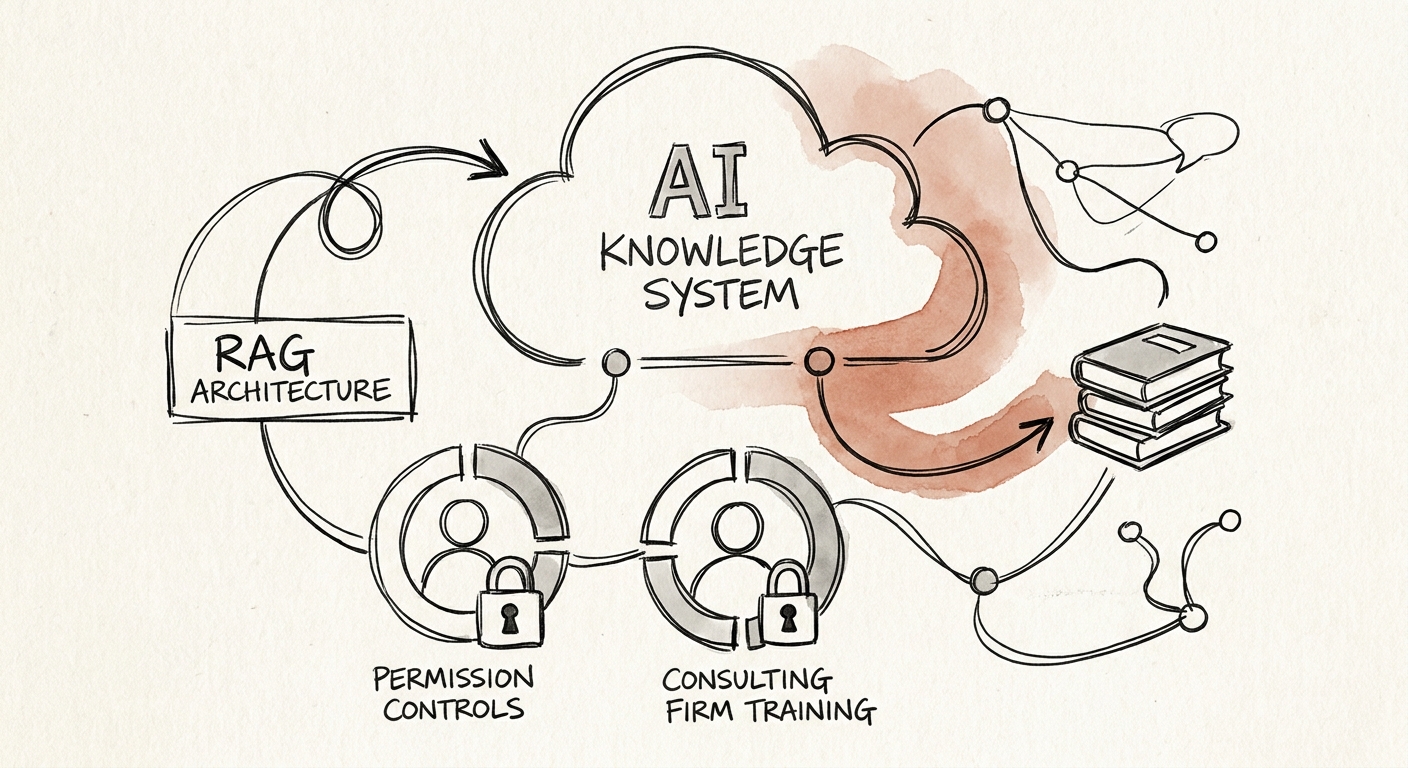
You cannot solve this ramp time crisis by simply purchasing an off-the-shelf AI license and pointing it at your entire Google Drive. If you feed a Large Language Model a dumpster fire of uncurated data, it will synthesize that garbage with absolute confidence at scale. Building an AI knowledge system for training documentation requires a strict Retrieval-Augmented Generation (RAG) architecture. RAG allows the AI to search your proprietary, approved training materials and generate answers strictly based on that trusted text, citing the exact document it referenced so your analysts know exactly where to find the source file.
But RAG is only as good as the source data and the permissions governing it. According to PwC's 2024 AI Business Predictions, 60% of executives view AI hallucination and data leakage risks as their primary barriers to deployment. They are entirely right to be paranoid. If you do not configure access controls properly at the vector database level, a new analyst asking "What is our standard margin on implementation projects?" might inadvertently retrieve unredacted profitability data from a partner's private Q3 financial review.
We enforce a strict "least privilege" architecture in every deployment. If a user does not have native permissions to view a document in your active directory, the AI cannot retrieve it to formulate an answer. Furthermore, you must aggressively archive outdated training materials before the AI ingests them. You must understand why data cleanup must precede your AI knowledge assistant. If you have five different versions of an onboarding checklist spanning from 2018 to 2024, the AI will pull from all of them, creating a synthesized Frankenstein procedure that is actively harmful to the new hire's workflow.
Governance, Retrieval Testing, and Ownership
Establishing an AI-powered training library is not an IT project; it is an operations mandate. You must assign a dedicated Knowledge Owner. This role is distinct from a database administrator. The Knowledge Owner is responsible for maintaining the "ground truth" of your training documentation. They dictate what gets indexed, what gets sunsetted, and how the AI is permitted to interpret complex, multi-step methodologies.
Before you roll this out to your incoming associate class, mandatory retrieval testing is required. I have rebuilt this team three times, and every successful deployment started with a baseline evaluation. We require our clients to produce a dataset of 100 common onboarding questions. We then run those questions through the RAG system and grade the responses for accuracy, relevance, and citation quality. If the system cannot pass this benchmark with 95% accuracy, it does not go into production.
The upside to getting this operational rigor right is immense. Gartner's 2024 employee onboarding benchmarks indicate that organizations with highly structured, easily accessible onboarding programs increase new hire retention by 50%. Furthermore, Deloitte's 2024 Enterprise Gen AI Adoption study reveals that 43% of professional services firms are aggressively targeting internal knowledge management to protect their margins. By shifting from static, buried PDFs to an interactive internal AI knowledge assistant, you eliminate the friction of learning. When consultants can ask natural language questions and instantly receive documented firm methodologies with links to the approved templates, you slash ramp time, protect your senior staff's capacity, and fundamentally change your firm's unit economics.