
The practical answer
- Short answer
- Professional services firms burn millions rewriting existing executive briefings. Learn how to build an AI knowledge system and RAG architecture to fix archival amnesia.
- Best fit
- Industry: Professional Services. Function: Operations
- Operating path
- AI Knowledge Systems → AI Transformation
- Key metric
- 9.3 Hours per week the average knowledge worker wastes searching for information.
Professional services firms are quietly burning between $2.5 million and $3.5 million annually because highly paid staff are forced to rewrite executive briefings that already exist in their own archives. SysAid's breakdown of the hidden cost of institutional knowledge documents how expensive this duplicated effort becomes. We see this margin leak in almost every consulting firm we evaluate. A partner needs to draft a digital transformation brief for a banking client, but instead of retrieving the framework the firm delivered to a competitor six months ago, they start from scratch. The firm's intellectual property is locked in a scattered mess of localized hard drives, buried SharePoint folders, and completely inaccessible email threads.
This isn't a theoretical efficiency problem; it is a punishing tax on billable utilization. Further data from McKinsey's research on knowledge worker productivity shows employees spend 9.3 hours per week simply searching for and gathering information. In a firm billing at $400 an hour, losing 20% of a consultant's week to archival amnesia is financial negligence. The problem compounds rapidly at scale. Nuclino's review of knowledge-sharing costs highlights a widely-cited estimate that Fortune 500 companies lose roughly $31.5 billion annually by failing to effectively share knowledge. Your firm's executive briefings contain your highest-value strategic thinking—if your team cannot access them instantly, that IP is worthless.
In our last engagement with a 250-person consulting firm, we found that practice directors were spending up to 12 hours a week manually digging through legacy systems to cobble together baseline strategy presentations. They assumed their team was just bad at organizing files. I had to explain that highly paid humans shouldn't be organizing these files at all. We built them an automated AI knowledge system, and the conversation on the floor immediately shifted from "where is that document?" to "how can we combine these past three strategies into a new offering?"
In our last engagement with a 250-person consulting firm, we found practice directors spending up to 12 hours a week manually digging through legacy systems. I had to explain that highly paid humans shouldn't be organizing these files at all anymore.
Fixing this amnesia requires transitioning from passive file storage to an active AI knowledge system using Retrieval-Augmented Generation (RAG). You cannot solve this by migrating to a newer intranet or enforcing stricter metadata tagging rules. By 2026, enterprise-search trend research projects that roughly 70% of enterprise employees will use AI-driven assistants daily for advanced knowledge discovery. Building a dedicated RAG system for an executive briefing archive means that when a principal asks, "What were our primary recommendations for supply chain resilience last year?", the AI actually reads historical briefings, synthesizes the core arguments, and provides a sourced answer with direct links.
However, implementing this technology introduces severe operational risks if not governed correctly from day one. The highest hurdle in professional services is access control. Executive briefings routinely contain sensitive data regarding M&A activity, workforce reductions, or proprietary financials. You cannot simply dump these files into a generic large language model workspace. A production-grade RAG architecture must enforce document-level permissions at the exact millisecond of retrieval. If an associate lacks explicit clearance to view a specific client's restructuring brief, the AI knowledge system must silently exclude that document. We strictly enforce active directory integration to ensure the AI only "knows" what the user is permitted to know.
Beyond strict security protocols, source quality is the second vital pillar of a successful implementation. An AI knowledge system will confidently retrieve and summarize garbage if your archives are filled with early drafts or outdated regulatory frameworks. Before automating internal knowledge search, your operations team must establish a clean data pipeline that isolates "client-approved" briefings. The AI is a powerful synthesis engine, but it requires an authoritative data foundation to prevent hallucinating a strategy that the firm legally rejected three years prior.
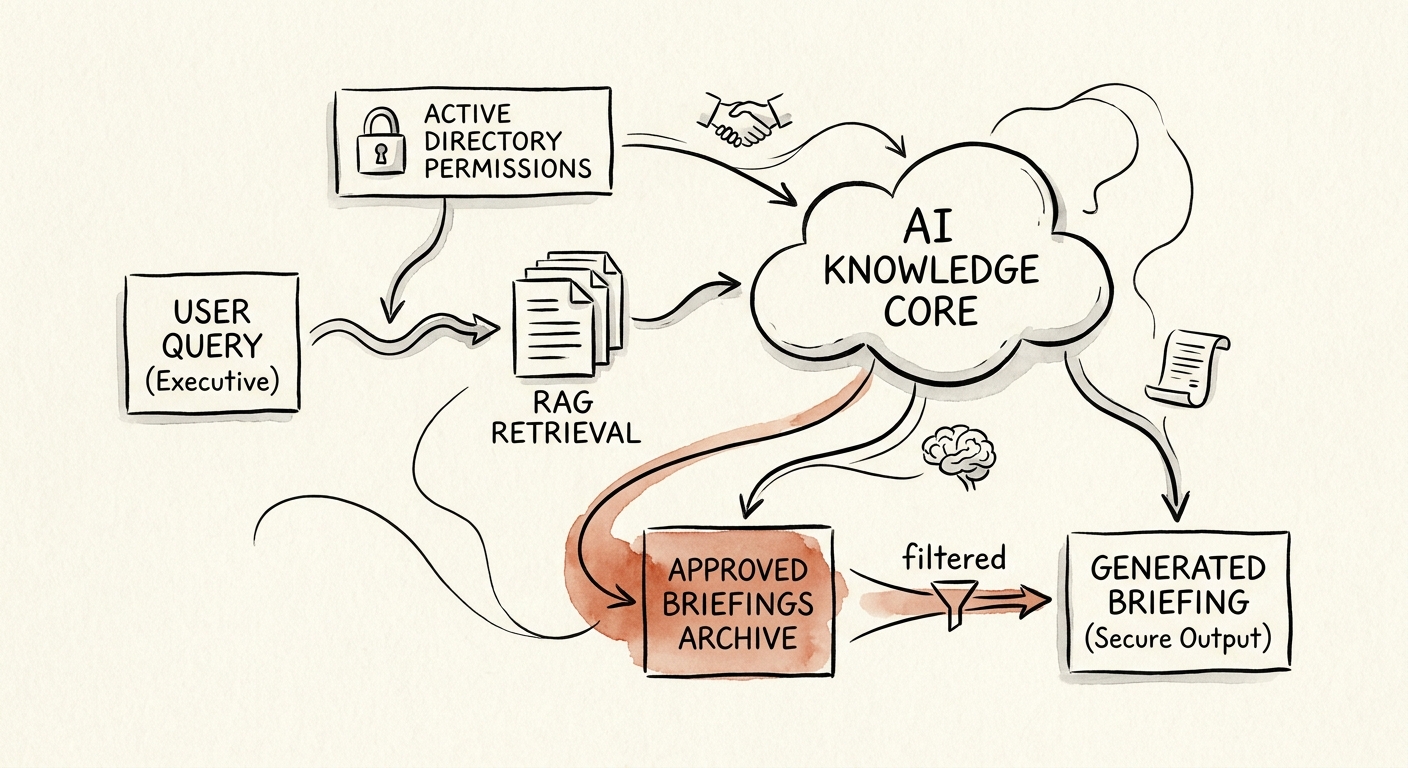
Governance and strategic ownership dictate whether your executive briefing archive becomes a massive competitive advantage or an expensive liability. IT teams should manage the technical infrastructure and security protocols, but IT cannot own the knowledge itself. Practice leads and domain experts must be held accountable for the accuracy of the system's outputs. Forrester's Q4 2024 review of GenAI in knowledge workflows notes that while vendors are aggressively integrating retrieval-augmented generation capabilities, IT leaders must build robust human governance to handle the complex reality of these deployments. This means instituting mandatory retrieval testing before the system is unleashed to the broader firm.
Rigorous retrieval testing ensures that when the system is queried about a complex strategic topic, it consistently pulls the correct, highest-quality briefings rather than defaulting to the most recently uploaded, irrelevant document. We force implementation teams to build a "golden dataset" of 100 common strategic queries and deeply measure the AI's accuracy against human expert answers. If the system fails to retrieve the critical nuances of a key deliverable, the underlying embedding strategy must be adjusted. This exact rigorous approach applies equally when extending AI capabilities to manage your firm's Project Delivery History.
Finally, you must ruthlessly track the financial impact of this transformation initiative. Do not accept soft vanity metrics from your vendors like "number of AI queries logged" or vague promises of "improved employee satisfaction." To properly measure AI ROI, you need to track the hard reduction in non-billable research hours per partner and the measurable acceleration in your proposal turnaround times. If your high-value consultants are still spending Friday afternoons desperately searching for old PowerPoint decks, your AI implementation has failed. An effective AI knowledge system should immediately translate into higher billable capacity, better-informed client interactions, and the elimination of redundant strategic labor.