
The practical answer
- Short answer
- Learn how mid-market professional services firms use AI knowledge systems and RAG architectures to turn scattered unstructured customer feedback into expansion revenue.
- Best fit
- Industry: Professional Services. Function: Customer Success & Operations
- Operating path
- AI Knowledge Systems → AI Transformation
- Key metric
- 40% Increase in expansion revenue for B2B companies that effectively leverage deep customer insights.
Mid-market professional services firms bleed millions in avoidable churn every year because up to 80% of their unstructured customer feedback rots in isolated project files instead of informing the next engagement. According to Gartner's research on unstructured Voice of the Customer data, the vast majority of B2B insights are trapped in free-text survey responses, email threads, and meeting transcripts. When an account director steps into a renewal conversation, they rarely have the full context of the client's historical frustrations or unvoiced desires. They rely on memory and a cursory glance at CRM notes, leaving massive expansion opportunities on the table.
In our last engagement with a 150-person IT consulting firm, we discovered their account leadership team was flying completely blind. They had accumulated thousands of post-implementation surveys, quarterly business review (QBR) notes, and support tickets over five years. Yet, because this data was siloed across three different platforms, nobody could answer a simple question: What are the most common unprompted complaints from our healthcare clients? We built a unified AI knowledge system to ingest this data, transforming a static archive into an active intelligence layer.
The financial impact of ignoring this data is staggering. Based on McKinsey's analysis on B2B customer personalization, companies that effectively leverage deep customer insights generate 40% more revenue from expansion activities than their average peers. If your firm operates without a Retrieval-Augmented Generation (RAG) system to synthesize client history, you are forcing your most expensive talent to act as human search engines. For a deeper look at this baseline, see What Knowledge Management Teams Should Automate First with AI: Customer Feedback Analysis.
Traditional keyword search fails spectacularly when applied to customer sentiment. Searching for the word "unhappy" won't surface a QBR note where the client stated, "we expected a faster turnaround on the phase two deliverables." An AI knowledge system utilizing semantic search understands the context of the feedback, identifying risk patterns before they metastasize into churn.
If your firm operates without a Retrieval-Augmented Generation system to synthesize client history, you are forcing your most expensive talent to act as human search engines.
Structuring the RAG Architecture for Feedback
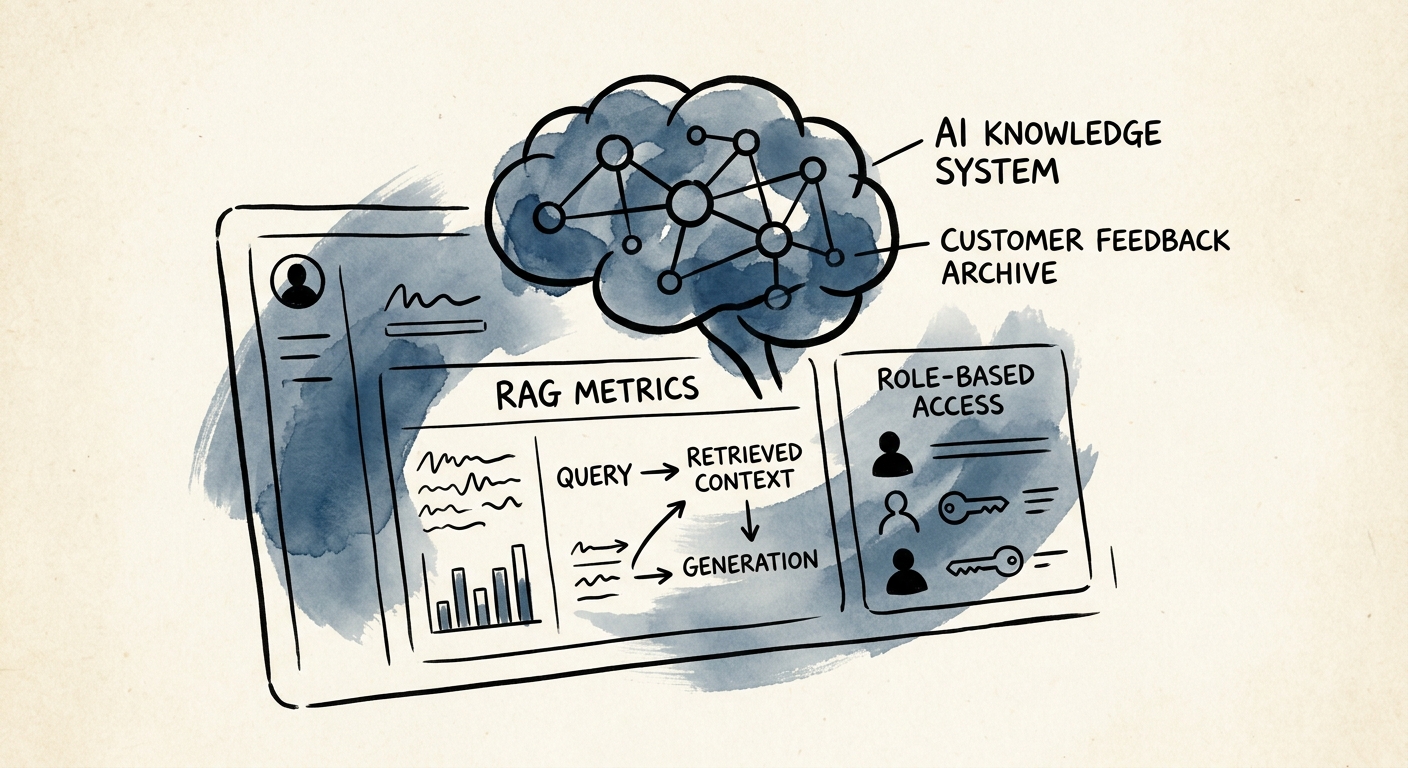
Building an AI knowledge system for customer feedback is not a technology acquisition; it is an operational overhaul. You cannot simply dump five years of raw, unfiltered Slack messages and survey responses into a large language model and expect actionable insights. The first critical step is establishing strict source quality and permissions. Feedback data often contains sensitive pricing discussions, candid employee performance reviews from clients, or proprietary intellectual property.
We saw this exact pattern at a regional marketing agency. They attempted a DIY AI pilot by connecting their entire Google Drive to a commercial AI wrapper. Within a week, junior account managers were inadvertently accessing highly sensitive executive feedback regarding their own performance. Implementing robust Role-Based Access Control (RBAC) at the vector database level is non-negotiable. According to Forrester's baseline for AI data governance, poor data controls and inadequate privacy structures are the primary reasons early AI initiatives fail to reach enterprise production.
Once permissions are locked down, the focus must shift to retrieval testing. A RAG system works by finding the most relevant chunks of text in your archive and feeding them to the AI to generate an answer. If the retrieval mechanism is flawed, the AI will confidently hallucinate an incorrect summary of a client's health. You must calibrate the chunking strategy specifically for your firm's documentation style. A QBR transcript requires a different parsing logic than a structured Net Promoter Score (NPS) survey. To understand how this fits into broader operational memory, operators should review our guide on Building an AI Knowledge System for Your Project Delivery History.
Furthermore, the stakes for getting this right are existential for client relationships. PwC's Future of Customer Experience report highlights that 32% of customers will walk away from a brand they ostensibly love after just one bad experience. An AI hallucination that causes an account director to reference a resolved issue as an ongoing failure—or worse, mix up feedback between two competing clients—can trigger immediate churn.
Governance, Ownership, and Clean Data
The most sophisticated AI knowledge system will collapse under the weight of garbage data. I have rebuilt this workflow three times for mid-market operators, and the failure point is always identical: attempting to automate insights over a polluted data foundation. If your CRM is filled with duplicate accounts, outdated contacts, and contradictory support tickets, your RAG system will merely amplify the chaos. Operations leaders must enforce a rigorous data hygiene protocol before turning the key on AI.
This mandate brings us to the question of system ownership. An AI knowledge archive for customer feedback cannot be solely owned by IT. The Revenue Operations (RevOps) or Customer Success leadership must own the output quality, while IT manages the infrastructure. This dual-ownership model ensures that the system is continually tested against real-world account management scenarios. You need a dedicated human-in-the-loop workflow where experienced account managers rate the quality and accuracy of the AI's generated feedback summaries.
According to BCG's guidelines on AI risk management and trust, organizations that implement systematic human-in-the-loop verification can reduce critical algorithmic errors by over 50%. This verification isn't a temporary crutch; it is a permanent governance requirement. Your AI assistant should cite exactly which QBR note or survey response it used to generate a claim, allowing the human operator to click through and verify the source instantly.
Ultimately, transforming your customer feedback archive into an AI knowledge system shifts your firm from a defensive posture to an offensive one. Instead of waiting for the annual review to discover client frustrations, your account teams can proactively query the system to find precise pain points from the last six months. That capability alone pays for the system in preserved revenue. If your firm is ready to build this, start by reading Why Data Cleanup Must Precede Your AI Knowledge Assistant to ensure your foundation is solid.