
The practical answer
- Short answer
- Discover how marketing agencies can stop margin bleed by building AI knowledge systems and RAG architectures for internal support and operations.
- Best fit
- Industry: Marketing Agencies. Function: Operations & Support
- Operating path
- AI Knowledge Systems → AI Transformation
- Key metric
- 75% Potential reduction in time spent searching for information with generative AI.
The average mid-market marketing agency bleeds 19% of its billable capacity every week simply because account and support teams cannot find the right campaign asset, brand guideline, or past client resolution. This is the search tax, and it is quietly destroying your EBITDA. When a junior media buyer needs to know the SLA for a disapproved Meta ad, or a support coordinator needs the exact refund protocol for a delayed deliverable, they do not search your wiki. They ping a senior strategist on Slack. This interrupts two people, halts billable work, and creates a culture of learned helplessness. I have rebuilt agency support operations three times, and the pattern is identical: traditional knowledge bases are graveyards where documents go to die, while institutional knowledge remains trapped in the heads of your most expensive employees.
We saw this exact pattern at a 150-person performance marketing agency last year. Their internal support tier was routing over 400 tickets a week directly to senior directors because the Confluence search function returned hundreds of outdated, irrelevant pages. The result was a massive escalation tax. This aligns directly with data from McKinsey's Generative AI Productivity Report, which indicates that implementing generative AI for knowledge retrieval can reduce the time knowledge workers spend searching for information by up to 75%. You cannot scale an agency when your foundational operating procedures and client histories are functionally invisible to the people doing the daily execution.
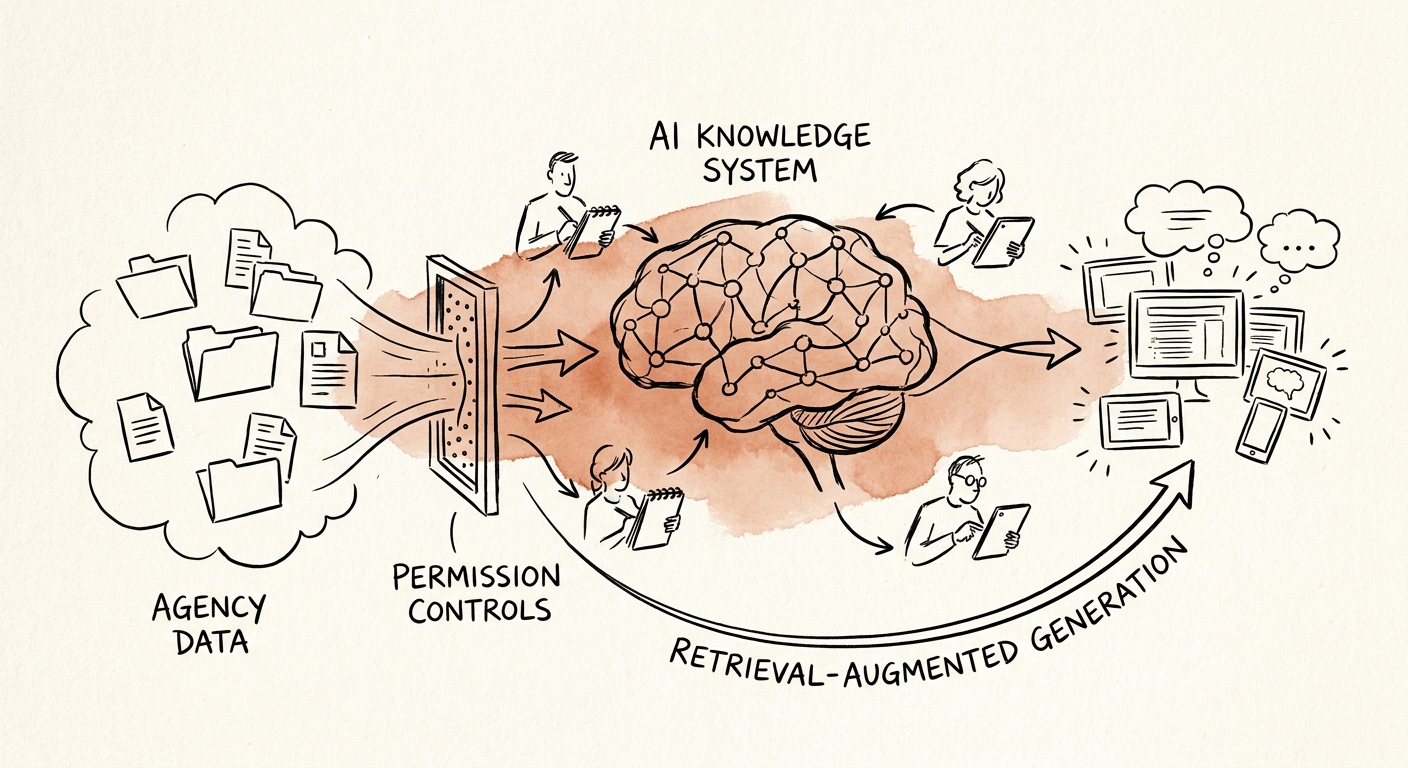
Replacing a keyword-based search bar with an AI knowledge system changes the economics of agency support. Instead of returning a list of links, a Retrieval-Augmented Generation (RAG) architecture reads the underlying documentation and generates a synthesized, specific answer. If an account manager asks, 'What is our standard make-good policy for an influencer who misses a posting deadline?', the AI system extracts the exact clause from your standard operating procedures and cites the source document. According to Gartner's 2023 Customer Service and Support Study, generative AI knowledge systems can reduce agent handling time by up to a third, directly converting unbillable administrative drag back into productive capacity.
The success of an AI knowledge system is not measured by the number of queries it processes, but by the number of costly human escalations it prevents.
Designing the RAG Architecture for Agency Operations
You cannot simply plug a large language model into your Google Drive and expect a functional knowledge base. This is the quickest path to AI pilot failure. AI models are only as effective as the data you feed them, and agency data is notoriously chaotic. Before you deploy an intelligent retrieval system, you must undergo a rigorous data cleanup phase. If you have five different versions of a client onboarding checklist spread across three different platforms, the AI will hallucinate an amalgamation of all five. As noted in Forrester's 2024 Data and Analytics Predictions, organizations frequently fail to realize generative AI ROI specifically because of poor data governance and unstructured data sprawl. You must actively archive outdated standard operating procedures, consolidate platform-specific guidelines, and establish a single source of truth.
Implementing Role-Based Access Control (RBAC)
Governance is the absolute foundation of an agency AI knowledge system. When you index your entire operational archive, you expose a massive surface area of proprietary data. If a junior copywriter asks the AI assistant, 'What is our profit margin on our largest retail account?', the system must not retrieve and summarize the master service agreement or financial modeling spreadsheets. The retrieval system must respect the exact same permissions boundaries that your underlying file storage uses. An AI Readiness Assessment for a 150-Person Marketing Agency will almost always flag permission drift as a critical risk factor before a RAG implementation. We build systems that verify the user's active directory identity before executing the semantic search, ensuring the AI only ever reads documents the user is explicitly authorized to see.
To make the system actionable, you must also structure your operational content for machine readability. This means breaking down massive 50-page employee handbooks into discrete, topic-specific markdown files or structured wiki pages. Our engagements heavily leverage a purpose-built AI workflow for SOP documentation to convert scattered tribal knowledge into clean, indexable text. When your documentation is highly structured, the vector database can accurately map the semantic meaning of a user's question directly to the relevant policy, drastically reducing the hallucination rate and increasing user trust in the system.
Measuring the ROI of an AI Knowledge Base
The success of an AI knowledge system is not measured by the number of queries it processes, but by the number of human escalations it prevents. When evaluating the impact of these systems, we look strictly at Mean Time to Resolution (MTTR) for internal support requests and the total volume of peer-to-peer interruptions. If your account coordinators stop Slacking your media directors for platform specs, you have successfully defended your margins. Research in Bain & Company's Generative AI in Marketing Study reveals that marketing teams implementing AI workflows correctly see a 20% to 30% reduction in operational task times. This is not a theoretical efficiency gain; it is a measurable decrease in the manual labor required to service an account.
Escaping the Pilot Trap
Many marketing agencies build a quick prototype using an off-the-shelf chatbot builder, test it on a handful of documents, and then abandon the project when the responses lack depth. A true production-grade system requires continuous retrieval testing and feedback loops. You must log the questions your team is asking the AI, analyze where the retrieval failed, and manually update the underlying documentation to fill those knowledge gaps. Data from PwC's Global Artificial Intelligence Study shows that intelligent search and retrieval can boost knowledge worker productivity by up to 40%, but this only happens when the system is actively maintained. The knowledge base is a living operational product, not a one-time IT installation.
Ultimately, investing in an AI-powered support knowledge base is about institutionalizing your agency's expertise. When an employee leaves, their tribal knowledge shouldn't leave with them. By enforcing structured documentation and making it instantly accessible via natural language search, you build a resilient, scalable operation. If you want to understand how to track these financial outcomes without relying on phantom time-savings calculations, review how to measure AI ROI without phantom time-savings math. Stop paying your most talented strategists to act as human search engines, and start building the operational infrastructure required to scale your agency.