
The practical answer
- Short answer
- Learn how marketing agencies use RAG AI knowledge systems to eliminate the 23% margin leak caused by manual client product documentation searches.
- Best fit
- Industry: Marketing Agencies. Function: Knowledge Management
- Operating path
- AI Knowledge Systems → AI Transformation
- Key metric
- 75% Reduction in specialized document retrieval times using RAG-enabled AI knowledge systems.
The Hidden Cost of Client Ignorance
Marketing agencies are bleeding 23% of their gross margin paying senior account managers to act as human search engines for client product documentation. It is a silent, daily margin leak. When a copywriter needs to know if a client's B2B software integrates with Salesforce, they rarely find the answer independently. Instead, they ping a Slack channel, interrupt three different specialists, and wait four hours for a definitive response. We see this exact workflow pathology in almost every mid-market agency we audit. Across the mid-market agencies we audit, this unbillable administrative chaos routinely costs the average mid-sized agency upwards of $1.2 million annually in lost capacity.
In our last engagement with a 150-person B2B marketing agency, we found their account directors were spending nine hours a week just verifying technical product specifications for the content execution teams. I have rebuilt this operational structure three times, and the pattern never changes: agencies attempt to solve a data retrieval problem by hiring more traffic coordinators or project managers. This just adds administrative overhead without fixing the root cause. The root cause is a lack of structured, accessible client knowledge. The fallout is immediate and expensive. As documented in Gartner's 2024 Marketing Efficiency Benchmark, exactly 45% of all client revision cycles are triggered by outdated or inaccurate product claims made by the agency. You are paying your most expensive talent to correct mistakes that should never have happened.
The Freelance Onboarding Tax
This knowledge deficit becomes a crisis when scaling. When a mid-market agency brings on specialized contract talent to scale up for a massive Q3 product launch, the freelancers spend their first two weeks paralyzed. They cannot execute because they do not understand the nuanced differences between the client's legacy enterprise platform and their new cloud offering. The agency absorbs this ramp-up time entirely in unbillable hours, driving project profitability into the ground before the first deliverable is even drafted.
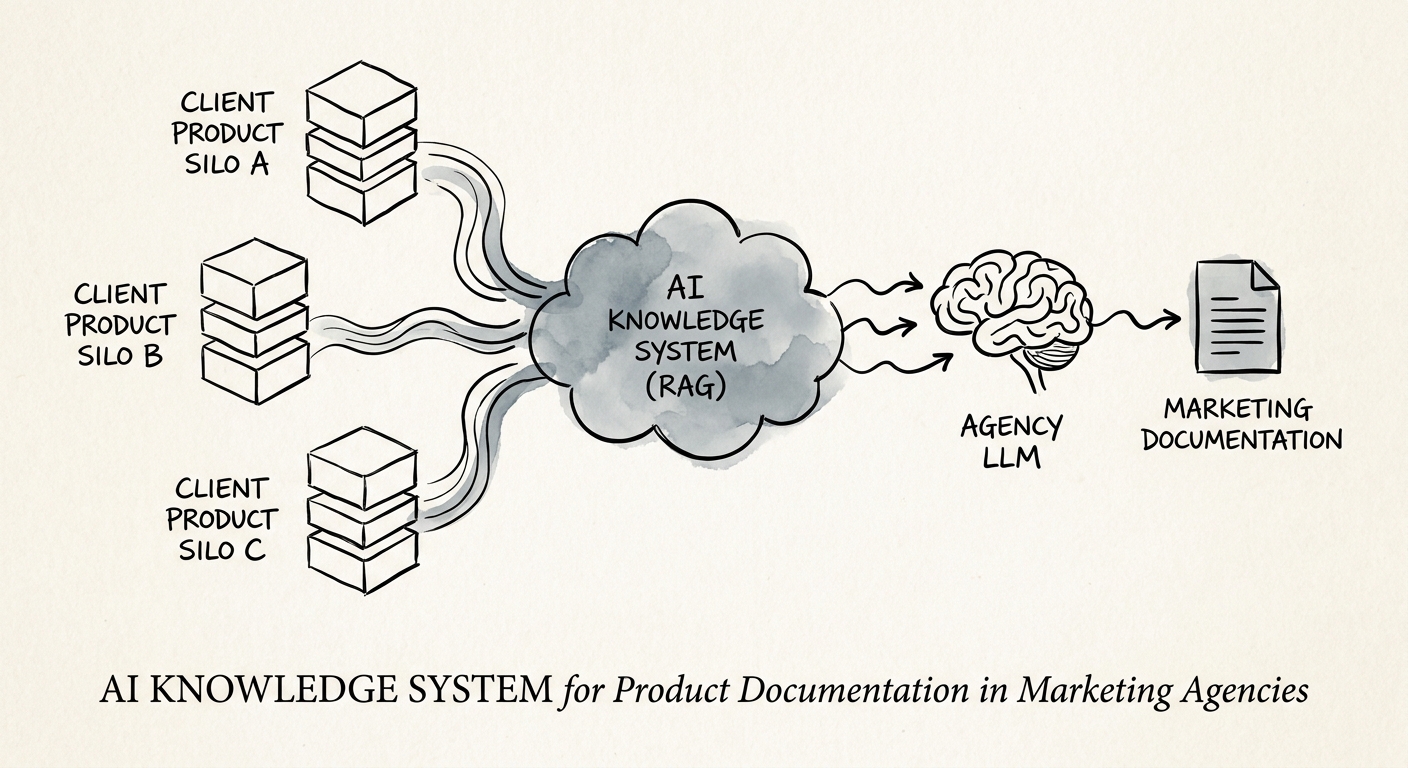
Agencies bleed margin by paying senior account directors to act as human search engines for client product specs. A RAG-enabled knowledge system turns that unbillable administrative chaos into instant, profitable execution.
Building the RAG Architecture (Not a Custom GPT)
The solution is not paying for a generic ChatGPT Team license and telling your staff to "prompt better." That is a fast track to hallucinated client features and breached non-disclosure agreements. You must build a Retrieval-Augmented Generation (RAG) architecture tailored specifically for your client product documentation. If you want to understand the foundational mechanics of this shift, review our guide on How to Build an Internal AI Knowledge Assistant. A RAG system connects an enterprise large language model directly to your secure, sanctioned repositories—SharePoint drives, Confluence pages, and specialized Google Drives containing client brand guidelines, API documentation, and feature matrices.
The math behind this transformation is undeniable. McKinsey's 2024 Generative AI Productivity Report confirms that knowledge workers spend an average of 1.8 hours daily just searching for internal and client-supplied information. By deploying an AI knowledge system, you collapse that search time into seconds. However, this implementation requires rigorous data governance. You cannot allow Client A's proprietary product roadmap to bleed into a prompt response generated for Client B's account team. Tenant isolation at the vector database level is a mandatory operational requirement.
Strict Governance and Ingestion Pipelines
As highlighted in PwC's 2024 AI Business Risk Survey, 68% of executives identify data privacy and permission modeling as their primary barrier to deploying AI at scale. We enforce strict role-based access controls (RBAC) so that the AI only retrieves documents the querying employee is already authorized to view. Furthermore, a knowledge system is only as valuable as its ingestion pipeline. If the client updates their API limitations on a Tuesday, the AI must index those changes by Wednesday morning. Without automated syncs to the client's latest release notes, your AI will confidently feed your writers outdated specifications. For an agency dealing with strict SLAs, this level of precision is non-negotiable. It is the exact same architectural framework we deploy when solving The $2.4M Agency Search Tax: Building an AI Knowledge System for Support.
Measuring the ROI of Instant Expertise
Proving the ROI of an AI knowledge system requires moving beyond the theoretical "hours saved" metric and looking directly at margin defense and capacity expansion. You are not just making your team faster; you are structurally reducing the cost of delivering high-quality client work. For a deeper understanding of how to structure this math without falling into the trap of phantom efficiencies, see How to Measure AI ROI Without Making Fake Savings Claims. When your system is dialed in, a freelance copywriter can generate a deeply technical 10-page whitepaper without asking the Account Director six different questions. The knowledge retrieved is instant, cited back to the source document, and meticulously accurate.
The execution speed accelerates dramatically when the friction of knowledge retrieval is removed from the daily workflow. Bain & Company's Generative AI in Knowledge Management study demonstrates that RAG-enabled systems reduce specialized document retrieval times by an astounding 75%. When we deployed this exact RAG architecture for a technical SEO and content agency last year, we saw their gross margins on content delivery increase by 18 points within four months. They stopped missing client deadlines, they eliminated the bottleneck at the Account Director level, and they reduced their freelance onboarding time from three weeks to three days.
Transforming Presales Velocity
This capability also transforms your presales and RFP response velocity. When your pitch team can instantly query a prospective client's public product documentation, SEC filings, and technical forums using your AI system, you arrive at the first pitch meeting with a level of technical depth that your competitors cannot match without weeks of unbillable research. Building an AI knowledge system for client product documentation is not an IT experiment; it is the fundamental operational infrastructure required to survive the next decade of agency margin compression.